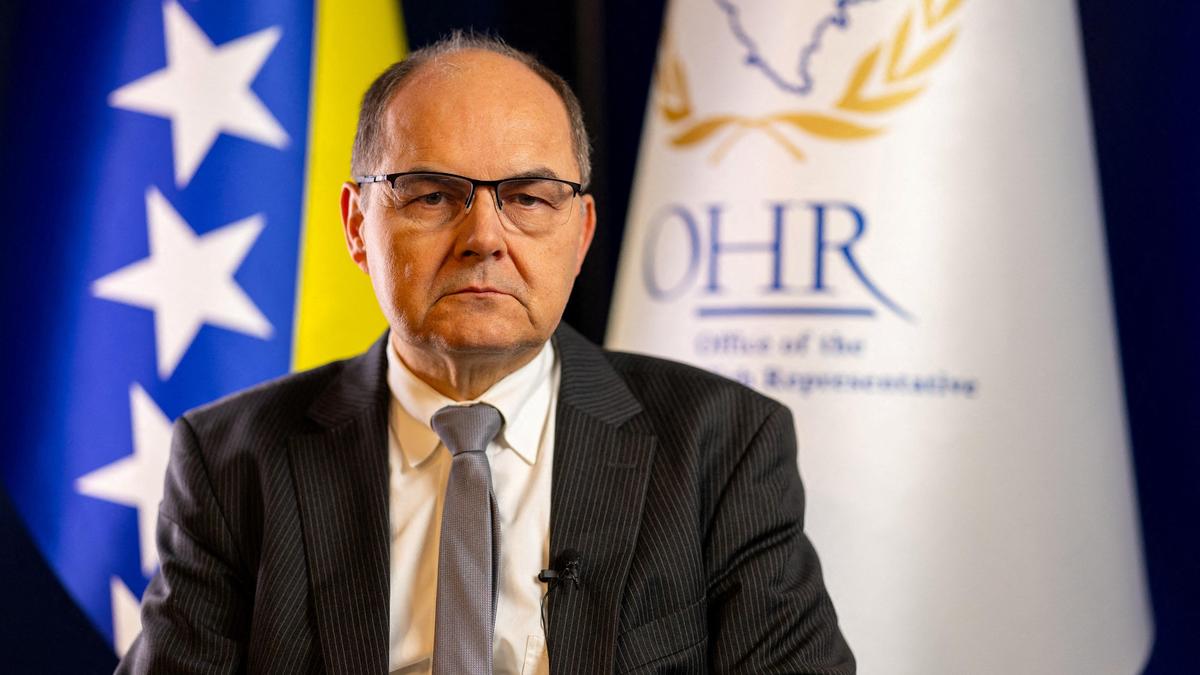
The resignation of Christian Schmidt as the High Representative for Bosnia and Herzegovina marks the failure of the "Executive Oversight" model established by the Dayton Agreement. The High Representative’s departure is not merely a personnel change but a signal that the Office of the High Representative (OHR) has reached a point of diminishing returns where its presence provides diminishing stability while its authority triggers escalating domestic resistance. The central tension lies in the mismatch between 1990s-era "Bonn Powers"—which allow the High Representative to bypass democratic processes to enact laws and remove officials—and the current 21st-century reality of decentralized, ethnic-based obstructionism.
The Tripartite Structural Conflict
The collapse of the High Representative's mandate is best understood through three distinct friction points that have rendered the office functionally inert.
- The Sovereignty Paradox: The OHR is tasked with preparing Bosnia for European Union membership, yet the very existence of a foreign official with supreme executive power is fundamentally incompatible with the EU’s "local ownership" requirements. This creates a circular logic: the OHR cannot leave until the state is stable, but the state cannot stabilize because the OHR’s presence allows local politicians to outsource difficult decisions or use the OHR as a convenient scapegoat for systemic failures.
- The Recognition Gap: Unlike his predecessors, Schmidt faced a unique legitimacy crisis stemming from the lack of a formal United Nations Security Council resolution confirming his appointment. Russia and China’s refusal to recognize his mandate provided Milorad Dodik and the Republika Srpska (RS) leadership with the legal opening to treat OHR decrees as non-binding. This effectively split the country into two legal realities: one where the OHR is the final authority, and another where it is an unrecognized foreign entity.
- Institutional Inelasticity: The Dayton framework was designed to stop a war, not to manage a modern economy or a functional democracy. By attempting to use the Bonn Powers to resolve issues like state property ownership, the OHR entered a domain where legal mandates collide with deeply entrenched ethnic survival narratives. The institution proved too rigid to adapt to a landscape where the threat is no longer kinetic warfare but institutional paralysis.
Quantifying the Obstructionist Feedback Loop
The conflict between the OHR and the Republika Srpska leadership operates on a predictable feedback loop that increases the political capital of ethno-nationalist leaders while degrading the OHR's credibility.
- Trigger: The High Representative imposes a law (e.g., the ban on genocide denial or state property regulations).
- Reaction: Sub-state entities pass counter-legislation or ignore the decree, citing "constitutional overreach."
- Escalation: The OHR threatens sanctions or dismissal; the sub-state entity threatens secession or a boycott of state-level institutions.
- Outcome: The OHR retreats or fails to enforce the decree, proving the "paper tiger" hypothesis.
This loop has shifted the power dynamic. In the early 2000s, the threat of removal by the High Representative was a career-ending event for Bosnian politicians. Today, being sanctioned by the OHR is a badge of nationalist credibility that secures voter bases. The "cost of defiance" for local leaders has dropped below the "benefit of confrontation."
The Mechanics of Legal Dissolution
The primary driver of the current crisis is the dispute over State Property. Under the Dayton Agreement, the division of assets between the state and the entities remained ambiguous. Schmidt’s attempt to resolve this through executive decree was met with the RS Law on Immovable Property, which claimed state assets for the entity level.
This is not a mere bureaucratic disagreement; it is a battle over the fiscal viability of the state. If the entities control the land, the central government lacks the collateral required for international financing and the authority to manage national infrastructure. The OHR’s inability to settle this reflects a broader failure in the "Consociationalist" model, where veto powers at every level of government ensure that no significant reform can pass without unanimous ethnic consent. The OHR was intended to be the tie-breaker, but in a multipolar world where the West no longer holds a monopoly on Balkan influence, the tie-breaker has been neutralized.
Geopolitical Vectors and the Balkan Power Vacuum
The OHR's decline is accelerated by the shifting priorities of the Peace Implementation Council (PIC). The consensus required to back the High Representative's decisions has fractured.
- The Atlanticist Faction: The US and UK remain the primary backers of the OHR’s executive authority, viewing it as a bulwark against Russian influence.
- The European Pragmatists: Certain EU member states favor a transition to a "Special Representative" model with no executive powers, prioritizing stability and EU accession metrics over the enforcement of Dayton's more intrusive elements.
- The Revisionist Powers: Russia and China have successfully used the OHR as a leverage point to demonstrate Western overreach, effectively neutralizing the office's ability to act on the global stage.
This fragmentation means the High Representative no longer carries the collective weight of the international community. When Schmidt acted, he did so with the support of only a portion of his original mandate-givers. This lack of unified backing transformed the OHR from a neutral arbiter into a participant in the domestic political struggle.
The State Property Bottleneck
The resolution of the State Property issue is the "Critical Path" for any future governance model in Bosnia. The current stalemate ensures that:
- Investment is chilled: Multinational corporations cannot secure clear title to land for large-scale energy or infrastructure projects.
- Fiscal Fragility: The central government remains dependent on entity-level transfers, which are frequently used as political leverage.
- Legal Uncertainty: Contradictory rulings between the OHR, the Constitutional Court of Bosnia, and entity-level courts create a jurisdictional mess that rewards corruption.
Schmidt’s departure without a clear resolution to this issue leaves a power vacuum that will likely be filled by further entity-level "de-facto" legislation, gradually hollowing out the central state’s authority until the OHR becomes an office that oversees an empty shell.
Strategic Realignment Requirements
The successor to the High Representative—or the transitional body that replaces the office—must move away from the "Decree and Sanction" model toward a "Conditionality and Integration" framework. The current strategy of using the Bonn Powers has hit a ceiling of effectiveness.
The international community must pivot toward a granular, technical approach to governance that focuses on the High Judicial and Prosecutorial Council (HJPC) and the integrity of the electoral process. Attempting to solve high-level constitutional disputes through a single foreign official has proven to be a strategic dead end. The transition must focus on strengthening the Constitutional Court’s ability to enforce its own rulings without OHR intervention. If the Court cannot function without the OHR’s muscle, then the state is not ready for sovereignty, and no amount of foreign decrees will change that fundamental reality.
The departure of the High Representative should be treated as the end of the "Post-War" era and the beginning of a "State-Building" era that acknowledges the limitations of external intervention. The focus must shift from enforcing the Dayton Agreement to evolving it. The immediate priority is not finding a new "strongman" for the OHR, but establishing a legal mechanism that transfers the OHR’s remaining responsibilities to domestic institutions while maintaining international monitoring. Failure to manage this transition will result in a "frozen conflict" dynamic where the central government exists on paper but the entities operate as independent, and increasingly hostile, states.