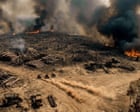
The intersection of state fragility and corporate territorial expansion represents a fundamental shift in the mechanics of South American governance. When fictional media like the film Amazon of America projects a future where a post-coup Brazil cedes the rainforest to a corporate entity, it serves as a stress test for current economic and environmental trajectories. This scenario is not merely a speculative narrative; it is an analysis of how sovereign debt, resource extraction rights, and the failure of centralized law enforcement create a vacuum that only a sufficiently capitalized private entity can fill. The transition from a state-managed biome to a corporate-administered "logistics zone" hinges on three structural variables: the degradation of institutional credit, the securitization of carbon sequestration, and the logistical primacy of river-based supply chains.
The Triple-Crested Failure of Sovereign Stewardship
The premise of a "post-coup" sell-off is rooted in the collapse of the Brazilian state’s ability to service its fiscal and ecological obligations. To understand how a corporation effectively replaces a government in the Amazon, we must examine the breakdown of the state’s monopoly on violence and administration.
1. Fiscal Insolvency and Land-as-Collateral
The Brazilian economy remains heavily tethered to its debt-to-GDP ratio. In a scenario involving a political rupture or coup, international credit markets typically freeze. The state, starved of liquidity, finds that its most valuable asset is not its tax base—which shrinks during instability—but its physical territory. The Amazon represents a massive, untapped collateral pool. A corporate entity providing a massive "liquidity injection" in exchange for extraterritorial administrative rights creates a debt-for-land swap that transcends traditional lease agreements.
2. The Enforcement Gap
Deforestation is currently driven by a fragmented network of illegal loggers, miners, and ranchers. The state’s failure to contain these actors is a function of budget constraints and geographic scale. A corporate entity like the one depicted in the film operates with a different cost function. Private security forces, satellite-linked drone surveillance, and algorithmic border control are more efficient at resource protection than a standard bureaucratic military. The "Amazon of America" concept assumes that the private sector can achieve a "peace through surveillance" that the public sector cannot afford.
3. Logistical Integration
The Amazon River system is a biological highway that is increasingly being viewed through the lens of global freight. Whoever controls the deep-water ports and the dredging rights controls the flow of commodities out of the continent's interior. When a tech-logistics giant takes over, the rainforest stops being an environmental asset and starts being a supply-chain node.
The Economic Logic of Extraterritoriality
The transition of the rainforest into a corporate-governed zone creates a "Charter City" on a continental scale. This is a rejection of traditional Westphalian sovereignty in favor of a service-level agreement (SLA) model of governance. Under this framework, residents and workers are treated as users or contractors rather than citizens.
The primary driver for this shift is the Externalization of Governance Costs. The Brazilian state currently bears the cost of healthcare, education, and security for the region’s inhabitants with diminishing returns. A corporate administrator eliminates these "unproductive" expenditures, focusing exclusively on the protection of the resource—whether that resource is timber, minerals, or carbon credits. This creates a bifurcated zone: high-tech, fortified corridors for resource extraction surrounded by unmanaged, lawless "gray zones."
The Carbon Sequestration Arbitrage
The film’s central anxiety—the loss of the rainforest—overlooks the reality that a corporate owner might actually protect the trees more ruthlessly than a state, but for the wrong reasons. We are entering an era of Carbon-Based Valuation.
In a world where the largest global corporations must hit Net Zero targets to maintain their stock prices and access to capital, the Amazon is the ultimate balance-sheet hedge. If a single entity owns the rights to the world’s largest carbon sink, they possess a global monopoly on the "right to emit." The rainforest becomes a digital asset, where every hectare is tokenized and sold on international markets.
The danger here is not "destruction" in the traditional sense of burning trees for cattle, but "sequestration-lock." This is a process where local populations are evicted to ensure the "purity" of the carbon offset. The corporate entity doesn't want a functioning society; it wants a sterile, measurable biological machine that absorbs CO2.
The Algorithmic State and the Death of Politics
When a logistics company assumes the role of a sovereign, the mechanism of change shifts from voting to "terms of service." This creates a bottleneck in human rights and environmental advocacy. In a standard democracy, citizens can protest against the Ministry of the Environment. In a privatized Amazon, protesters are simply "trespassers" on private property.
The "Amazon of America" model uses data as the primary tool of control. By controlling the communication infrastructure (satellite internet, mesh networks), the corporation dictates the flow of information. The "coup" described in the film is not just a military event; it is a permanent data-takeover where the state’s digital records, land registries, and census data are migrated to a private cloud. Once the data is privatized, the state loses the ability to reclaim the territory because it no longer possesses the "source code" of the region's administration.
Strategic Forecast: The Rise of the Biological Fortress
The trajectory toward the scenario depicted in the film is governed by the increasing value of "Natural Capital." As climate volatility increases, the value of the Amazon’s humidity pump and biodiversity will skyrocket. The most likely outcome is not a sudden sale of the entire forest, but a "Salami-Slicing" of sovereignty.
- Security Enclaves: Private corporations will first be granted "security concessions" to protect their specific investments (mines, ports, or research stations).
- Infrastructure Corridors: These enclaves will be connected by private roads and rail lines where state law does not apply.
- Total Administrative Absorption: As the central government weakens under the weight of climate-driven disasters, it will outsource the entire management of the "North Zone" to a consortium of global tech and logistics firms.
The strategic play for Brazil and its neighbors is the immediate "Hard-Coding" of ecological assets into the national constitution, backed by international environmental treaties that make territorial sales a breach of global law. Failing this, the Amazon will cease to be a place and will instead become a proprietary technology owned by a board of directors. The shift from "State" to "Service Provider" is the most significant threat to the global commons in the 21st century.
Governments must prioritize the digitizing of land rights on public, immutable ledgers to prevent the "data-erasure" that precedes corporate annexation. Without a transparent, state-controlled digital infrastructure, the physical forest is defenseless against the inevitable march of private equity.