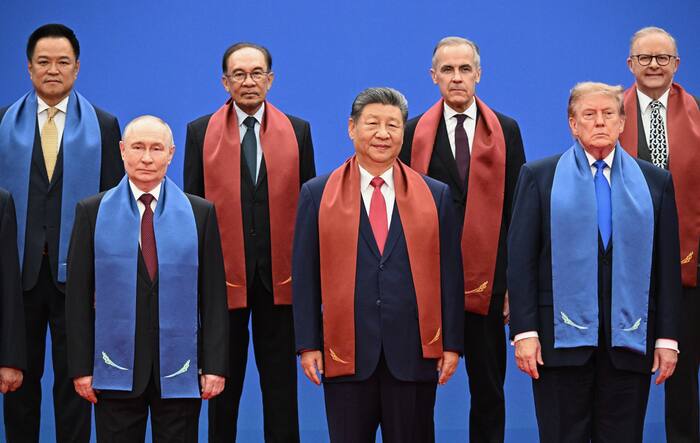
Multilateral economic forums no longer function as engines of tariff reduction or regulatory harmonization; they operate as structural arenas for great-power containment. When the Asia-Pacific Economic Cooperation (APEC) convenes, official agendas prioritize open trade frameworks and cross-border artificial intelligence governance, yet the substantive outcomes are dictated by bilateral security competition between Washington and Beijing. Understanding this divergence requires separating institutional rhetoric from the underlying mechanics of statecraft, where national security overrides comparative advantage.
The Structural Inversion of the APEC Mandate
Founded in 1989 during the zenith of post-Cold War globalization, APEC was engineered around a specific economic premise: non-binding consensus and voluntary liberalization would gradually eliminate barriers to trade and investment across the Pacific Rim. The institutional architecture relies on the Bogor Goals and the Putrajaya Vision 2040, both of which assume that economic interdependence reduces the probability of geopolitical conflict. You might also find this similar article useful: Why Faults in 90% of Government-Insulated Homes Still Aren't Fixed.
That foundational assumption has inverted. Instead of trade integration pacifying security rivalries, security rivalries now dictate the boundaries of permissible trade. The mechanism driving this shift is weaponized interdependence—a structural condition where asymmetric control over global network hubs (such as semiconductor manufacturing, financial clearing systems, and submarine data cables) allows dominant states to extract intelligence or coerce adversaries.
In this environment, APEC summits serve three distinct operational functions that diverge sharply from their stated economic mandates: As discussed in detailed coverage by Al Jazeera, the effects are widespread.
- Bilateral Crisis Management: The multilateral summit provides essential diplomatic cover for high-stakes bilateral meetings between superpowers. Leaders use the forum to establish communication guardrails, manage military-to-military deconfliction, and prevent accidental escalation in flashpoints like the Taiwan Strait or the South China Sea without appearing to make unilateral concessions to domestic audiences.
- Coalition Signaling: Major powers utilize the sidelines of the forum to audit the alignment of middle powers. Washington uses these gatherings to reinforce adherence to export controls and friend-shoring initiatives, while Beijing deploys bilateral infrastructure commitments and market-access incentives to prevent regional economies from joining containment blocs.
- Narrative Arbitrage: Both primary powers use the plenary sessions to frame themselves as the true defenders of the rules-based order. Washington emphasizes fair competition, labor standards, and countering economic coercion; Beijing emphasizes non-interference, sovereignty, and opposition to protectionist decoupling.
Because APEC operates on strict consensus—requiring unanimity among all 21 member economies for any joint declaration—any substantive measure affecting core strategic interests is automatically vetoed. The resulting communiqués are reduced to lowest-common-denominator language that masks deep structural fractures.
The Three Pillars of Trade Fragmentation
Standard commentary frequently describes the decline of open trade at APEC as a temporary wave of protectionism. This diagnosis misses the systemic nature of the shift. Global commerce in the Asia-Pacific is undergoing a permanent structural reorganization driven by three interacting variables: supply chain resilience, industrial policy subsidies, and export control regimes.
1. The Efficiency-to-Resilience Repricing
For three decades, multinational enterprises optimized supply chains using a single objective function: minimizing unit cost through just-in-time inventory and geographic concentration. Recent systemic shocks—ranging from pandemic-induced logistics bottlenecks to maritime chokepoint disruptions—exposed the fragility of single-source dependencies. Corporate boards and state planners have subsequently repriced risk. Capital expenditure is actively migrating away from pure cost-efficiency toward redundancy ("China Plus One" strategies), shifting assembly and component manufacturing to Vietnam, Malaysia, India, and Mexico. This reallocation is not a temporary market fluctuation; it is a permanent structural tax on global trade efficiency designed to insulate critical industries from geopolitical disruption.
2. Asymmetric Industrial Policy
Open trade relies on price signals reflecting true factor costs rather than state intervention. Across the APEC bloc, major economies have abandoned market neutrality in favor of aggressive industrial subsidies. The United States has deployed massive fiscal incentives through the CHIPS and Science Act and the Inflation Reduction Act to onshore semiconductor fabrication and clean energy manufacturing. Simultaneously, China continues to channel state-directed capital into electric vehicles, batteries, and legacy semiconductors to offset domestic real estate contraction and dominate global export markets. When multiple major economies subsidize identical strategic sectors simultaneously, the inevitable result is structural overcapacity, followed by retaliatory tariffs and anti-dumping duties that dismantle multilateral trade rules.
3. Extraterritorial Export Controls
The most potent instrument eclipsing open trade is the expansion of national security export controls. Unlike traditional tariffs, which raise the price of goods while permitting trade to continue, export controls sever commercial transactions entirely. By restricting the transfer of advanced lithography equipment, high-bandwidth memory chips, and specialized design software, the United States and its allies have established a technological perimeter. Furthermore, the application of the Foreign Direct Product Rule extends this jurisdiction extraterritorially, compelling third-party economies within APEC to comply with Washington’s security mandates if their supply chains incorporate American intellectual property.
Why AI Governance Remains Deadlocked
Artificial intelligence occupies a prominent position on modern APEC agendas, framed around ethical deployment, interoperability, and inclusive digital growth. However, substantive multilateral governance of AI within the Asia-Pacific faces an intractable structural barrier: the dual-use dilemma.
Unlike nuclear weapons, where fissile material enrichment is distinct from civilian power generation and easily monitored via international inspections, foundation AI models and the compute infrastructure required to train them are inherently dual-use. The exact same graphics processing units (GPUs), algorithmic architectures, and data centers used to optimize commercial logistics or protein folding are utilized for autonomous drone targeting, cyber-offense automation, and signals intelligence decryption.
This dual-use reality creates three insurmountable friction points for regional AI diplomacy:
- The Compute-Security Nexus: Dominance in frontier AI is directly correlated with access to advanced semiconductors and concentrated computing power. Because states view frontier AI capabilities as decisive determinants of future military superiority, no major power will agree to multilateral transparency regimes or compute-sharing frameworks that could compromise its asymmetric advantage or expose proprietary training methodologies.
- Divergent Regulatory Ideologies: APEC encompasses fundamentally incompatible models of digital governance. The United States favors a market-driven, innovation-first approach focused on voluntary safety commitments and private-sector self-regulation. China enforces strict state-centric content controls, algorithmic registration, and data localization mandates designed to preserve regime stability. Middle powers like Japan, South Korea, and Singapore attempt to bridge these poles through interoperable technical standards, yet they lack the market scale to force convergence between Washington and Beijing.
- Data Sovereignty Barriers: Effective cross-border AI development requires frictionless data flows across jurisdictions. However, national security concerns over citizen surveillance, intellectual property theft, and critical infrastructure mapping have prompted APEC economies to erect strict data localization laws. Under the banner of digital sovereignty, states increasingly classify commercial and industrial datasets as strategic national assets, starving regional AI initiatives of the cross-border training data required for scale.
The Middle-Power Strategic Dilemma
As great-power competition overshadows APEC’s economic agenda, the remaining 19 member economies—including Southeast Asian nations, Australia, Canada, and Latin American states—face an acute strategic optimization problem. Their economic prosperity depends on deep integration with Chinese manufacturing and consumer markets, while their security architectures rely heavily on American military deterrence and financial systems.
This structural asymmetry forces middle powers into complex hedging behaviors that further dilute multilateral consensus:
- Selective Alignment: Economies refuse to choose a single hegemon across all domains. A nation may participate in US-led security dialogues and semiconductor supply chain initiatives while simultaneously joining the Regional Comprehensive Economic Partnership (RCEP) and accepting Chinese infrastructure financing.
- Institutional Proliferation: Rather than relying on APEC to deliver binding trade liberalization, middle powers negotiate overlapping, sub-regional plurilateral agreements—such as the Comprehensive and Progressive Agreement for Trans-Pacific Partnership (CPTPP) or the Digital Economy Partnership Agreement (DEPA). These narrower frameworks allow like-minded economies to establish high-standard digital and trade rules without being held hostage by superpower vetoes.
- Regulatory Arbitrage: Several Southeast Asian economies actively capitalize on US-China decoupling by positioning themselves as neutral manufacturing hubs. By importing intermediate components from China, performing final assembly locally, and exporting finished goods to Western markets, these states capture displaced foreign direct investment. However, this strategy carries high execution risk, as Washington increasingly scrutinizes transshipment routes and tightens rules-of-origin enforcement to close tariff loopholes.
Limitations of the Multilateral Framework
Evaluating APEC through the lens of traditional trade theory produces systematically flawed forecasts. Analysts who expect a return to the tariff-cutting momentum of the 1990s misunderstand the institutional design of the forum and the incentives of its primary actors.
First, APEC possesses zero enforcement mechanisms. Unlike the World Trade Organization (historically) or binding free trade agreements, APEC commitments are entirely voluntary. When geopolitical survival or technological primacy is at stake, non-binding peer pressure exerts zero behavioral constraint on great powers.
Second, the consensus rule guarantees institutional paralysis on contested issues. As the definition of national security expands to encompass semiconductors, pharmaceuticals, critical minerals, agricultural technology, and artificial intelligence, the domain of "non-sensitive" trade shrinks toward zero. Consequently, APEC’s actionable agenda is progressively restricted to technical harmonization—such as customs digitization, maritime port efficiency, and sustainable aviation fuel standards—while macro-level economic rules are dictated outside the forum through unilateral decrees and bilateral pacts.
Third, treating AI governance as a purely technical or ethical challenge ignores its foundational role in power projection. International treaties succeed when verification is high and defection yields low immediate advantage. In AI development, verification of compute clusters and algorithmic weights is exceptionally difficult without invasive physical inspections, while the perceived payoff of achieving a decisive technological breakthrough is existential. Multilateral AI statements issued at APEC will therefore remain aspirational declarations rather than binding constraints.
Operational Execution for Enterprises and Policymakers
Operating within an Asia-Pacific environment defined by geopolitical primacy requires abandoning legacy assumptions of frictionless globalization. Strategic planning must account for permanent structural segmentation across trade, capital, and technology stacks.
For multinational enterprises with exposure to APEC economies, capital allocation must shift toward bifurcated supply chain architectures. Organizations cannot rely on a single global production network to serve both Western and Chinese markets without facing severe compliance bottlenecks, export control violations, or retaliatory boycotts. Companies must establish ring-fenced operational ecosystems—separating data storage, software development, and hardware sourcing into distinct regulatory jurisdictions—to maintain market access across competing blocs while absorbing the higher working capital costs of inventory redundancy.
For middle-power policymakers, maximizing strategic autonomy requires accelerating plurilateral digital and trade integration outside consensus-bound forums. Rather than expending diplomatic capital attempting to force comprehensive trade breakthroughs within APEC, regional governments must focus on expanding high-standard, binding agreements like the CPTPP and DEPA. Simultaneously, states positioning themselves as supply-chain connectors must implement rigorous origin-tracing and export-control compliance regimes to prevent secondary sanctions and preserve access to Western capital and technology markets.
The defining reality of the Asia-Pacific economic order is clear: commerce no longer dictates security policy; security policy defines the narrow corridors within which commerce is permitted to operate.