Foreign military footprint friction operates on a predictable economic and diplomatic ledger where the localized costs of personnel behavior directly offset the strategic value of forward-deployed deterrence. When criminal acts occur within host-nation jurisdictions involving sovereign defense personnel, the resulting institutional crisis is rarely isolated to a single criminal docket. Instead, it triggers a systemic renegotiation of bilateral security agreements, public trust deficits, and operational constraints. Understanding this friction requires examining the structural vulnerabilities inherent in base-hosting arrangements, the mechanics of jurisdictional friction, and the cascading secondary effects on regional stability.
The architecture of a foreign military presence relies heavily on a delicate balance between operational readiness and host-nation sovereignty. In regions like Japan, specifically within prefectures hosting significant American military infrastructure such as Okinawa, this balance is codified through legal frameworks like the Status of Forces Agreement. These treaties determine which entity holds primary criminal jurisdiction over service members accused of offenses off-base and off-duty.
When a violent crime or homicide occurs, the jurisdictional default often creates immediate public pressure. Host-nation citizens perceive an asymmetry of justice, particularly when primary custody of the suspect remains with the visiting military power until an indictment is formally issued by local prosecutors. This procedural lag acts as a primary catalyst for civil unrest, transforming an individual criminal act into a referendum on foreign military utility.
To quantify the fallout, analysts must look at the diplomatic cost function. Every high-profile criminal infraction forces host-nation governments into a defensive political posture. Domestic political actors leverage public outrage to demand base consolidations, curfew implementations, or reductions in troop numbers. Consequently, military planners face an increased administrative and operational burden. Curfews restrict liberty, which impacts morale and retention, while political negotiations consume diplomatic capital that would otherwise be allocated to broader security cooperation.
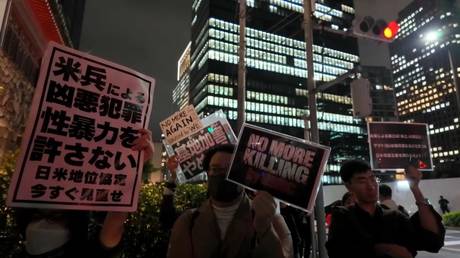
Public protest in urban centers like Tokyo serves as a physical manifestation of this diplomatic strain. These demonstrations are rarely spontaneous eruptions; they are organized expressions of accumulated local grievances regarding noise, environmental impact, and behavioral externalities associated with transient military populations. The strategic risk for the host government is acute: failure to respond robustly to public anger risks destabilizing the ruling coalition, while overreacting risks degrading the bilateral security alliance that underpins regional deterrence postures.
Mitigating this friction demands a structural shift from reactive crisis management to preventative behavioral control and rapid jurisdictional transparency. Military command structures must enforce rigorous off-duty risk mitigation protocols, recognizing that behavioral failures among enlisted personnel directly impair national security objectives. Simultaneously, host-nation legal frameworks require predictable, expedited pathways for accountability to reassure the local populace that sovereign laws hold precedence over external force protections.
Ultimately, the presence of foreign garrisons is sustained by a social license granted by the host population. When criminal behavior breaches that license, the cost-benefit analysis of the alliance shifts unfavorably. Long-term regional stability depends on closing the gap between military necessity and local civic safety, ensuring that strategic deterrence is not systematically eroded by avoidable tactical failures.