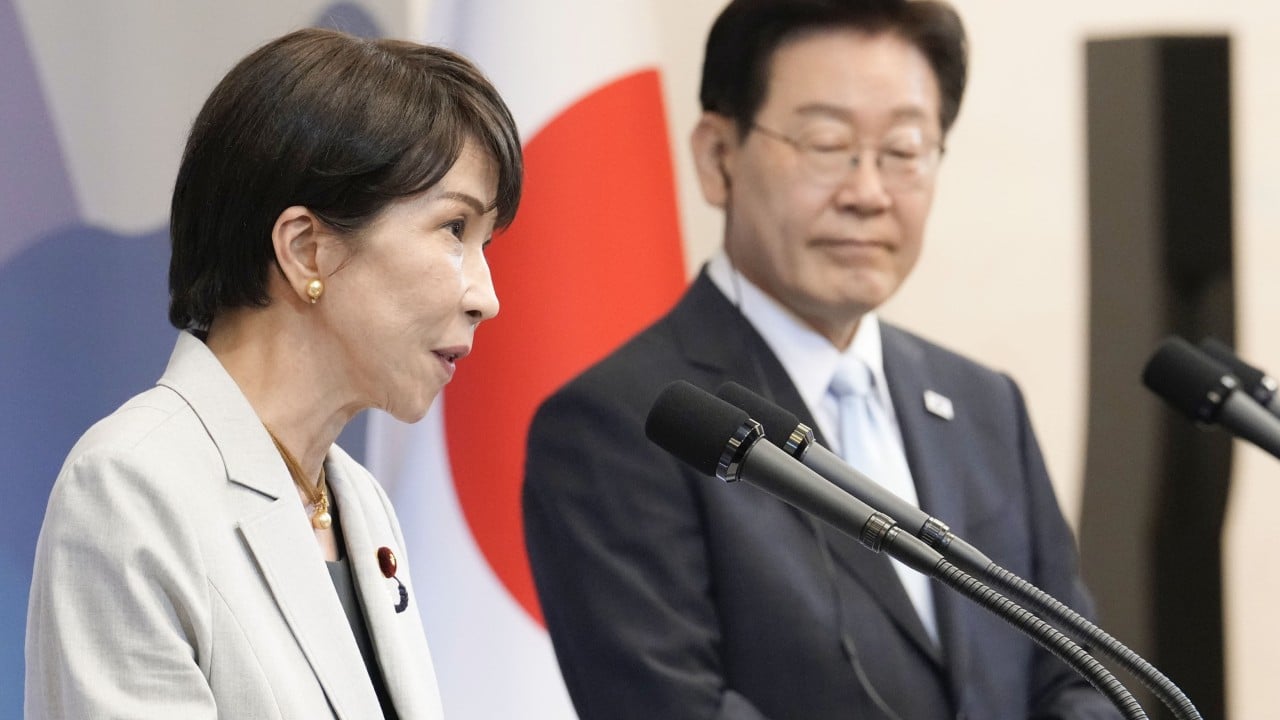
Bilateral military integration between South Korea and Japan remains fundamentally constrained not by a lack of shared tactical threats, but by a structural friction function where historical grievances directly cap the maximum allowable level of security cooperation. The public acknowledgment by South Korean President Lee Jae-myung regarding the structural limits of an Acquisition and Cross-Servicing Agreement (ACSA) with Japanese Prime Minister Sanae Takaichi exposes a critical vulnerability in trilateral Pacific architecture: state-level strategic alignment cannot bypass domestic public sentiment vectors when sovereign defense dependencies are introduced.
This friction operates through measurable friction mechanisms, creating a strategic bottleneck where operational logic fails to overcome historical path dependency.
The Operational Logic vs. Sovereignty Friction Model
The fundamental friction between South Korea and Japan is best understood as an Optimization Problem under a Political Sovereignty Constraint. The two states possess highly overlapping national security priorities, primarily driven by North Korean ballistic capability expansion and regional maritime shifts. However, the operational utility of a formal logistics treaty is strictly governed by a domestic sociopolitical threshold.
Maximum Cooperative Velocity = f(Shared Systemic Threat) - f(Domestic Sovereignty Friction)
When South Korea evaluates a formal ACSA, the agreement introduces bilateral interdependencies regarding core military inputs: fuel, food, and ammunition. For the South Korean executive branch, the strategic equation is split between two conflicting forces:
1. The Operational Utility Vector
A formal ACSA dramatically reduces transaction costs during joint maneuvers, trilateral exercises with the United States, and contingency scenarios in the East Sea. It establishes a predictable legal and logistical framework for mutual procurement, eliminating the need for ad hoc diplomatic negotiations during a kinetic crisis.
2. The Sovereignty and Identity Constraint
Because the memory of Japan’s 1910–1945 colonial occupation functions as a living element of South Korean political identity, any formal reliance on the Japanese Self-Defense Forces (JSDF) for sovereign defense requirements is perceived as an unacceptable dilution of strategic autonomy. President Lee’s specific warning—that entering into an ACSA without a prior, unambiguous historical apology would trigger massive domestic political backlash—demonstrates that the domestic cost of implementation routinely exceeds the marginal utility of tactical efficiency.
This creates a systemic asymmetry. Japan seeks the formalization of these agreements to solidify a predictable, institutionalized balance of power in Northeast Asia. Conversely, South Korean leadership is forced to manage a highly volatile domestic sentiment vector, resulting in a policy of bifurcated engagement: cooperating on real-time intelligence sharing through the General Security of Military Information Agreement (GSOMIA) while strictly blocking logistics integration.
The Mechanics of the Apology Prerequisite
To an outside analyst evaluating the situation purely through a realist lens, demanding a "sincere apology" as a prerequisite for cross-servicing agreements appears inefficient. However, within the framework of game theory and international signaling, an official state apology serves as a vital risk-reduction mechanism.
In bilateral relations marked by deep historical trauma, declarations of current goodwill are treated as cheap talk. A formal, legally binding, and culturally resonant apology from the highest level of the Japanese state operates as a high-cost signal. It requires the issuing government to expend domestic political capital, signaling a long-term commitment to respect post-war borders and sovereign equality.
[Historical Grievance Risk] ---> [Cheap Talk / Ad-Hoc Accords] ---> [High Systemic Vulnerability]
[High-Cost Signal / Apology] ---> [Verified Commitment] ---> [Institutional Logistics Integration]
Without this high-cost signal, any South Korean administration that signs an ACSA exposes itself to immediate domestic vulnerability. The political opposition can easily frame logistics dependency as a concession to a state that has not fully renounced its imperial past or reconciled its historical accounts.
The primary structural bottleneck preventing this signal from occurring is the domestic political equilibrium within Japan itself. The ruling Liberal Democratic Party relies heavily on conservative factions that view repetitive historical apologies as damaging to national pride and revisionist historical narratives. Consequently, the minimum acceptable apology threshold required by the South Korean public remains structurally higher than the maximum politically viable apology package that any Japanese prime minister can deliver without destabilizing their own governing coalition.
Path Dependency and the Multilateral Fallback
Because bilateral mechanisms are stalled by this structural friction, South Korea’s stated long-term strategy shifts toward a multilateral security framework. This shift is a direct attempt to dilute bilateral friction through third-party institutional padding.
By shifting the operational theater from a strict Seoul-Tokyo axis to a broader multilateral or minilateral design, South Korean planners can access the technical benefits of regional coordination without incurring the domestic political penalties associated with direct bilateral dependency.
- Trilateral Insulation: Utilizing the United States as a central hub allows South Korea and Japan to share data and coordinate paths without signing direct bilateral treaties that require public ratification.
- Operational Anonymity: Multilateral exercises dilute the visibility of direct cooperation with the JSDF, making security coordination more palatable to domestic audiences.
- The Nuclear Proliferation Constraint: This multilateral balancing act also serves to suppress regional nuclearization cycles. As President Lee noted, unilateral security escalations—such as potential South Korean nuclear armament in response to deterrence failures—would trigger a cascading proliferation chain across Japan and Taiwan, completely destabilizing the regional security balance.
The Strategic Path Forward
The analytical reality indicates that a comprehensive bilateral ACSA between South Korea and Japan is impossible under current political parameters. Forcing the issue through executive decree without resolving the underlying historical friction function will only result in policy reversal during the next electoral cycle, replicating the collapse of the 2012 draft agreement.
The most viable strategic play for regional actors is to abandon the immediate pursuit of a formal, high-profile logistics treaty and instead optimize the existing trilateral framework.
Operational focus must look to institutionalize data-sharing pipelines through Washington, lock in automated intelligence-exchange protocols that do not require recurring political authorization, and build out indirect logistics interoperability via shared Western supply nodes.
By accepting that domestic public sentiment functions as a fixed, unyielding parameter rather than a variable that can be ignored, strategic planners can maximize regional deterrence capabilities while operating safely within the hard limits of historical path dependency.