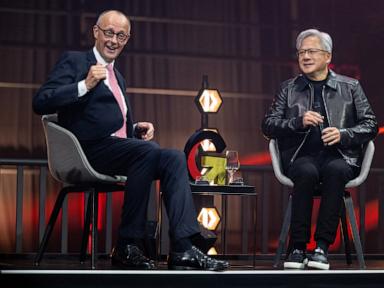
Software won't stamp steel, wind industrial turbines, or mill precision gears. Yet Jensen Huang's message to German manufacturers at the Invest in Germany Summit in Berlin hits a nerve because Berlin's industrial model is under real strain.
Huang's core argument is simple and blunt. AI should amplify Germany's engineering strengths, not replace its physical factories. Standing beside German Chancellor Friedrich Merz, the Nvidia chief pointed straight at the country's factory data, mechanical know-how, and specialized industrial base as a national asset waiting to be put to work.
If you've spent time around shop floors or industrial engineering teams, you know how easy it is for tech evangelists to talk past the realities of heavy industry. Heavy machines don't run on slide decks. They run on tolerances, thermal limits, power draw, supply chains, and decades of hard-won operational habits.
Why Heavy Industry Isn't Going Away
A lot of commentators treat "digital transformation" like a software startup eating a brick-and-mortar store. That framing falls apart fast when you look at what Germany actually makes.
Cars, industrial machinery, chemical plants, precision tooling, power gear—none of that becomes weightless just because an algorithm gets smarter. Even when a design starts in simulation or an AI agent schedules a line, physical atoms still have to move, heat up, get machined, and pass inspection.
Huang's push works best when you read it as a plea for physical AI and industrial tooling rather than hype. In fact, Siemens and Nvidia have been pairing simulation, digital twins, and factory operations software to tackle concrete bottlenecks like virtual ramp-ups and adaptive production planning.
That distinction matters. A chatbot can draft an email in two seconds. Teaching a robot arm or scheduling a multi-product assembly line without blowing up cycle times or risking safety is a completely different beast.
Where German Manufacturers Actually Have an Edge
Honestly, Germany doesn't suffer from a lack of engineering discipline. Its problem has been turning decades of shop-floor knowledge and machine data into faster cycles and fresh competitiveness while energy costs, global rivals, and shifting demand squeeze margins.
Huang called Germany's manufacturing expertise and data a natural resource that belongs to the country. That's an aggressive way to put it, and part of it is salesmanship from a chipmaker selling compute. Still, the underlying point holds up: proprietary operational data from real machines is hard to fake.
Look at the pieces Germany already has on the board:
- Deep domain knowledge: Engineers who understand why a press chatters, how a batch behaves under heat, or where tolerances drift over a shift.
- The Mittelstand: Hundreds of specialized small and medium-sized manufacturers that build critical components for global supply chains.
- Industrial software and automation roots: Strong local players in automation, enterprise processes, and robotics who already speak the language of plant managers.
When an AI model learns from messy real-world telemetry—paired with physics and domain rules—it becomes far more useful than a generic model trained on internet text.
The Trap That Trips Up Factory AI Projects
Here is where theory and reality often clash. Plenty of manufacturers get pitched grand "AI factory" visions, only to stall out on basic plumbing.
If your sensor data is locked in silos, poorly labeled, or inconsistent across shifts, throwing fancy models at it won't magically fix your line. Bad data in means confident nonsense out—and on a factory floor, a bad prediction isn't just annoying, it can waste material or cause downtime.
Cost and security are real friction points too. Smaller firms often feel the pinch of upfront capital costs, integration headaches, and worries about protecting sensitive industrial data. A giant enterprise with dedicated data scientists and multi-million-euro budgets doesn't face the same hurdles as a 120-person precision parts maker.
There's also a timing trap. Some companies wait around for a "complete" autonomous setup before doing anything. Meanwhile, practical wins usually come from narrower, high-friction spots first—like faster simulation runs, better maintenance signals, or smarter scheduling on a single bottleneck line.
What AI Changes on the Shop Floor and What It Doesn't
People searching this topic usually want a straight answer to a practical question: Does AI replace traditional industrial know-how, or does it just raise the bar?
From what we're seeing in industrial deployments, it raises the bar. It doesn't erase the need for mechanical engineers, plant supervisors, or skilled technicians.
A virtual model can test variations fast, and software can help coordinate workflows, but someone still has to verify physical constraints, maintain hardware, and own accountability when something goes wrong on the floor. Treating AI as a shortcut around engineering fundamentals is a fast way to build brittle systems.
On the flip side, ignoring AI completely has its own risk. Competitors that cut simulation times, spot equipment drift earlier, or adapt production schedules faster can out-execute slower rivals—even when both make physical hardware.
Practical Next Steps for Manufacturers
If you run or advise an industrial operation and want to act on this without chasing buzzwords, start small and stay grounded in operations:
- Pick one measurable bottleneck. Don't start with a "company-wide AI strategy." Pick a line, step, or workflow where delays, scrap, or setup time visibly hurt the business.
- Audit your data before buying tools. Check what machine and process data actually exists, how clean it is, and who owns access to it.
- Keep domain engineers in the driver's seat. Pair process experts with technical builders from day one so models respect real physical limits instead of fighting them.
- Demand clear ROI metrics. Tie pilots to concrete targets—like cycle time, changeover speed, energy use, or unplanned downtime—and walk away from pilots that don't move the needle.
Heavy industry isn't going anywhere, and neither is the need to make it smarter. The companies that win won't be the ones chanting slogans—they'll be the ones combining real engineering grit with practical AI where it actually pays off.
NVIDIA GTC Berlin 2026: Physical AI, AI Factory, Digital Twins
This video explores how physical AI, digital twins, and AI factory infrastructure connect directly to Jensen Huang's push for industrial transformation in Germany.