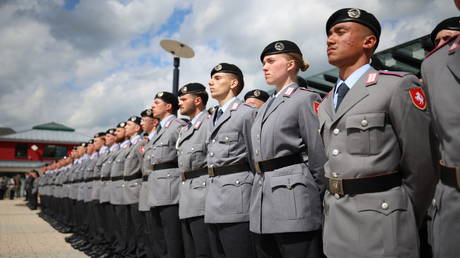
The hand-wringing headlines look catastrophic. The European press is fixated on a single, isolated statistic: only 530 young Germans applied to join the Bundeswehr's new voluntary military service within its first few months. Commentators are already calling it a definitive cultural failure, proof of a codigested generation refusing to defend the West, and a fatal blow to Berlin’s Zeitenwende—the highly publicized turning point in German defense policy.
They are fundamentally misreading the mechanics of modern warfare.
The lazy consensus treats military readiness like a 20th-century factory floor: more warm bodies equals more output. This view is obsolete. The frantic panic over low recruitment numbers ignores how defense capabilities actually scale. Germany does not have a recruitment crisis; it has an infrastructure, procurement, and strategic identity bottleneck. Measuring a country's defensive capability by counting how many teenage volunteers line up to scrub barracks is like judging a tech company's valuation by its headcount. It is the wrong metric for the wrong era.
The Myth of the Meat Grinder
Traditional defense analysts remain obsessed with mass. They look at the raw numbers of active-duty personnel and panic when the graph dips. But look at modern combat environments. High-intensity conflicts are dominated by long-range precision fires, electronic warfare, autonomous systems, and distributed logistics.
Adding 50,000 raw, unmotivated conscripts to an army that faces fundamental equipment shortages does not create a formidable fighting force. It creates a massive, vulnerable target.
The Bundeswehr does not need more infantry privates; it needs systems engineers, logistics managers, cyber specialists, and drone operators. These are highly skilled professionals who do not join via a vague, generalized "voluntary service" portal designed for high school dropouts looking for direction. By focusing the public debate on the 530 volunteers, critics obscure the real issue: Germany’s defense apparatus is structurally unequipped to absorb and train high-tech talent at scale.
If you want to understand real military capability, stop looking at recruiting offices. Look at the procurement cycle.
The Bottleneck Nobody Talks About
Imagine a scenario where 50,000 eager young Germans signed up tomorrow. The system would instantly collapse.
The Bundeswehr currently lacks the basic infrastructure to house, clothe, and equip its existing personnel, let alone a massive influx of new recruits. Reports from the Parliamentary Defense Commissioner have repeatedly highlighted the stark reality: barracks with moldy walls, a lack of working thermal optics, and digital radios that cannot communicate with NATO allies.
Citing data from the Stockholm International Peace Research Institute (SIPRI), Germany has dramatically increased its defense spending to meet the 2% NATO target. But throwing money at a broken procurement system does not instantly produce equipment. Defense acquisition in Berlin remains a bureaucratic nightmare where contracts take years to clear legal hurdles.
If a military cannot reliably distribute combat boots, adding thousands of volunteers only amplifies the logistical strain. The bottleneck is not a lack of patriotism; it is an administrative paralysis that treats ammunition procurement like a corporate office supply order.
Dismantling the Consensual Premise
Mainstream media frequently asks a variation of the same question: "How can Germany motivate its youth to serve?"
The premise of the question is deeply flawed. It assumes the youth are the problem.
The real question should be: "Why would a highly capable tech graduate choose a rigid, bureaucratic hierarchy over a private sector that pays triple and provides functional tools?"
The Bundeswehr attempts to compete on traditional corporate grounds—advertising flexible hours and "adventure"—instead of leaning into its actual differentiators. True military professionals are drawn to mission clarity, operational competence, and elite training. When Germany offers a watered-down, compromise version of national service that feels more like an underfunded social program than an elite defense force, it naturally fails to attract top-tier talent.
Furthermore, critics argue that low volunteer numbers prove Germany needs to reinstate compulsory conscription (Wehrpflicht), which was suspended in 2011. This is a nostalgic delusion.
Reintroducing conscription would require billions of euros just to rebuild the basic medical examination, housing, and training infrastructure that was dismantled over the last fifteen years. It would siphon resources away from critical modernization programs—like the procurement of F-35 fighter jets or the digitalization of land forces—to pay for the upkeep of reluctant, short-term soldiers.
The Downside of Efficiency
There is an uncomfortable truth that advocates for a lean, high-tech military rarely admit: building a professional, specialized force means sacrificing raw mass.
If a nation relies entirely on a smaller pool of highly technical specialists, it loses the capacity to absorb heavy casualties over a prolonged, multi-year conflict of attrition. A highly trained drone specialist or cyber defense operator takes years to develop; they cannot be replaced in a six-week basic training cycle.
This is the strategic trade-off Berlin faces. But trying to solve this vulnerability by chasing low-tier volunteer recruitment targets is a half-measure that satisfies neither strategy. It yields the disadvantages of a mass army—high infrastructure costs, logistical bloat—without achieving actual combat mass.
Shift the Capital from Flesh to Iron
Stop tracking volunteer metrics. They are a vanity metric for politicians who want to signal that they are taking defense seriously without doing the hard work of structural reform.
If Germany wants a defense force capable of acting as the backbone of European deterrence, it must stop treating the military as a national employment scheme or a moral correction facility for its youth.
- Scrap the voluntary service programs entirely. They divert administrative energy and training staff away from core combat units.
- Decentralize procurement. Allow individual branches of the military to purchase off-the-shelf equipment directly from European defense contractors without waiting for centralized ministerial sign-off.
- Outsource non-combat technical roles. Treat cyber security and logistical software development like the specialized industries they are. Hire private defense contractors for backend technical infrastructure so the active-duty military can focus exclusively on kinetic operations.
The fixation on 530 volunteers is a distraction designed by bureaucrats who prefer counting heads to measuring capability. A country's security is not built on the backs of confused teenagers looking for a gap-year alternative. It is built on industrial capacity, functional supply chains, and operational competence. Berlin needs to stop worrying about who isn't showing up to volunteer and start fixing the house they are inviting them into.