The sea does not care about your rank, your commission, or the billion dollars of carbon-fiber and titanium shielding bolted around your hull. It asks only for equilibrium. When that balance breaks, the ocean takes what it wants, quietly, without a press release.
Picture a bridge at three in the morning somewhere in the murky green expanse of the South China Sea. The air is thick enough to chew, smelling of diesel exhaust, ozone, and salt. Outside the heavy, tinted glass of the combat information center, the water is a flat, ink-black mirror reflecting nothing. Inside, the neon glow of multi-million-dollar consoles paints the operators' faces in a pale, anxious green.
They are hunting a ghost.
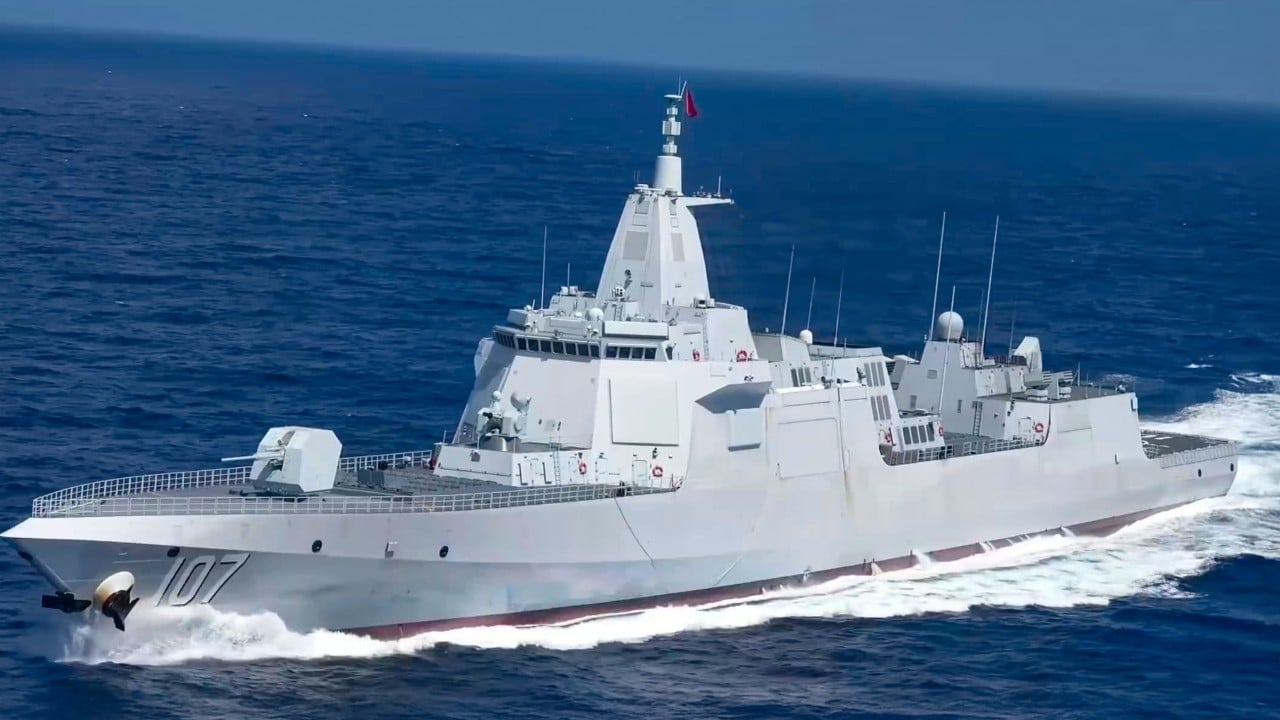
A few thousand yards away, a Chinese Type 055 destroyer cuts through the swells. It is a sleek, modern leviathan, bristling with vertical launch systems, moving with an eerie, predatory confidence. The American warship—a guided-missile destroyer representing the absolute apex of naval engineering—is right on its flank. The proximity is suffocating. Every radar sweep is a heartbeat. Every subtle course correction is a high-stakes game of maritime chicken played in international waters where a miscalculation means an international incident, or worse.
And then, without warning, the floor drops out.
The screens don't just flicker; they die. The hum of the combat systems—that steady, reassuring thrum that tells six hundred sailors they are safe inside an armored floating city—silences. The lights shift from a crisp industrial white to a dull, pulsing amber emergency glow. In the engine rooms, the turbines scream a dying song as they spin down into absolute, helpless silence.
Dead in the water.
For a few terrifying seconds, the most sophisticated war machine on the planet is nothing more than an expensive, unsteerable target adrift in contested waters.
Rumors move faster than electricity. By the time the fleet gets back under way, the whispers have already leaked across civilian channels and encrypted military forums. Did a US warship lose power while chasing a Chinese destroyer in the South China Sea? The official channels stay tight-lipped, offering vague assurances about routine maintenance and electrical anomalies. But sailors talk. Veterans know. The hardware is aging faster than we can patch it, pushed to the absolute edge of its operational envelope in a theater that demands perfection twenty-four hours a day, three hundred sixty-five days a year.
To understand why a warship loses power, you have to look past the political posturing and into the bowels of the ship.
Imagine running a nuclear-powered data center through a hurricane while simultaneously trying to calculate the trajectory of a bullet fired from another moving vehicle. Modern naval destroyers are not just boats anymore; they are floating power grids. They draw staggering amounts of electrical current to feed their phased-array radars, electronic warfare suites, and weapon systems. The power distribution network is a complex, sprawling nervous system.
When you push that system to its limit—chasing high-speed contacts, maneuvering violently to match an adversary's unpredictable vector, running auxiliary systems at peak capacity in tropical heat that fries cooling intakes—you are walking a tightrope over an abyss.
A single tripped breaker, a localized salt-water corrosion shorting out a main bus bar, or a sudden thermal overload in the generator controls can cascade through the ship in milliseconds. One moment you are hunting a dragon. The next, you are sitting in the dark, sweating through your utilities, waiting to see if the auxiliary generators will kick in before the adversary realizes you are paralyzed.
This is the hidden cost of great power competition.
We talk endlessly about geopolitics in terms of grand strategy, aircraft carrier groups, and freedom of navigation patrols. We draw neat little lines on maps in Washington and Beijing, as if international relations were a game of risk played with pristine plastic pieces. We measure strength in tonnage, missile tubes, and defense budgets.
We rarely talk about the grease.
We rarely talk about the nineteen-year-old machinist's mate standing in a windowless compartment filled with the deafening roar of failing machinery, covered in hydraulic fluid, trying to troubleshoot a blown electrical relay while the ship rolls in the trough of a hostile swell. We rarely talk about the engineering officer who has to look the captain in the eye and explain why the ship's heart just stopped beating sixty miles off a disputed reef.
The friction of empire is mechanical. It is worn-out gaskets, software bugs in legacy operating systems, exhausted crews working eighty-hour weeks on deployment extensions, and equipment designed for a different century trying to keep pace with a modern adversary that builds ships faster than we can dry-dock ours.
When the story of this era is written, the historians will focus on the grand maneuvers, the diplomatic cables, and the shifting balance of global hegemony. They will analyze the tactical decisions made in the South China Sea during the mid-2020s with the cold, sterile distance of hindsight.
They will miss the sweat.
They will miss the terrifying, silent ten minutes in the dark when the screens went black, the radar died, and the crew of an American warship had to remember that beneath all the technology, all the steel, and all the geopolitical ambition, survival still depends on human hands turning a wrench in the dark.
The ship eventually relit its fires. The generators roared back to life, the cooling fans spun up, and the combat displays flickered from amber back to green. The destroyer resumed its station, sliding back into the wake of the Chinese vessel like a shadow. To anyone watching from a satellite miles above, nothing had happened at all.
Just another routine patrol on the edge of the world.
Yet deep inside the hull, the metal was still cooling, and the engineers were still wiping grease from their brows, knowing full well how close they had danced to the edge of the abyss. The sea is deep, the margins are razor-thin, and the ghosts in the machine are always watching, waiting for the exact moment the power gives out.


