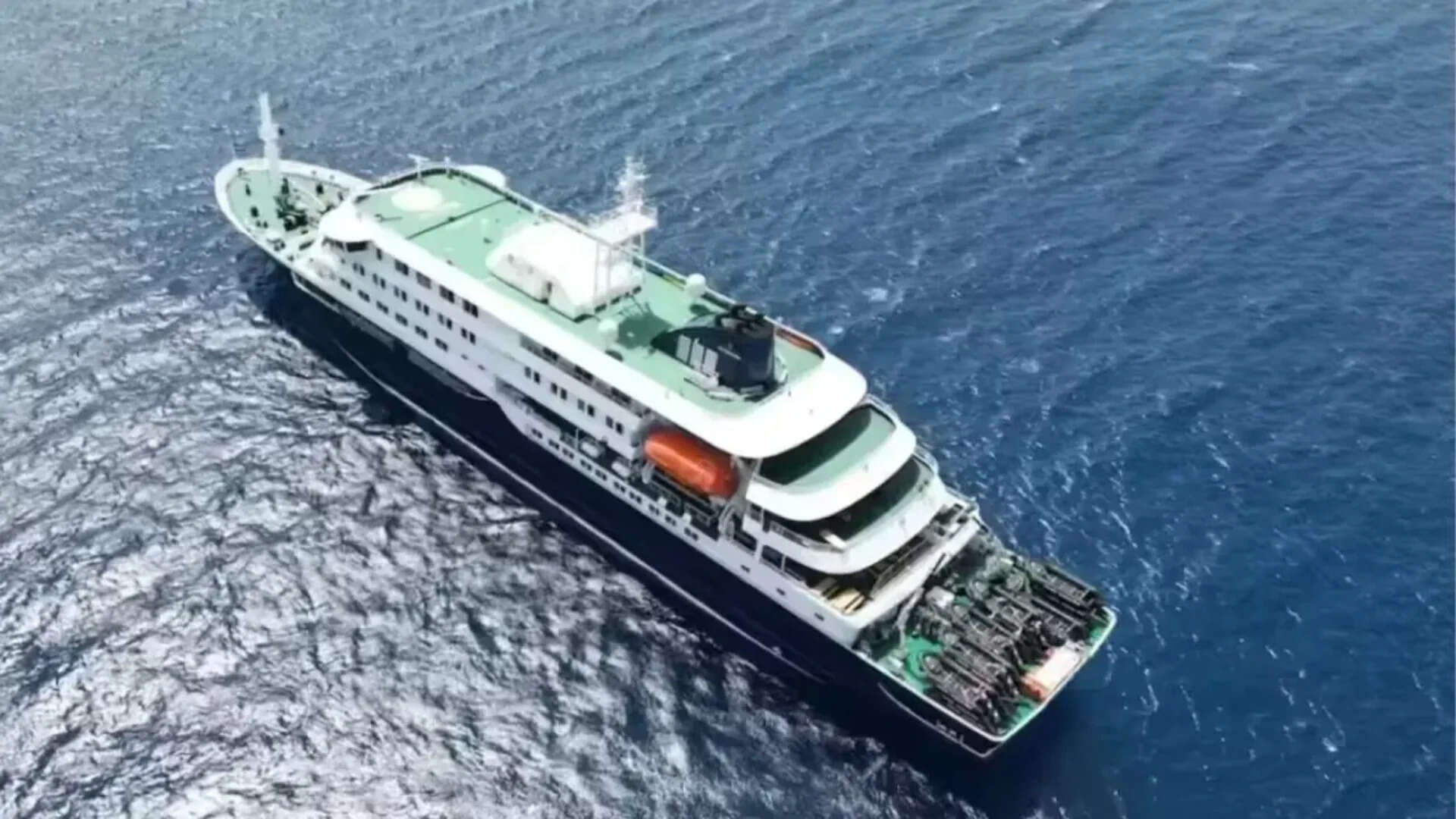
The Atlantic breeze off the coast of Spain usually carries the scent of salt and the promise of escape. For the passengers aboard the luxury vessel currently cutting through the waves toward the Canary Islands, that salt air is now tinged with the sterile, metallic tang of anxiety.
A cruise ship is a closed system. It is a floating city where every hand touches the same polished railings, every breath is recycled through the same vents, and every meal is shared under the same glittering chandeliers. Usually, this proximity is the draw. It is the communal joy of the voyage. But when a shadow enters that system—something invisible, microscopic, and potentially lethal—the dream of the open sea starts to feel like a gilded cage. If you found value in this post, you might want to check out: this related article.
The shadow in this case is Hantavirus.
The Uninvited Passenger
Imagine a traveler named Elena. She saved for three years to afford this cabin with a balcony. She spent her first two days on board watching the horizon, convinced that her only worry was whether the sun would stay out for the stop in Tenerife. Then came the announcement. A whisper at first, then a formal notification: the virus had been detected. For another angle on this development, refer to the latest coverage from USA Today.
Hantavirus isn't like the common flu or the Norovirus outbreaks that occasionally sweep through vacation liners. It doesn't typically hop from person to person through a cough or a handshake. Instead, it is a souvenir from the land. It arrives via rodents—their droppings, their urine, their very breath left behind in dusty corners.
On a ship, where every inch is scrubbed and every surface shines, the idea of a rodent-borne pathogen feels like a violation of the contract. How did it get here? Was it a crate of supplies loaded in a humid port? Was it tucked away in the dark recesses of the engine room? For Elena and the hundreds of others on board, the "how" matters less than the "now."
Now, they are sailing toward the Canaries, not as tourists, but as a biological question mark.
The Weight of the Decision
The Spanish authorities faced a choice that sits at the intersection of public health and cold, hard logistics. They could have quarantined the ship at its previous port, keeping the potential "hot zone" stationary. Instead, they allowed it to sail.
This wasn't a lapse in judgment. It was a calculated risk.
To understand why, you have to look at how Hantavirus behaves. It is a master of the slow burn. In its most dangerous form—Hantavirus Pulmonary Syndrome—it starts with fever and muscle aches, masquerading as simple exhaustion or a mild cold. But then, with terrifying speed, the lungs begin to fill with fluid. It is a literal drowning on dry land. The mortality rate can hover near 38%, a statistic that turns a luxury vacation into a high-stakes waiting game.
By allowing the ship to continue to the Canary Islands, officials are betting on the stability of the vessel's medical facilities and the specific nature of the virus. Because Hantavirus rarely spreads between humans, the risk to the general public in the islands is deemed manageable. The ship is a microcosm. As long as the passengers stay on board or are moved through strictly controlled corridors, the virus stays contained within its steel walls.
The Human Cost of Containment
Data tells us the risk is low. Logic tells us the virus is unlikely to jump from Elena to the person in the cabin next door. But humans do not live by data alone.
Fear has a specific physics. It expands to fill whatever space it is given. On the ship, every sneeze in the buffet line now feels like a siren. Every person who stays in their cabin a little too long is a source of panicked speculation. The crew, usually the smiling faces of the hospitality industry, are now the front line of a containment strategy they never signed up for.
Consider the psychological toll of being told you are "hit." You are no longer a guest; you are a data point in a potential outbreak. The Canary Islands, with their volcanic peaks and black sand beaches, represent freedom. But for those on the ship, the islands are currently just a backdrop for medical screenings and thermal cameras.
The Biological Reality
The science of Hantavirus is as fascinating as it is grim. It is a Bunyavirus, a category of pathogens that are remarkably hardy. When a rodent's waste dries, the virus can become "aerosolized." This means that someone sweeping a floor or moving a box can kick up microscopic particles that are then inhaled.
Once inside, the virus targets the endothelium—the thin layer of cells lining our blood vessels. It makes them "leaky." In the lungs, this leakage is catastrophic. The body’s own immune response, trying desperately to fight the invader, ends up flooding the very air sacs needed for survival.
There is no "cure" in the traditional sense. No magic pill or quick-fix antibiotic. There is only "supportive care"—ventilators, oxygen, and time. This is why the ship's journey is so fraught. If a passenger’s condition turns, they don't need a ship's doctor with a first-aid kit. They need an Intensive Care Unit.
A Lesson in Shared Vulnerability
The Spanish government’s decision to let the ship sail reflects a modern reality: we cannot stop the world every time a threat appears. We have learned, through painful global experience, that total isolation is often impossible and sometimes counterproductive.
Instead, we manage. We monitor. We move the problem to a place where it can be handled.
But for the people on that ship, this isn't a case study in crisis management. It is their life. It is the vacation they worked for. It is the fear that every breath they take might be the one that carries the ghost of a rodent's passing.
The ship continues its trek across the Atlantic. It remains a beautiful, white speck against the deep blue of the ocean, a symbol of human engineering and leisure. Yet, beneath the surface of that image, there is a pulse of tension.
We are never as isolated as we think. We carry our environments with us, tucked into the holds of ships and the vents of our buildings. The tragedy of the Hantavirus ship isn't just the illness itself; it is the reminder that even in our most manicured, luxury-filled moments, we are still biological entities, forever dancing with a natural world that doesn't care about our itineraries.
The Canary Islands are waiting. The medical teams are waiting. And on the balcony of a cabin she thought would be her sanctuary, Elena watches the waves, waiting to see if her own body remains her own.
The sea is vast, but on a ship with an uninvited guest, the world becomes very small indeed.