The coffee in the basement of the International Monetary Fund headquarters in Washington, D.C., tastes like wet cardboard and adrenaline. It is the beverage of people who spent the night watching numbers bleed.
When the IMF adjusts its global growth forecast downward, the world usually treats it like weather report data—a abstract shift from 3.2% to something slightly more bruised. But numbers do not live in spreadsheets. They live in the grocery bills of a family in Lima, the shuttered factory gates in Stuttgart, and the panic-buying of grain in Cairo.
This year, the ledger is haunted.
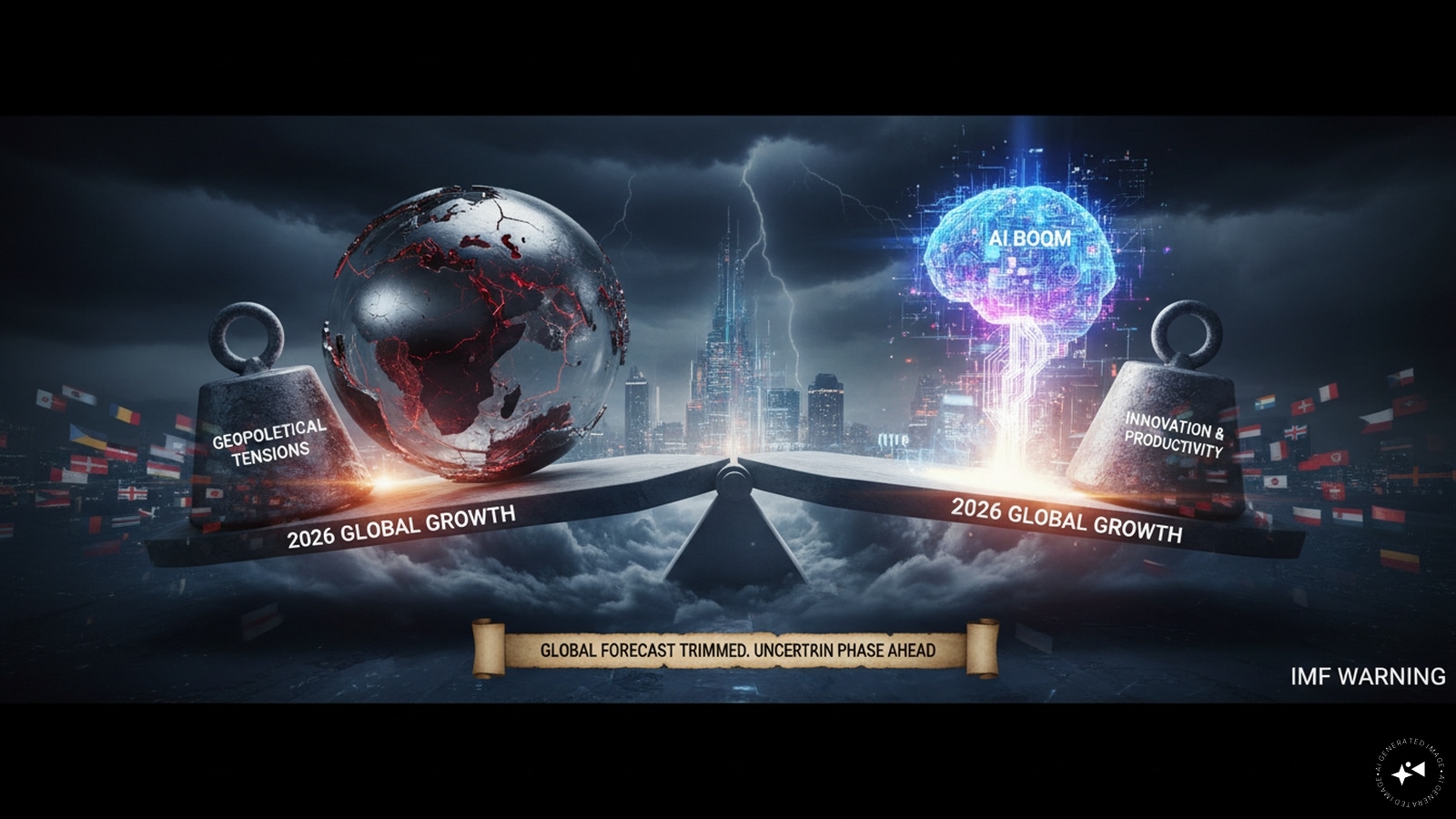
If you look closely at the math behind the latest global economic outlook, you are looking at a tug-of-war between two of the most powerful forces humanity has ever unleashed. On one side is the ancient, bloody reality of geopolitical warfare. On the other is an invisible, silent network of code. War is dragging the world economy down; artificial intelligence is holding it by the collar, keeping it from falling into the abyss.
The Price of Shrapnel
To understand how a conflict in the Middle East alters the price of a gallon of milk in Ohio, we have to look at the invisible lines connecting us. Let us use a hypothetical proxy: a logistics coordinator named Marcus sitting in a port office in Rotterdam.
Marcus does not fight in wars. He watches screens. But when conflict erupts across Iran and its critical maritime corridors, Marcus’s screen turns red.
The Strait of Hormuz and the surrounding shipping lanes are the carotid artery of the global energy trade. When a region catches fire, insurance premiums for cargo ships do not just rise; they skyrocket. A container ship that used to cost $2,000 to transit a route suddenly costs $10,000.
To avoid the danger zone, captains take the long way around. They steer ships past the Cape of Good Hope. This choice adds ten days to a journey. Ten days of burning diesel. Ten days of crew wages. Ten days of cargo sitting idle.
Multiply Marcus’s dilemma by ten thousand ships.
Suddenly, supply chains stretch until they snap. The IMF’s decision to cut its global growth forecast is the formal, bureaucratic acknowledgment of this friction. Every mile of detour is a tax on human progress. It means manufacturing slows down because components are stuck at sea. It means energy prices tick upward, forcing central banks to keep interest rates high. High interest rates mean a young couple cannot afford a mortgage, and a small business owner cannot get the loan they need to expand.
War is a black hole. It consumes capital, confidence, and time. Left unchecked, the economic shockwave of this prolonged friction would have triggered a severe global slowdown.
But it didn't. The numbers dropped, but they did not crash. Why?
The Digital Cushion
The answer lies in an office park in Hyderabad, a research lab in Toronto, and a server farm cooled by glacial water in Iceland.
While the physical world is bogged down by conflict and geography, the digital world is accelerating at a speed that defies historical precedent. The widespread integration of advanced algorithmic systems across global industries has acted as an economic shock absorber.
Think of it as a macro-economic balance sheet. War is a massive, unexpected debit. AI is an unprecedented, unmapped credit.
Consider what happens next in our global supply chain when things go wrong. In the old days—say, five years ago—a shipping delay caused by regional conflict created a chaotic domino effect. Human planners spent weeks manually rerouting cargo, guessing at warehouse capacities, and over-ordering safety stock, which created massive gluts and shortages.
Today, predictive algorithms are rewriting the rules of corporate survival.
When a port closes or a route becomes a hazard, enterprise software automatically recalculates thousands of variables in seconds. It shifts manufacturing schedules in Vietnam, reallocates inventory across North American warehouses, and optimizes fuel consumption for the longer routes around Africa.
It is a quiet, bloodless victory of efficiency.
This efficiency gain is not limited to shipping. Across the service sector—which makes up more than two-thirds of the developed world's economy—the productivity leap is staggering. Software developers are writing code forty percent faster with digital assistants. Legal firms are auditing thousands of complex cross-border contracts in the span of a lunch break. Healthcare systems are using machine learning to predict patient admissions, allowing them to staff hospitals with surgical precision.
These are not just corporate savings. They are structural shifts that lower the cost of doing business. When the cost of doing business drops, it counteracts the inflationary pressures caused by expensive oil and disrupted shipping lanes.
The Illusion of Balance
It is tempting to view this as a perfect symmetry. A beautiful, techno-optimist equation where human folly is canceled out by human ingenuity.
But that is a dangerous misreading of the moment.
The IMF’s data reveals a deeply fractured reality. The offsetting effect of technology is not distributed evenly. It is a concentrated privilege.
If you are an economy heavily reliant on digital infrastructure, services, and advanced technology, you feel the cushion. Your businesses adapt. Your white-collar workforce becomes more productive. You ride out the storm.
But what if you are an economy that relies entirely on the physical export of agricultural goods or heavy manufacturing, with little digital integration?
For those nations, there is no AI cushion. There is only the cold weight of the forecast cut. They face higher shipping costs, expensive fuel, and expensive credit, without any of the productivity gains to soften the blow. The gap between the digital affluent and the digitally impoverished is widening into a chasm.
We are watching a two-speed world emerge. One speed is governed by the physical constraints of an unstable planet. The other speed is propelled by the exponential growth of computing power.
The Human Friction
The numbers inside the IMF report are ultimately about survival.
When we talk about global growth slowing down, we are talking about the margin of error for humanity shrinking. A lower growth forecast means governments have less tax revenue to fund public services. It means debt becomes harder to service. It means the transition to green energy slows down because capital becomes cautious.
It is easy to get lost in the brilliant promise of technology. We marvel at large language models, automated logistics, and the sheer velocity of digital transformation. We treat technology as a savior.
But software cannot build a bridge. It cannot grow wheat. It cannot replace a bombed-out power plant or bring back a lost trade route.
The cushion provided by algorithmic productivity is a temporary reprieve, a historical grace period. It has prevented a bad situation from becoming catastrophic. It has given global leaders, central bankers, and corporate executives room to breathe.
But room to breathe is not a solution.
The real danger is that we mistake the digital cushion for a permanent cure. We cannot rely on silicon to endlessly clean up the messes we make in the dirt. If the conflicts widen, if the physical arteries of global commerce continue to constrict, the digital efficiency gains will eventually find their limit. A perfectly optimized supply chain cannot deliver goods if the ports themselves are gone.
The ghost in the ledger has done its job for now. It has balanced the books when human conflict threatened to tear them apart. But as the sun sets over the IMF headquarters, the wet cardboard coffee is gone, and the screens remain lit. The numbers tell us that we are surviving, but they also offer a quiet, unmistakable warning.
We are running out of margins.