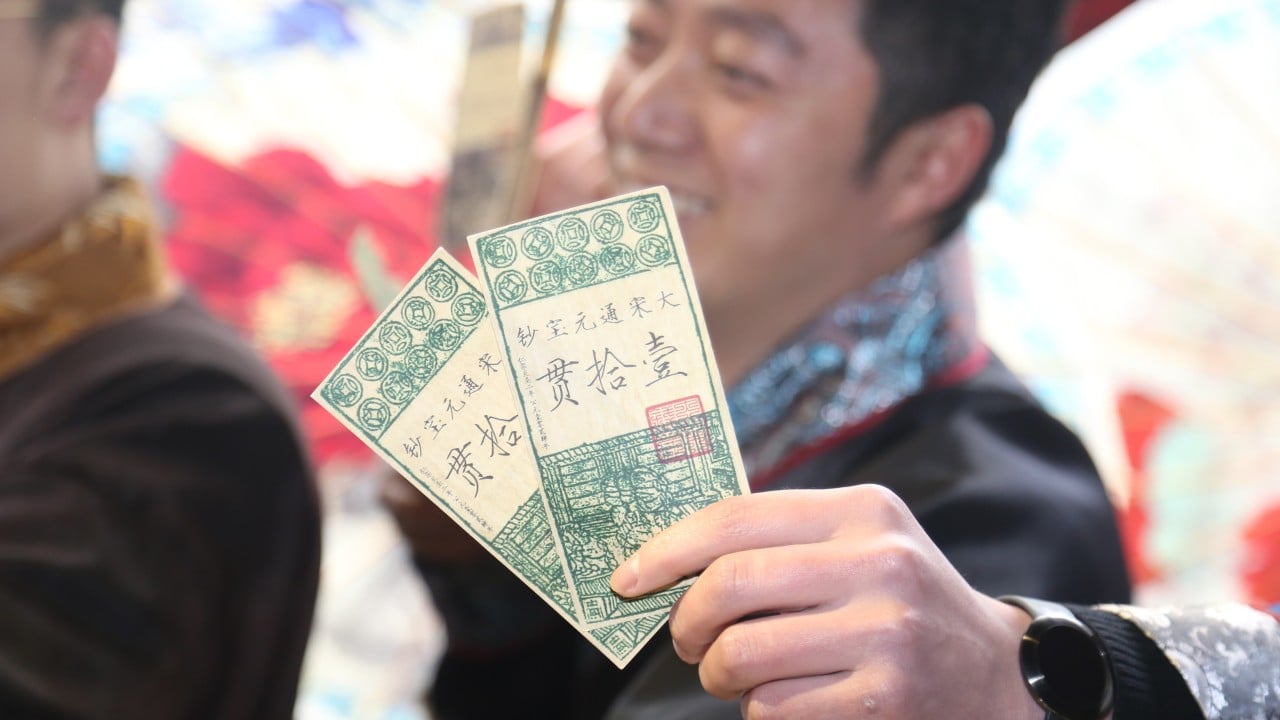
A merchant named Li stands on the edge of the Chengdu market in the year 1024. His back aches. For decades, the weight of his trade was literal. If he wanted to buy a shipment of silk, he had to lug heavy strings of iron coins across mountain passes infested with bandits. Iron is cheap, heavy, and honest. It has substance. You can drop it on a stone and hear the truth of its value. But today, Li holds something that feels like nothing at all.
It is a slip of mulberry bark paper.
It weighs less than a feather. It has no intrinsic value. You cannot melt it down to make a plow or a sword. Yet, as he hands this scrap of paper to a supplier, he is participating in a ritual that will eventually devour the world. He is trading a physical reality for a collective hallucination. He is holding the world’s first official government-issued paper money.
We call it fiat.
The word sounds clinical, like a line of code or a legal filing. But in the bustling streets of the Song Dynasty, it was a desperate, brilliant solution to a crushing physical problem. China was running out of metal. The economy was growing too fast for the earth to keep up. There wasn't enough bronze or iron in the crust of the Middle Kingdom to facilitate the sheer volume of tea, salt, and silk changing hands.
The Song emperors didn't set out to reinvent the nature of value. They were simply trying to stop their economy from grinding to a halt under the weight of its own currency.
The Weight of a Dead Metal
To understand the leap the Song Dynasty took, you have to feel the exhaustion of the old system. Imagine you are a tea trader. To buy a single high-quality horse, you might need 100 kilograms of iron coins. That is not a wallet; that is a logistical nightmare. You need a cart. You need oxen. You need armed guards to protect the cart. By the time you reach the vendor, your overhead has eaten your profit.
The merchants of Sichuan province were the first to snap. They started leaving their heavy iron coins with trusted deposit houses. In exchange, these houses issued a receipt—a jiaozi. These notes were essentially promises: "The bearer of this paper owns the iron sitting in my vault."
It was efficient. It was light. It worked because of a single, fragile human emotion: trust.
But the Song government, perpetually fighting expensive wars against northern invaders like the Jurchens and the Mongols, saw something the merchants didn't. They saw a magic trick. If people were willing to trade paper for goods because they believed it represented metal, what would happen if the metal wasn't there at all?
What if the value didn't come from the ground, but from the throne?
By 1024, the state took over the issuance of these notes. They moved from a "representative" currency (paper backed by metal) toward a "fiat" currency (paper backed by an edict). The transition was subtle, but it changed the DNA of human civilization. It shifted the foundation of wealth from the physical world to the political one.
The Invisible Stakes of the Mulberry Note
When you hold a gold coin, you are holding a piece of the universe that took a supernova to create. It doesn't care who the King is. It doesn't care if the harvest failed. It just exists.
When you hold fiat, you are holding a contract with your neighbor. You are betting that the government will be there tomorrow to enforce the value of that paper. You are betting that the tax collector will accept it. You are betting that the baker still fears the law enough to give you bread for a piece of bark.
The Song Dynasty's experiment was a triumph of engineering. They used sophisticated woodblock printing with multiple colors to prevent counterfeiting—techniques that wouldn't reach Europe for centuries. They used specialized paper made from mulberry trees to ensure durability. They created the first central bank infrastructure, managing reserves and setting expiration dates on notes to keep the supply in check.
For a time, the Song economy exploded. Without the tether of metal, trade moved at the speed of thought. Cities swelled. Science, art, and philosophy flourished because the friction of exchange had been lubricated by paper.
But there is a dark side to removing the tether.
When money is made of metal, the King's greed is limited by the output of the mines. When money is made of paper, the King’s greed is only limited by the speed of the printing press.
The Song government eventually learned the lesson that every superpower since has had to reckon with: the temptation to print "just a little more" to fund a war or bridge a deficit is irresistible. Inflation isn't just a number on a chart; it is the slow evaporation of a merchant's life work. It is Li, now an old man, realizing that the paper he saved for twenty years can no longer buy the same amount of grain it once could.
The ghost in the ledger had begun to haunt the market.
The Great Divorce from Reality
Modern Wall Street likes to think of itself as the pinnacle of financial evolution. We trade derivatives of derivatives, moving trillions of dollars through fiber-optic cables at the speed of light. We treat money as a digital abstraction, a series of ones and zeros flickering on a Bloomberg terminal.
We act as if we invented this.
But the Song Dynasty was already dealing with liquidity crises and hyperinflation while Europe was still bartering for cows. They understood the fundamental truth that we often forget: money is not a thing. It is a story.
Consider the "Quantity Theory of Money." It sounds like a dry economic principle, but in the streets of Kaifeng, it was a lived tragedy. As the Song printed more paper to pay for their desperate defense against the Mongols, the "story" began to break. If everyone has a piece of paper that says they are rich, but there is no more rice on the shelf, the paper is just paper.
Trust is a non-renewable resource. Once it leaks out of a currency, no amount of woodblock printing or imperial decrees can put it back.
By the time the Mongols finally breached the walls, the Song's paper money system had already collapsed under the weight of its own overproduction. The conquerors, led by Kublai Khan, actually kept the system. Marco Polo arrived in China and stood in slack-jawed amazement, watching people trade "pieces of paper as if they were gems or gold." He went back to Italy and told his friends.
They thought he was a liar. They couldn't conceive of a world where value was invisible.
The Legacy of the Mulberry Bark
We live in the world the Song Dynasty built.
Every time you tap your credit card or check your bank balance on an app, you are walking the path laid down by those Sichuan merchants. We have perfected the art of the abstraction. We have moved so far away from the "iron coin" that the idea of money having physical weight seems like a fairy tale.
But the tension remains.
The Song experiment teaches us that fiat currency is the ultimate social bridge. It allows for a level of cooperation and growth that metal could never sustain. It is the fuel of empires. Yet, it requires a level of institutional discipline that humans historically struggle to maintain. It demands that we trust the person in the high tower to not dilute the value of our labor for their own convenience.
Li, the merchant, eventually died. His iron coins are rusted or lost in the dirt. But his mulberry paper—or rather, the idea of it—conquered the planet.
We are all holding that paper now. We are all participating in the same grand, fragile narrative. We look at our screens and see numbers, and we believe in them because we have to. We believe in them because the alternative is to go back to the oxen and the cart, back to the weight of the world, back to a reality that is too heavy to carry.
The Song gave us the wings to fly, but they also left us with the constant, nagging fear of what happens when we stop believing we can stay in the air.
Money is a ghost. And we have spent the last thousand years trying to make sure it doesn't vanish.