Saltwater tastes like copper when you have been awake for thirty-six hours watching a radar screen blink in the dark.
Out in the Malacca Strait, the water isn't the turquoise blue you see on travel brochures for Bali or Langkawi. At three in the morning, it is thick, black oil. Heavy. Indifferent. Massive container ships groan past one another like blind whales, their hulls riding low under the weight of cheap electronics, palm oil, and timber destined for ports from Rotterdam to Yokohama. Most of it is entirely legal. Most of it keeps the global economy breathing.
Then, there is the cargo that doesn't appear on any manifest.
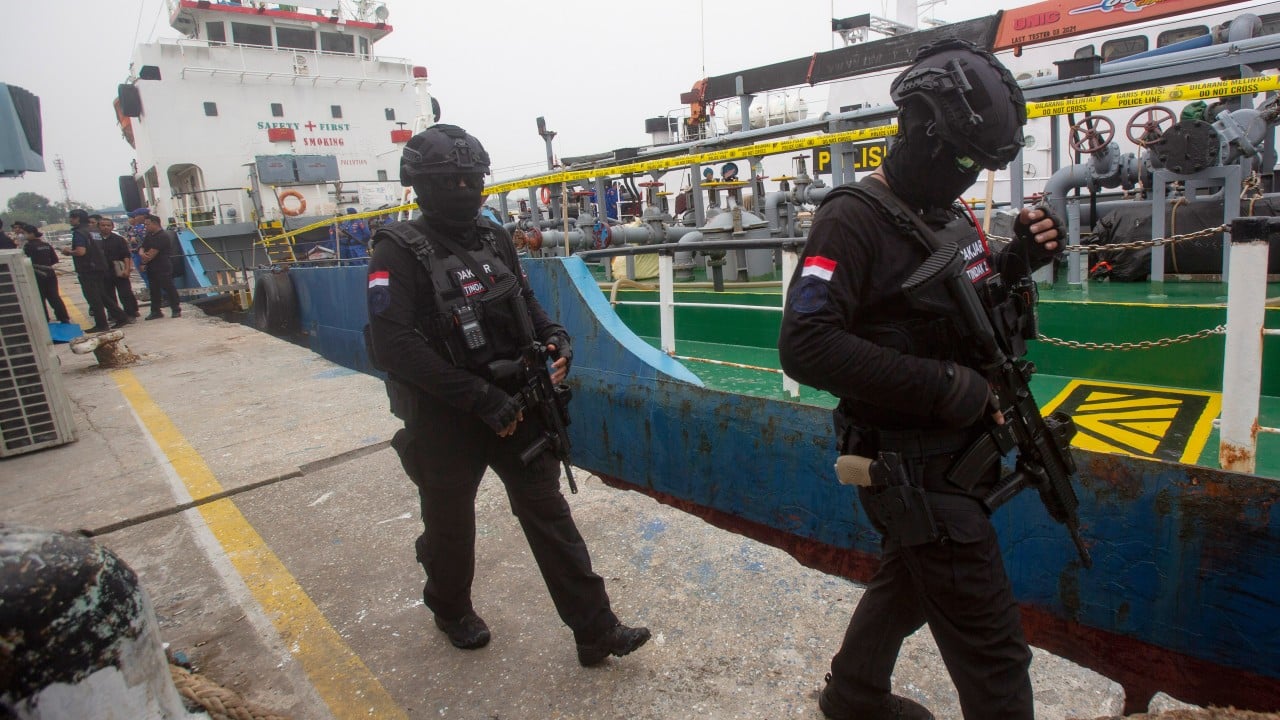
When Indonesian maritime authorities boarded a Malaysian-owned tanker in the waters off the Riau Islands, the official press release read like every other bureaucratic report you have ever scrolled past without clicking. Authorities intercepted a vessel. They searched the hull. They found roughly two tons of ketamine—an estimated street value of US$14 million—tucked into hidden compartments where fuel or ballast should have been. Arrests were made. An investigation is ongoing.
Read those facts again. Two tons. Fourteen million dollars. A Malaysian-owned hull floating in Indonesian territory.
If you only read the headline, this looks like a clean victory for law enforcement—a neat, contained story about bad guys getting caught on the high seas. It isn't. To understand what was actually sitting in the dark belly of that tanker, you have to stop looking at the boat and start looking at the water around it, the economies that built it, and the quiet, devastating shift happening in the veins of Asia's underground drug trade.
The Architecture of a Smuggling Route
Picture a hypothetical deckhand—let's call him Arif—standing on the rusted steel plates of a regional coastal tanker. Arif isn't a cartel kingpin from a streaming drama. He doesn't wear gold chains or carry a silver-plated pistol. In reality, maritime smuggling in Southeast Asia relies almost entirely on men like Arif: underpaid seafarers from coastal villages across Indonesia, Malaysia, and the Philippines who take a contract because the local fishing yields have collapsed and a cousin knows a broker in Batam.
To Arif, the ship is just a paycheck. The hull smells of diesel, rust, and boiled rice.
Smuggling syndicates understand this desperation better than any economist ever could. They don't build sleek, high-speed submarine fleets when an aging, mid-sized commercial tanker will do the job ten times better. Think of maritime traffic in the Malacca Strait and the South China Sea like a crowded highway during rush hour. If you drive a bright red sports car at a hundred miles an hour, every patrol car on the road will pull you over. If you drive a dented, beige delivery van at the exact speed limit, nobody looks twice.
A Malaysian-owned tanker moving through Indonesian waters is the ultimate beige delivery van.
Legitimate maritime commerce between Malaysia, Singapore, and Indonesia is so dense, so relentless, that inspecting even five percent of the vessels passing through the Riau Archipelago would bring regional supply chains to a grinding halt. Port authorities know this. Coast guards know this. And the Golden Triangle syndicates—the shadowy networks operating out of the borderlands where Myanmar, Laos, and Thailand meet—know it best of all.
Why Ketamine?
For decades, when people heard about massive drug seizures in Southeast Asia, the substance was almost always methamphetamine. Crystal meth—known locally as shabu or ice—flooded the region in staggering quantities, cooked in hidden jungle labs in Myanmar's Shan State and pushed south toward Australia, Indonesia, and Malaysia.
Ketamine was supposed to be different.
In hospitals from Jakarta to New York, ketamine is an essential, life-saving anesthetic. Paramedics use it in ambulances. Surgeons rely on it when other sedatives might crash a patient's blood pressure. Over the last few years, psychiatrists have even begun using tightly controlled micro-doses to pull people back from the brink of severe, treatment-resistant depression.
But in the back rooms of nightclubs in Kuala Lumpur, Jakarta, Hong Kong, and Sydney, ketamine has mutated into something else entirely.
It is cheap to manufacture compared to plant-based drugs like cocaine or heroin. You don't need sprawling fields of coca or opium poppies that satellite imagery can spot from orbit. You just need industrial chemical precursors, a warehouse, and a chemist willing to look the other way. Once synthesized into a crystalline white powder, ketamine offers smugglers a brutal financial advantage: staggering profit margins packed into tight, dense bricks that don't emit the sharp, organic odors that trained sniffer dogs detect so easily.
Fourteen million dollars' worth of ketamine isn't a recreational stash. It is an industrial supply drop.
To put two metric tons into perspective, imagine the weight of a full-sized pickup truck, broken down into tiny, fingernail-sized plastic sachets sold on street corners and behind VIP velvet ropes. One tanker carrying US$14 million in product represents millions of individual doses—millions of nights where young people lose track of where their bodies end and the floor begins, slipping into the dissociative numbness users call the "K-hole."
The Invisible Hand on the Helm
Here is where the story gets uncomfortable, and where the dry news reports conveniently stop asking questions.
Notice the phrasing in the headlines: Malaysian-owned tanker.
In the shipping world, ownership is a hall of mirrors. A vessel can be registered in one country, owned by a shell company in a second, insured through a broker in a third, crewed by nationals from a fourth, and chartered by a logistics firm that exists only as a post office box in a fifth. When Indonesian naval officers or customs patrols board a ship and find millions of dollars in narcotics, the men in handcuffs on the deck are almost never the men who bought the fuel, paid the bribes, or own the title to the hull.
I remember standing on a concrete pier in a Southeast Asian port years ago, watching customs officials unload contraband from a seized coastal freighter. What struck me wasn't the mountain of wrapped packages piled under the fluorescent lights. It was the crew sitting cross-legged against a warehouse wall, guarded by men with automatic rifles. They looked terrified, exhausted, and utterly bewildered. One of them kept staring at his plastic sandals, his shoulders shaking silently.
Those men were going to spend the next decade—or the rest of their lives—inside an overcrowded prison cell. Meanwhile, whoever actually owned the shell company that owned the tanker was probably sitting in an air-conditioned office tower three hundred miles away, writing off the loss as a routine business expense.
Money doesn't drown when a ship gets caught.
In transnational narcotics trafficking, syndicates build a thirty-percent seizure rate directly into their accounting spreadsheets. If they send four tankers south through the Indonesian archipelago and three slip past the patrol boats, the profits from those three vessels don't just cover the loss of the fourth—they finance the next ten shipments. The arrested captain and crew are simply the cost of doing business, as replaceable as a snapped mooring line.
The Geography of Vulnerability
Indonesia is a nation made of water held together by over seventeen thousand islands.
Try to picture guarding that. Imagine trying to lock every window and door in a mansion with seventeen thousand rooms, while storm clouds roll in every afternoon and the budget only covers a handful of flashlights. That is the daily reality for Indonesia's National Narcotics Board (BNN), the Indonesian Navy, and the customs patrols working the Malacca Strait.
Because Indonesia maintains some of the strictest drug laws in the world—penalties that routinely include life imprisonment and the death penalty—the street price of narcotics inside the country is artificially high. High risk creates high reward. A kilogram of ketamine that costs a few thousand dollars to produce in a clandestine lab in mainland Southeast Asia multiplies in value the moment it crosses the maritime border into Indonesian waters.
And the tankers know every blind spot.
They use the shallow coves of the Riau Islands to transfer cargo in the dead of night—a ship-to-ship ballet where a massive tanker slows to a crawl, shuts off its Automatic Identification System (AIS) transponder so it vanishes from public maritime tracking maps, and lowers heavy waterproof sacks onto wooden fishing boats waiting below with their engines idling. By dawn, the tanker is back in the main shipping lane, transponder blinking innocently, heading toward a legitimate port to offload legal cargo. The wooden boats have already disappeared into the mangrove swamps of Sumatra.
This time, the ballet failed. Intelligence tipped off the authorities, or a patrol boat caught an anomaly on the water that didn't match the paperwork. The hull was breached. The compartments were opened. The white powder was dragged into the sunlight.
What the Cameras Don't Capture
When the press conference happens, the staging is always identical.
Law enforcement officials in crisp uniforms stand behind a long table covered in neatly stacked bricks of seized narcotics. A banner hangs behind them. Photographers snap pictures of the haul while officials recite the street value—US$14 million—and estimate how many "young lives were saved" by the interception.
It is an easy metric to applaud, and an easy one to misunderstand.
Because while two tons of ketamine sits inside an evidence locker waiting to be incinerated, the systemic conditions that put it on that Malaysian tanker haven't budged an inch. Global shipping lanes are still operating on razor-thin margins that incentivize vessel owners to lease their ships to sketchy charterers without asking too many questions. Coastal communities across Southeast Asia are still struggling with inflation and stagnant wages, ensuring an endless supply of desperate sailors willing to sign onto suspicious voyages. And chemical supply chains across Asia remain vast enough that shutting down one precursor pipeline simply forces chemists to tweak a molecule and open another.
Worst of all, seizures like this reveal how deeply organized crime has embedded itself into legitimate maritime infrastructure. This wasn't a smuggling operation run out of the shadows; it was run through the very vessels that carry the world's commerce. Every time a legitimate shipping company cuts corners on due diligence, every time a port authority waves through a manifest because the harbor is too congested to check, the shadow economy grows another inch.
The Wake Left Behind
Out in the strait tonight, the water is black again.
The seized tanker is tied up at a heavily guarded Indonesian naval base, its rusted hull gently slapping against rubber dock fenders, its engines cold. Inside a local detention center, a handful of men are realizing that their lives just ended at sea. Somewhere in an unmarked office, a ledger is being updated, a loss is being absorbed, and a broker is already scrolling through maritime registries looking for another coastal tanker with a clean record and an owner who doesn't ask where the cargo comes from.
Fourteen million dollars in white powder is sitting in a vault tonight, but the ships are still moving.


