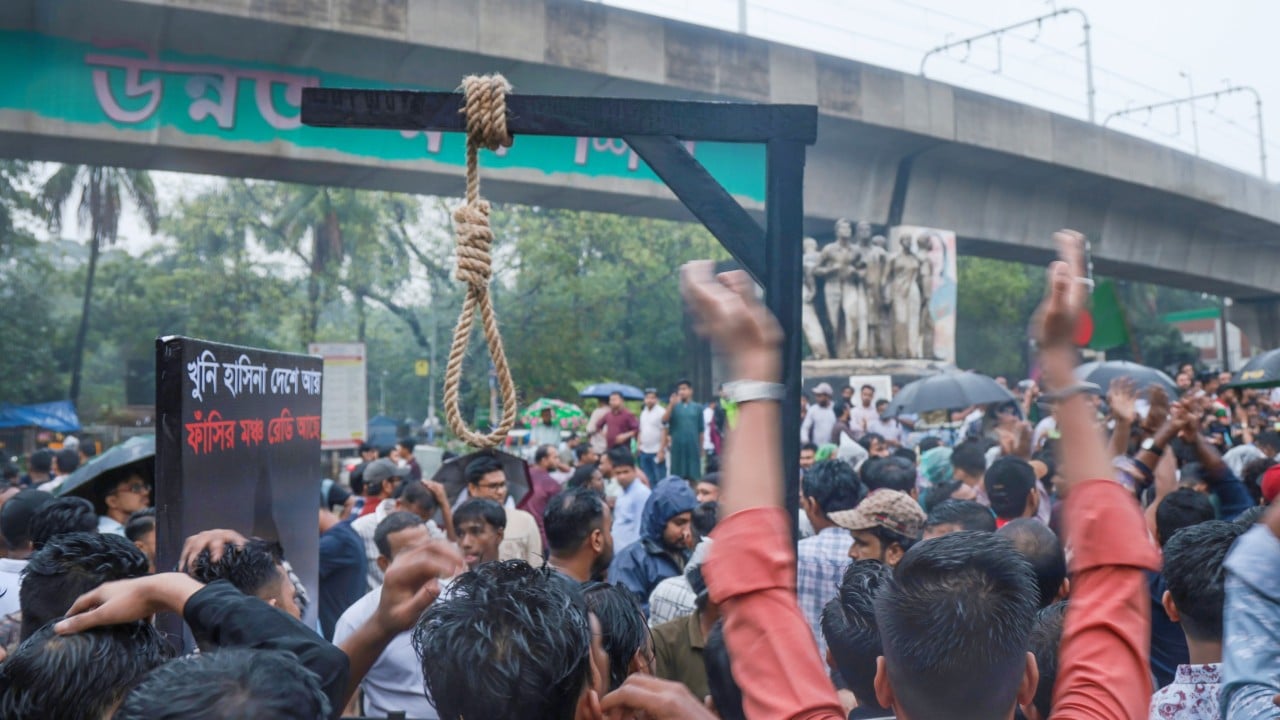
The shutter of a small pharmacy in Dhaka makes a very specific sound when it is pulled down in a hurry. It is a sharp, metallic shriek that cuts through the humid afternoon air, followed by a heavy thud against the concrete.
If you have ever stood on a crowded street in Bangladesh when the air suddenly shifts, you know that sound. You know how the ambient noise of rickshaw bells, shouting vendors, and idling diesel engines vanishes in less than ten seconds. People do not scream at first. They just move. Eyes dart toward the end of the avenue where black smoke is beginning to curl above the tangled overhead power lines, and the shutters start dropping, one after another, like falling dominoes.
We are hearing that sound again.
Months after a student-led uprising toppled Sheikh Hasina’s fifteen-year rule in August 2024 and forced her into exile in India, the streets of Bangladesh are tightening once more. News tickers summarize the shift in cold, clinical shorthand: Violence rises in Bangladesh as ex-PM Hasina’s supporters escalate protests.
That headline tells you what is happening. It does not tell you what it feels like to stand in the middle of it, wondering whether the country you nearly died to rebuild is slipping back into the exact cycle of street warfare you thought you had escaped.
The Architecture of a Counter-Surge
To understand why the pavement in Dhaka, Gopalganj, and Chittagong is burning again, you have to stop looking at this as a simple clash between rival political parties. It is a collision of two entirely different realities occupying the same cramped geography.
Consider a hypothetical family living in a fourth-floor walk-up in the Mirpur neighborhood. Let us call the father Tariq, a mid-level textile buyer whose livelihood depends entirely on shipping containers leaving the port of Chittagong on schedule. In July and August 2024, Tariq watched his nineteen-year-old son march toward police barricades armed with nothing more than a bamboo stick and a bottle of saline water to wash tear gas from his eyes. When Hasina fled on August 5, Tariq wept on his balcony, convinced that the suffocating era of enforced disappearances, rigged ballots, and state-sanctioned extortion was finally over.
Now, consider Tariq’s neighbor across the hall, a hypothetical former local ward leader for Hasina’s Awami League party—let us call him Rafiq. For fifteen years, Rafiq was the man you went to if you needed a municipal permit, a hospital bed, or a dispute settled. His loyalty to the ruling party was not merely ideological; it was the foundation of his income, his social standing, and his physical safety. Overnight, Rafiq went from being untouchable to being hunted. His party was sidelined, its student wing banned as a terrorist organization by the interim government, and thousands of its members slapped with criminal charges ranging from corruption to murder.
When you corner a political machine that spent a decade and a half fusing itself into the bedrock of every police station, court, and bazaar in a nation of 170 million people, it does not simply evaporate. It goes underground. And then, when the dust settles and the new authorities struggle to fix the price of onions and electricity, it pushes back.
That pushback has turned visibly violent. What began after August 2024 as scattered, nocturnal flash mobs by Awami League loyalists has escalated into coordinated daytime demonstrations, arson attacks on public buses, and fierce street battles with security forces and rival student groups. In districts like Gopalganj—Hasina’s ancestral stronghold—clashes between her supporters and law enforcement have left vehicles torched and dozens injured. Elsewhere, mobs have attacked rallies commemorating the August uprising, tearing down banners and clashing with the very students who dismantled the old regime.
Why the Streets Are Heating Up Now
A political vacuum is never empty for long; it fills with whoever is willing to risk the most pain to claim it.
Following Hasina’s ouster, Nobel laureate Muhammad Yunus stepped in to lead an interim government tasked with an almost impossible mandate: stabilize a tanking economy, overhaul a compromised judiciary, purge politicized security forces, and prepare the country for free elections. It is the equivalent of trying to rewire a burning house while a hurricane batters the roof.
For the first few months, public euphoria bought the interim administration time. People tolerated soaring inflation and lingering insecurity because the air felt breathable for the first time in a generation.
Time, however, is a ruthless currency in South Asian politics.
As the months dragged on without a concrete election date, the cracks began to show. The police force—demoralized, understaffed, and deeply distrusted after firing on unarmed protesters during the summer uprising—remained hesitant to assert control on the streets. Criminal syndicates stepped into the void, taking over the extortion rackets in transport hubs and wholesale markets that Awami League cadres used to run. For an ordinary rickshaw puller or vegetable seller, the flag flying over the local party office changed, but the hand demanding a daily "tax" remained the same.
Hasina, speaking through leaked audio clips and statements from her exile in New Delhi, recognized the opening immediately. Her message to her fractured base has been sharp and uncompromising: the interim government is unconstitutional, the economy is collapsing without her leadership, and her supporters must take back the streets.
For those loyalists still inside Bangladesh, escalating protests serves a dual purpose. First, it shatters the narrative that the Awami League is dead, proving to both domestic rivals and international observers that the party still commands the muscle to paralyze major roads. Second, it baits the interim government and student activists into heavy-handed retaliation. Every video of an Awami League worker being beaten in the street or arrested without a warrant becomes ammunition in a fierce propaganda war, designed to paint the post-Hasina era as chaotic, vengeful, and intolerant.
The Invisible Stakes of a Torched Bus
When a television broadcast shows a passenger bus burning at a Dhaka intersection, most viewers register the spectacle and move on. They do not see the quiet, cascading ruin that follows that single match strike.
Bangladesh’s economy runs on razor-thin margins and relentless physical movement. Roughly eighty percent of the country’s export earnings come from its ready-made garment sector—the factories that stitch the shirts and trousers hanging in malls across New York, London, and Berlin. Those factories rely on a fragile daily choreography: raw cotton moving inland from ports, workers commuting before dawn on crowded buses, finished garments racing back toward cargo ships against strict international deadlines.
Every time political violence flares, that choreography breaks.
A single day of highway blockades or arson threats does not just inconvenience commuters; it causes international fashion brands to quietly shift orders to Vietnam or India. It means factory owners delay overtime pay. It means millions of daily wage earners—masons, tea-stall workers, delivery drivers—go to bed hungry because nobody stepped outside to buy what they were selling.
Worse still is the psychological toll on a generation that believed it had broken history’s wheel.
Walk through the campus of Dhaka University at dusk, where walls are covered in vibrant, defiant murals painted in the aftermath of the August revolution. The artwork depicts fallen students with outstretched arms, doves breaking free from iron bars, and bold typography promising a "Bangladesh 2.0" free of dynastic politics and bloodletting.
Talk to the young men and women standing beneath those murals, and you will hear something rarely captured in official press briefings: exhaustion mixed with a creeping, cold dread. Many of them lost friends in July and August, when more than a thousand people were killed in the crackdown that preceded Hasina’s fall. They watched their classmates die so that politics would no longer be settled with machetes, petrol bombs, and tear gas canisters.
Now, watching Hasina’s supporters regroup and fight back in the streets, those same students feel pulled back into the mud. Some student factions have responded to Awami League rallies by forming vigilante patrols, hunting down suspected loyalists, and clashing directly with demonstrators. In trying to defend their revolution from a counter-revolution, they risk becoming the very street enforcers they risked their lives to overthrow.
I have seen this fever take hold of a city before. It starts as righteous vigilance—young people telling themselves they are protecting their neighborhoods because the police will not. Within weeks, vigilance curdles into paranoia. Any stranger lingering near a tea stall becomes an "agent." Any dissenting opinion online becomes treason. And before anyone realizes what has happened, the rule of the mob quietly replaces the rule of law.
The Trap of Selective Memory
There is an uncomfortable truth that both sides of this conflict prefer to ignore, yet it sits at the center of why Bangladesh cannot seem to find peace.
For decades, Bangladeshi politics has operated like a blood feud disguised as a democracy. When the Awami League held power, it systematically dismantled the opposition Bangladesh Nationalist Party, jailing its leaders, shuttering critical media, and treating political dissent as an existential threat to the state. Now that the tables have turned, the temptation for the victors—and for the millions of citizens nursing legitimate grievances against Hasina’s rule—is to erase the Awami League from public life entirely.
History offers a grim warning about what happens when you try to ban a mass political movement out of existence without offering its millions of ordinary voters a peaceful off-ramp.
You do not eliminate their loyalty; you radicalize it. You convince moderate party members who might have accepted electoral defeat that their only choices are prison, exile, or violent resistance. At the same time, by failing to swiftly prosecute the specific security officials and politicians responsible for the 2024 killings through transparent, unimpeachable courts, the authorities leave a vacuum that street justice rushes to fill.
And what of Hasina herself? Sitting across the border in India, her presence has become a diplomatic fault line straining relations between Dhaka and New Delhi. Every time her supporters launch a coordinated protest, suspicion in Bangladesh deepens that external forces are actively trying to destabilize the country’s fragile transition. Whether accurate or exaggerated, that suspicion poisons public discourse, turning local street skirmishes into fuel for regional nationalism.
Watching the Smoke
It is easy, from a distance, to treat political unrest in South Asia as inevitable—just another chapter in a region accustomed to strikes, curfews, and tear gas. That cynicism is an insult to the people living through it.
Nothing about the current escalation is inevitable, yet nothing about stopping it will be easy. The interim government faces a brutal balancing act: it must enforce the law firmly enough to stop arson, intimidation, and organized violence by Hasina’s loyalists, without slipping into the arbitrary detentions and blanket crackdowns that defined the previous regime. Meanwhile, the political factions preparing for future elections must decide whether they want to govern a functioning democracy or rule over ashes.
Until those choices are made, life in Bangladesh remains suspended between hope and reflex.
Late in the evening, when the day’s clashes finally subside and the acrid tang of burnt rubber begins to clear from the avenues of Dhaka, the city slowly exhales. A shopkeeper unlocks the heavy padlock on his shutter, hoists the corrugated metal halfway up, and peers out into the dim streetlight, listening to the hum of the traffic before deciding if it is safe enough to open the rest of the way.


