Red.
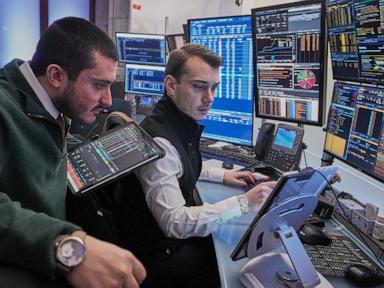
Just a relentless, pulsing wall of crimson glowing across three monitors at 9:34 AM in a cramped suburban kitchen outside Chicago. You might also find this connected story useful: Sector Rotation Mechanics and Peak Season Logistics Economics.
Consider a hypothetical day trader—let’s call him Marcus—staring at his coffee cup as it goes cold. He doesn't work in Silicon Valley. He has never written a line of code in his life, nor has he ever stepped foot inside the sun-drenched, pastel-bike-filled campus in Mountain View, California. Yet, on this particular morning, Marcus’s palms are sweating because a company two thousand miles away just lost more market value in forty minutes than the entire gross domestic product of several small nations.
The ticker symbol is GOOGL. The parent company is Alphabet. And when Alphabet takes a historic nose-dive, it doesn't fall alone. It grabs the rest of the American stock market by the collar and drags it down into the cellar. As highlighted in latest coverage by Investopedia, the implications are worth noting.
If you read the standard financial headlines, the story sounds sterile, almost clinical. Analysts talk about basis points, valuation multiples, and broader index drag. They treat a massive sell-off like a meteorological event—a cold front moving across the Midwest, unfortunate for your picnic plans, entirely divorced from human emotion.
That is a lie we tell ourselves to keep from panicking.
Behind every percentage point shaved off Alphabet’s stock price is a quiet, invisible chain reaction that reaches directly into the pockets of teachers in Ohio, retired firefighters in Florida, and young couples trying to scrape together a down payment in Austin. To understand why a historic drop in Alphabet’s stock drags the entire U.S. market lower, you have to stop looking at the ticker tape and start looking at the architecture of modern American wealth.
The Gravity of a Trillion-Dollar Anchor
Imagine the U.S. stock market—specifically the S&P 500—not as a democratic collection of five hundred equal businesses, but as a precarious pyramid balanced upside down.
At the very top, bearing an absurd amount of weight, sit a handful of technology titans. Alphabet is one of the heaviest stones in that crown. Because the major market indexes are weighted by market capitalization, a giant like Alphabet doesn't just participate in the market; it is the market, to a staggering degree. When a mid-sized regional bank or a legacy clothing retailer has a terrible quarter and drops ten percent, the broader market barely blinks. It’s a pebble tossed into a lake.
When Alphabet drops seven, eight, or nine percent in a single session—a move that wipes out over a hundred billion dollars in paper wealth before lunch—it isn't a pebble. It is a boulder dropped into a swimming pool. The water doesn't just ripple; it sloshes over the concrete and floods the patio.
I remember the first time I truly felt the weight of index concentration. It was a brutal tech sell-off a few years back, and I was sitting at my desk watching my own conservative, "diversified" retirement account bleed value hour by hour. I didn't own a single share of big tech directly. I thought I was safe, tucked away in broad index funds designed to protect ordinary people from single-company disasters. What I hadn't fully grasped—and what most financial brochures bury in footnotes—is that buying the whole market means buying a massive slice of Alphabet whether you intend to or not.
When the giant stumbles, your 401(k) trips over its feet.
What Actually Breaks the Spell
Stocks of Alphabet’s magnitude rarely crater because of a single bad Tuesday. They fall because a deeply held, collective belief suddenly cracks.
For over two decades, Alphabet enjoyed one of the most lucrative, unassailable monopolies in human history. Search wasn't just a product; it was a reflex. We didn't look things up on the internet; we Googled them. That verb printed money with a consistency that made Wall Street weep with joy. Advertisers had no choice but to pay the toll at the bridge, because all human curiosity crossed that bridge first.
But empires rarely fall to external invaders; they erode from within when the ground beneath them shifts.
A historic drop in Alphabet’s stock usually signals one of three terrifying realities colliding with Wall Street’s expectations:
- The Threat to the Moat: The sudden realization that artificial intelligence and conversational interfaces might make ten blue links feel as archaic as the Yellow Pages. If users get their answers directly from an AI prompt without clicking through to websites, what happens to the ad auction that funds Alphabet's entire existence?
- The Regulatory Hammer: The slow, grinding realization that the Department of Justice isn't bluffing about antitrust enforcement. When courts begin questioning the legality of default search deals—the billions paid to keep Google front and center on every smartphone screen—investors suddenly have to price in a future where the tollbooth is dismantled.
- The Ad-Spend Canary: Because Google sits at the absolute center of global commerce, its advertising revenue is the ultimate real-time thermometer for the broader economy. When corporations get nervous about inflation, interest rates, or consumer spending, the very first budget they slash is marketing. If Alphabet reports even a slight chill in ad growth, Wall Street assumes a blizzard is coming for everyone else.
Consider what happens next on the trading floors of Manhattan and inside the server farms of New Jersey where high-frequency algorithms live.
The moment Alphabet’s earnings miss the mark, or a courtroom ruling goes sideways, or a new AI competitor steals the spotlight, the algorithms don't pause to reflect on the company's long-term vision. They execute. They sell Alphabet. And because Alphabet is bundled inside thousands of Exchange-Traded Funds (ETFs) alongside Apple, Microsoft, Amazon, and Nvidia, selling the bundle forces a mechanical sell-off across the entire technology sector.
Fear is contagious, and on Wall Street, it travels at the speed of fiber-optic cable.
The Psychology of the Herd
Have you ever been in a crowded theater when someone near the back suddenly stands up and walks briskly toward the exit? Nobody knows why they left. Maybe they just had to use the restroom. Maybe they got a text from a babysitter. Yet, within ten seconds, half the row is checking their phones, craning their necks, wondering if they smell smoke.
That is precisely how institutional money behaves when a bellwether like Alphabet cracks.
Hedge fund managers—men and women paid millions to outsmart the crowd—are paradoxically the most terrified of looking foolish alone. If Alphabet is falling, holding onto other high-flying tech stocks suddenly feels reckless. To protect their quarterly bonuses, managers begin dumping shares in companies that have nothing to do with Alphabet's specific problems. Semiconductor makers drop. Cloud software companies drop. Digital ad agencies get hammered.
Before the closing bell rings, a specific problem at one California tech giant mutates into a broad market rout. The Dow Jones Industrial Average sinks. The Nasdaq Composite looks like a crime scene. Financial news anchors switch to their somber, disaster-coverage voices, flashing graphics of red arrows pointing toward the floor.
It is easy to feel helpless watching this unfold. Even after years of studying market cycles, I still feel that sharp, cold knot in my stomach when a mega-cap stock unravels. You start second-guessing everything. Should I pull my money out? Is this 2000 all over again? Am I the last sucker holding the bag while the insiders cash out?
That doubt is the invisible tax of modern investing.
The Illusion of Safety
Let's step back from the panic for a moment and look at the mechanics of what is actually happening beneath the surface.
When a stock like Alphabet suffers a historic single-day drop, the financial media loves to calculate the "lost" billions. It makes for sensational copy. “Alphabet Evaporates $150 Billion in Value!”
Here is a secret that rarely makes it into the first three paragraphs of those articles: that money didn't vanish into thin air, because it was never cash sitting in a vault to begin with.
Market capitalization is simply the price of the very last share traded multiplied by the total number of shares in existence. Think of it like a neighborhood of a thousand identical houses. If your neighbor sells his house for $500,000, the town assessor says the neighborhood is worth $500 million. If your other neighbor gets desperate during a snowstorm and sells his house for $400,000, suddenly the "value" of the entire neighborhood drops by $100 million—even though nobody else moved, the roofs didn't cave in, and the schools are just as good as they were yesterday.
The danger isn't the paper loss itself; the danger is what human beings do in response to seeing the number drop.
When Marcus, our hypothetical day trader in Chicago, sees red across his screens, he might panic-sell at the exact bottom, locking in real losses to escape imaginary ones. When a retiree in Florida sees the evening news report that Alphabet dragged the market down by two percent, she might call her advisor in the morning and demand to move her savings into cash, missing the inevitable rebound that almost always follows emotional sell-offs.
Wall Street transfers wealth from the impatient to the patient, and historic drops in mega-cap stocks are the ultimate stress test of human patience.
Beneath the Wreckage
So what does a bruised Alphabet actually mean for the rest of us?
First, it is a brutal, necessary reminder that no company is immortal. History is littered with corporate titans that seemed entirely invincible right up until the decade they became irrelevant. IBM once owned computing. Kodak owned photography. Nokia owned mobile phones. Alphabet’s stumbles remind us that capitalism is supposed to be ruthless—even to the winners. When a monopoly gets comfortable, disruption eventually kicks the door down. For consumers, a wounded giant fighting for its life is actually good news. It forces Alphabet to innovate faster, build better tools, and stop taking its users for granted.
Second, a market-wide sell-off triggered by one giant exposes the hidden fragility of passive investing. For fifteen years, the easiest money in the world was made by blindly buying the index and letting big tech carry the load. When Alphabet drags the S&P 500 lower, it forces everyday investors to confront a truth they’ve been ignoring: owning five hundred companies doesn't mean much if five of them control the steering wheel.
Finally, it separates the noise from the signal.
If you look past the panic of a single red day on Wall Street, the fundamentals of human behavior haven't changed overnight. People still wake up with questions they need answered. Businesses still need to reach customers. Engineers are still building the future in fluorescent-lit rooms, largely indifferent to whether their company's stock price ended the afternoon up four dollars or down twelve.
Late that evening, long after the closing bell has silenced the shouting on the exchange floor, Marcus finally shuts down his monitors in Chicago. The red glow fades from the kitchen walls. Outside, the street is quiet. A delivery truck hums past under the amber streetlights, guided by GPS maps running on a server farm owned by Alphabet. Inside the house down the block, a teenager asks a smart speaker for help with her calculus homework, tapping into a neural network trained by Alphabet.
The ticker tape says the giant took a historic beating today. The charts look like a cliff.
Yet the invisible threads connecting that company to the rhythm of daily life haven't snapped at all—and come Monday morning at 9:30 AM, the whole noisy, terrifying machine will start turning all over again.