Silence.
In a city built on the relentless, low-frequency hum of air conditioners and eight-lane highways, silence is the first warning that something has gone terribly wrong.
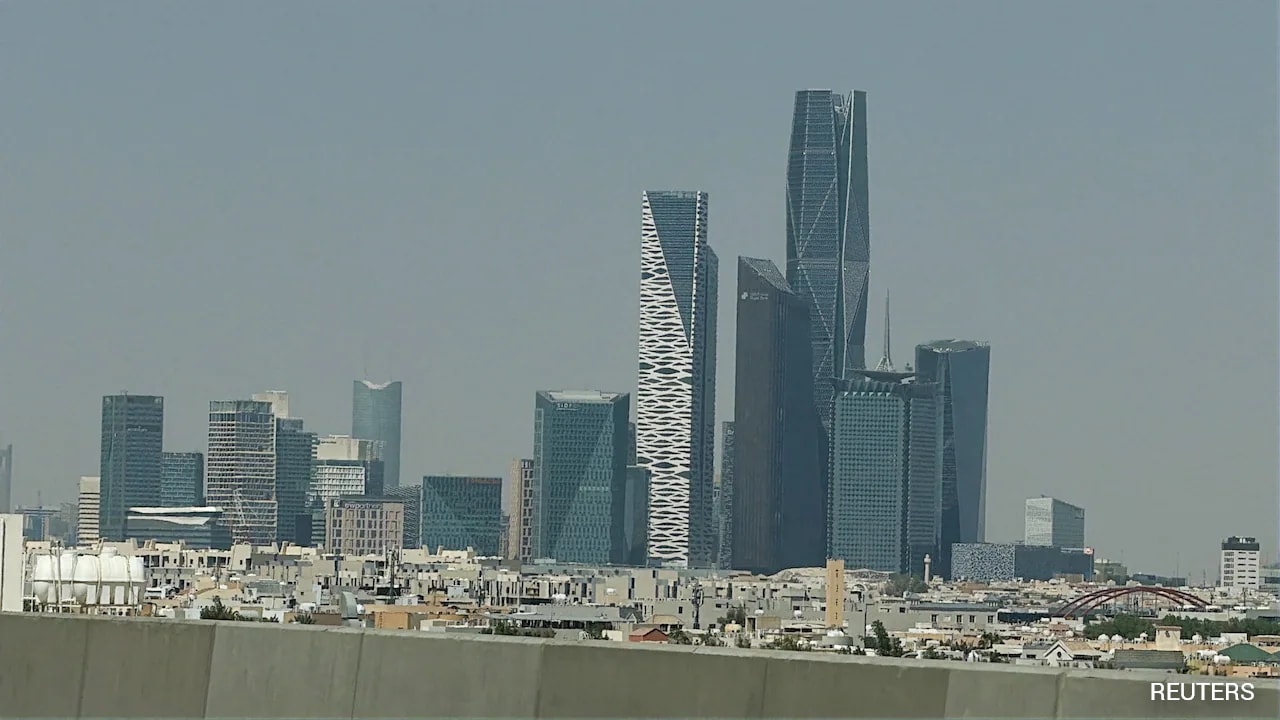
Picture Tariq, a structural engineer who has spent twelve years working in the gleaming towers of central Riyadh. He is a composite character, a hypothetical stand-in for the thousands of professionals whose daily lives orbit the Kingdom Centre—the 99-story, 302-meter skyscraper with the iconic inverted arch slicing through the Arabian sky. On an ordinary Tuesday, Tariq’s biggest worry is the afternoon traffic bottleneck along King Fahd Road or whether the espresso machine on the forty-second floor will survive another fiscal quarter. He lives inside a symbol. To the outside world, the Kingdom Centre is not merely concrete, steel, and reflective blue glass. It is a physical manifestation of Saudi Arabia’s economic ambition, a vertical monument to permanence, safety, and modern prosperity rising out of the Najd plateau.
Then comes the sound that breaks the silence. Not a thunderclap—rain is rare enough in Riyadh to draw people to their windows with phones raised—but a sharp, metallic crack high in the upper atmosphere, followed by a concussion that rattles the double-glazed curtain walls in their aluminum mullions.
When Saudi authorities report new Houthi attacks targeting the capital, and news dispatches confirm that Riyadh’s tallest building has sustained damage, the headlines tend to reduce the event to cold, clinical shorthand. Interceptions. Debris. Minor structural impact. No casualties reported. The wire services move on within hours, treating the incident as another routine data point in a protracted regional conflict that has dragged on since 2015.
They miss the entire point.
To understand what actually happens when drones or ballistic missiles are intercepted above a dense metropolis, you have to look past the box score of air defense. You have to look at the geometry of falling debris, the psychology of an urban skyline, and the fragile social contract that allows millions of people to work, shop, and sleep beneath thousands of tons of suspended glass.
The Physics of a Successful Interception
People often assume that when a Patriot battery or a THAAD interceptor destroys an incoming projectile mid-air, the threat simply evaporates into harmless smoke. That is a comforting illusion. In reality, warheads and airframes do not vanish; they obey Isaac Newton.
Think of an interception at thirty thousand feet as a high-speed car crash occurring directly above a crowded city square. Even when the kinetic kill vehicle strikes its target dead-on, neutralizing the explosive payload before it can detonate on the ground, the combined mass of both objects—twisted titanium, carbon fiber, unspent propellant, and jagged steel—still belongs to gravity. The wind shear over central Riyadh catches those fragments and scatters them across an unpredictable footprint.
For a supertall skyscraper like the Kingdom Centre, the vulnerability is not necessarily a direct strike to its reinforced concrete core. Modern skyscrapers are engineered to withstand immense lateral wind loads and seismic shifts. Their Achilles' heel is their skin. The building’s facade is an intricate puzzle of thousands of individual glass panels, sealed against 115-degree summer heat and abrasive desert dust. When superheated shrapnel or a shockwave from an upper-atmosphere detonation washes over that facade, the glass does not politely crumble. Even tempered and laminated safety glazing can fracture, spiderweb, or tear loose from its gaskets, turning a architectural triumph into a vertical rain of razor-sharp confetti.
I have stood on the streets of Middle Eastern capitals minutes after an air-defense engagement, and the sensory memory never quite leaves your nervous system. First, there is the smell—a sharp, acrid tang of burnt cordite and ozone hanging in dry air that usually smells only of exhaust and warm limestone. Second, there is the sound of dust settling on parked cars, a faint, gritty hiss that sounds like static on an old radio. You look up, squinting against the glare, searching the pale sky for contrails that have already begun to fray in the upper-level winds. Your neck aches from staring straight up, because for the first time all week, you are acutely aware that the sky above you is not empty.
The Invisible Stakes of the Skyline
Why target—or risk striking—a landmark like the Kingdom Centre? The military utility of damaging a commercial skyscraper containing a luxury shopping mall, a Four Seasons hotel, and corporate offices is practically zero. It holds no radar installations, no ammunition depots, no command bunkers.
That is precisely why it matters.
In asymmetric warfare, symbolism is a primary munition. Since the Houthi movement seized Sanaa in 2014 and a Saudi-led coalition intervened the following year, the conflict has evolved from a localized civil war in Yemen into a long-range battle of attrition fought with drones, cruise missiles, and ballistic trajectories. Over the years, Houthi forces have launched hundreds of cross-border projectiles toward Saudi territory. Most are aimed at oil infrastructure—such as the 2019 attacks on Abqaiq and Khurais that temporarily knocked out half of Saudi Arabia’s crude production—or military airbases in the south.
When those trajectories reach Riyadh, roughly a thousand kilometers north of the Yemeni border, the target shifts from industrial capacity to psychological certainty.
Consider what Riyadh is trying to become. Under Vision 2030, the Saudi capital is undergoing one of the most aggressive urban transformations on earth. Billions of dollars are pouring into new transit lines, financial districts, entertainment hubs, and skyscrapers designed to dwarf even the Kingdom Centre. The entire economic thesis relies on convincing multinational corporations, foreign investors, tourists, and expatriate engineers that Riyadh is an unshakable, tier-one global city—a place as predictable and secure as Singapore, Zurich, or Dubai.
A single cracked facade on Riyadh’s most recognizable building threatens that narrative far more effectively than a crater in an empty stretch of desert. You do not need to topple a tower to shake the confidence of the people sitting inside it. You only need to remind them that the glass between their desk and the horizon is thin.
Inside the Suspension of Disbelief
Let us return to our hypothetical engineer, Tariq, standing near the base of the tower as emergency sirens begin their familiar, rising wail along Olaya Street.
In the immediate aftermath of an attack, human behavior follows a predictable, quiet choreography. Nobody screams like they do in disaster movies. Instead, people freeze, clutching their phones, refreshing local news feeds and social media channels to confirm whether what they just felt was real. Within minutes, security personnel in crisp suits begin herding pedestrians away from the building’s perimeter, eyes scanning the upper stories for loose panels that might still be shifting in the breeze.
If you have never lived in a city under intermittent aerial threat, it is difficult to grasp the peculiar mental tax it imposes. It is not constant terror; human beings are remarkably bad at sustaining panic over months and years. Rather, it is a low-grade, ambient vigilance. You begin to notice things you used to ignore. You calculate how many floors sit between your office and the street. You unconsciously step away from floor-to-ceiling windows when a low-flying commercial jet passes overhead on its approach to King Khalid International Airport. You catch yourself wondering, during a perfectly ordinary business lunch, what happens if an interceptor misses by fifty meters.
This is the true cost that never appears in military communiqués. Official statements pride themselves on interception rates—ninety percent, ninety-five percent, ninety-eight percent. Those numbers are a testament to extraordinary radar tracking and split-second software execution by Royal Saudi Air Defense Forces. Yet in the math of urban life, a two-percent margin of error is not a rounding error. Two percent is a shattered atrium. Two percent is a family driving home from dinner on King Fahd Road when a spent booster casing falls out of the dark.
The Architecture of Resilience
Still, cities like Riyadh do not stay down, and pretending that a damaged skyscraper signals collapse would be a profound misreading of both history and human nature.
Cities have always absorbed shockwaves and adapted. London rebuilt its skyline after the Blitz; Beirut patched its bullet-pocked concrete towers time and again; Tel Aviv and Kyiv have woven air-raid protocols so tightly into daily commerce that cafe patrons barely lose their place in conversation after the all-clear sounds. Riyadh possesses financial reserves, engineering capacity, and state security apparatus that few capitals can match. Within hours of any incident, municipal crews sweep the asphalt, glaziers measure damaged frames, and traffic resumes its relentless flow past the base of the tower.
Yet the scars remain, even after the replacement glass is hoisted into place and sealed against the desert heat.
Look closely at any modern metropolis situated near a geopolitical fault line, and you begin to see the subtle compromises built into its beauty. You see the blast-resistant film applied to lobby windows. You see the concrete bollards disguised as decorative planters lining the sidewalks. You see the way residents look at their own skyline—not merely with pride, but with a quiet, unspoken awareness of how much invisible machinery is working every second of the night to keep the sky from falling.
By morning, the cranes are already swinging high above central Riyadh, lifting fresh panels of blue-tinted glass toward the inverted arch of the Kingdom Centre, while ten stories below, a maintenance worker kneels on the plaza tiles with a broom, sweeping the last glittering splinters into a plastic dustpan before the morning commute begins.