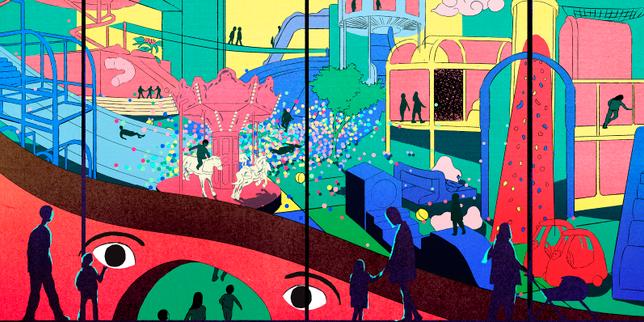
The air inside the Lilliput "kids café" in Seoul's Gangnam district does not smell like a typical playground. There is no scent of old sweat, dusty mats, or the metallic tang of a public slide. Instead, it smells of high-end espresso beans and a faint, expensive floral diffuer. Soft jazz plays at a volume that allows for adult conversation.
Ji-won sits at a marble-topped table, her fingers tracing the condensation on a glass of iced Americano. Twenty feet away, behind a floor-to-ceiling plexiglass partition, her four-year-old son is buried up to his waist in a pit of polished Hinoki wood cubes. A staff member in a neat apron crouches beside him, gently showing him how to stack the wooden blocks.
Ji-won isn't playing with him. She isn't watching him with the hyper-vigilance of a parent at a park. She is looking at her phone, her shoulders dropping an inch for the first time in three days. For the next two hours, she has bought something that is becoming the most expensive and sought-after commodity in South Korea: a moment of peace that doesn't feel like an apology.
The Architecture of Exclusion
South Korea is currently grappling with a demographic winter so cold it has begun to reshape the very layout of its cities. With a fertility rate that has plummeted to 0.72—the lowest in the world—the country is essentially witnessing a slow-motion vanishing act. But numbers on a spreadsheet don't capture the friction of daily life for the people actually trying to raise those few children.
Walk through any trendy neighborhood in Seoul, from Mapo to Seongsu, and you will see them: stickers on the windows of sleek coffee shops and restaurants featuring a crossed-out stroller. "No Kids Zones." These aren't just rare anomalies; there are over 500 of them across the country. They are the physical manifestation of a growing social intolerance for the messiness of childhood in a society that is increasingly optimized for the childless, the productive, and the pristine.
This is where the kids café moves from being a business venture to a survival mechanism. They are the "Yes Kids Zones" that parents pay for, often at a premium of 20,000 to 30,000 won ($15–$22) for just two hours of access. It is a segregated utopia.
The Premiumization of Play
The competitor's view of these spaces often focuses on the business expansion—the "exporting" of the Korean model to places like Paris or New York. But to understand the model, you have to understand the desperation. These are not just play centers. They are luxury lounges designed to make parents feel like humans again.
In a standard neighborhood park, a child screams and the parent feels the weight of a dozen judgmental stares. In the kids café, the scream is part of the ambient noise, muffled by acoustic tiling and managed by professional "play assistants." These assistants are the secret sauce of the business model. They aren't just babysitters; they are the proxies that allow parents to disengage.
Consider the economics of a typical high-end Seoul café. In a culture where the "Instagrammable" aesthetic dictates success, children are often seen as a threat to the vibe. A spilled strawberry latte isn't just a mess; it's a disruption of the curated silence that young professionals have paid for. The kids café solves this by creating a parallel reality. It offers the aesthetic of a boutique hotel with the floor plan of a nursery.
But this luxury comes with a hidden psychological tax. By moving children into these pay-to-play enclosures, the "ordinary" world becomes even less prepared to deal with them. It creates a feedback loop. The more parents use these specialized spaces, the more the public square becomes a vacuum where children are seen as intruders rather than citizens.
The Global Export of the Gilded Cage
French entrepreneurs are now looking at this model with hungry eyes. In Paris, where the traditional bistro is sacred and space is at an even higher premium than in Seoul, the idea of a "Kids Café à la coréenne" is being pitched as the future of urban family life.
The logic is seductive. If you provide a space where the coffee is actually good—not the lukewarm sludge found at a typical indoor soft-play center—and the food involves truffle pasta rather than frozen chicken nuggets, the parents will come. They will pay.
But what happens when we export a solution born from a demographic crisis? In Korea, these cafés are a response to a society that has forgotten how to live with children. In Europe, the hope is that they will simply be a "lifestyle" upgrade. Yet, the risk remains the same: the commercialization of the village.
We used to say it takes a village to raise a child. Now, it takes a membership fee and a reservation on an app.
The Invisible Stakes
If you speak to the owners of these establishments, they will talk about safety, hygiene, and "curated experiences." They will show you the HEPA filters and the organic wood toys. They won't talk about the loneliness that drives the business.
Ji-won, our mother in Gangnam, isn't there because her son needs Hinoki wood cubes. He would be just as happy with a pile of dirt and a plastic shovel. She is there because she is tired of apologizing for his existence in the grocery store, in the elevator, and in the "No Kids" coffee shop downstairs from her apartment.
The kids café is a sanctuary, but it is also a gilded cage. It is a place where parents can pretend for two hours that their country isn't disappearing, and where the rest of society can pretend that children don't exist.
The real innovation isn't the ball pit or the play assistant. It’s the plexiglass. It’s the ability to see your child, to know they are safe, but to be completely insulated from the sound of their voice.
As these businesses prepare to "make little ones" across the globe, as the headlines suggest, we have to ask what we are actually building. Are we creating a better way for families to thrive in the city? Or are we just perfecting the art of the partitioned life?
The success of the kids café is the ultimate indictment of the modern city. It proves that we have made our public spaces so rigid, so fragile, and so focused on the aesthetic of the "productive adult" that the only place left for a child to be a child is behind a paywall.
Ji-won finishes her coffee. The ice has melted, watering down the last few sips of her Americano. She looks at the clock. Her two hours are up. She stands, adjusts her coat, and prepares to re-enter a world where she will, once again, have to mind the gap between her life and everyone else's silence.
She taps on the plexiglass. Her son doesn't hear her.