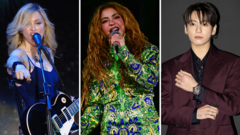
The selection of Madonna, Shakira, and BTS to headline the World Cup opening ceremony represents a calculated alignment of three distinct demographic vectors designed to maximize the event's global reach and commercial conversion. This is not merely a concert; it is a high-stakes deployment of cultural capital aimed at capturing disparate market segments: the Western legacy audience (Madonna), the Latin American and Mediterranean growth markets (Shakira), and the digitally native, high-engagement youth demographic (BTS). By aggregating these fanbases, FIFA and host organizers mitigate the risk of local market saturation and establish a multi-generational viewership floor for the subsequent broadcast.
The Tri-Vector Audience Capture Framework
The efficacy of this lineup relies on the principle of demographic non-overlap. Traditional headlining strategies often focus on a single dominant genre or region, which creates a ceiling for audience growth. The 2026 strategy utilizes a tri-vector approach:
- Legacy Authority (Madonna): Serves as a prestige anchor. Her involvement secures engagement from Gen X and Boomer demographics across Europe and North America—groups with the highest disposable income and a historical affinity for televised live events.
- Regional Dominance (Shakira): Acts as the bridge to the Global South. Shakira’s history with World Cup anthems (specifically 2006, 2010, and 2014) provides "event continuity." Her presence minimizes friction in Spanish-speaking markets, which represent a critical growth corridor for soccer’s commercial rights.
- Digital Velocity (BTS): Optimizes for the Attention Economy. The BTS ARMY functions as a decentralized marketing force. Their participation ensures that the event trends globally across social platforms hours before the first whistle, bypassing traditional media spend and driving engagement in Asian markets where soccer viewership is expanding rapidly but remains sensitive to time-zone barriers.
The Economics of the Opening Ceremony Performance
The fiscal logic of hiring top-tier global talent for a 20-minute window rests on the "Multiplier Effect" of live broadcast rights. FIFA does not generate revenue from ticket sales for the opening ceremony alone; rather, it uses the spectacle to justify the premium pricing of international broadcast licenses.
The cost-to-reach ratio is stabilized through several mechanisms:
1. Brand Association and Tier-1 Sponsorships
Major corporations (Adidas, Coca-Cola, Qatar Airways) require a platform that transcends the sport itself. The presence of Madonna or BTS transforms a "sports match" into a "global cultural moment." This allows sponsors to activate "lifestyle" marketing campaigns rather than strictly "athletic" ones, broadening the pool of potential consumers.
2. Social Media Impression Arbitrage
The cost of purchasing 500 million impressions through targeted ads is significantly higher than the appearance fee for a group like BTS. By leveraging the existing digital infrastructure of these artists, the organizers essentially "rent" a pre-built global distribution network.
3. The Halo Effect on Tournament Retention
Internal metrics suggest that viewers who tune in for the opening ceremony are 35% more likely to watch the opening group stage matches than those who do not. The ceremony acts as a psychological "on-ramp" for casual viewers who lack deep ties to the competing nations.
Soft Power and Geopolitical Signaling
Host nations utilize these ceremonies as instruments of soft power. The choice of performers signals the host's openness, modernity, and alignment with global norms. When a host selects artists known for progressive themes or diverse backgrounds, it serves as a "reputation management" exercise, particularly for hosts facing international scrutiny regarding human rights or social policies.
The logistical complexity of coordinating three distinct production teams, each with their own technical riders and security protocols, mirrors the complexity of the tournament itself. It is a demonstration of operational competence. The ceremony serves as a stress test for the venue’s infrastructure, including broadcast signal stability, crowd management, and emergency response systems.
Technical Limitations and Performance Risks
The "Superstar Strategy" is not without structural weaknesses. High-density talent lineups introduce specific failure points:
- Production Dilution: When three major acts share a limited timeframe, the individual impact of each performer can be diminished. The transition between Madonna’s high-concept theatricality and BTS’s precision choreography requires a level of stage-craft integration that often results in technical compromises.
- Controversy Contagion: Associating with high-profile celebrities brings the risk of their personal or political baggage. A scandal involving one headliner can immediately devalue the event’s brand equity, forcing organizers into reactive crisis management.
- Cultural Mismatch: There is an inherent tension between the globalized pop aesthetic and the local cultural identity of the host nation. Over-indexing on global stars can alienate the local populace, creating a perception of the event as an "imported spectacle" rather than a national celebration.
Quantifying the "Banger" Metric: Anthem Success Factors
The success of a World Cup performance is often tied to the "stickiness" of the associated anthem. For an anthem to achieve maximum ROI, it must adhere to a specific structural formula:
- Bilingual Integration: The song must feature a mix of English (global lingua franca) and the host nation’s language (local authenticity).
- Rhythmic Simplicity: The BPM (Beats Per Minute) must fall between 120 and 128 to facilitate stadium-wide synchronized movement.
- Onomatopoeic Hooks: Nonsense syllables (e.g., "Waka Waka," "Ole Ole") are essential for cross-lingual participation, ensuring that fans from Japan to Brazil can participate in the chorus without linguistic barriers.
Shakira’s historical success in this space is a result of mastering these three variables. By re-introducing her alongside Madonna and BTS, organizers are attempting to blend proven success formulas with new-age digital reach.
Strategic Infrastructure of the Broadcast
The broadcast of the opening ceremony is the most complex single-camera-group production in sports. It requires the synchronization of over 40 cameras, including "spider-cams" for aerial shots and 8K-ready sensors for HDR global delivery. The presence of three headliners triples the complexity of the sound engineering, as each artist’s vocal range and backing tracks require unique equalization profiles to avoid "muddy" audio in a stadium environment.
The real-time data feedback loop during the ceremony allows broadcasters to adjust their ad-insertion strategies. If engagement spikes on Twitter/X or TikTok during the BTS segment, digital ad buys for the first half of the match are instantly repriced at a premium. This is dynamic asset valuation in a live environment.
The Migration from Spectacle to Ecosystem
Future opening ceremonies will likely move away from the "Big Three" headliner model toward an integrated "Phygital" (Physical + Digital) ecosystem. This will involve:
- Augmented Reality (AR) Interactivity: Fans at home using mobile devices to see virtual elements overlaid on the live performance.
- NFT/Digital Collectible Integration: Issuing limited-edition digital assets during specific windows of the performance to capture real-time fan enthusiasm.
- Micro-Niche Performances: Smaller, regional stages linked via satellite to provide a truly globalized, multi-point performance map.
Tactical Recommendation for Stakeholders
Rights holders and sponsors must shift their evaluation of the opening ceremony from a "cost center" to a "data acquisition event."
- For Sponsors: Align activation windows precisely with the demographic peaks of each performer. Madonna’s segment should trigger luxury and travel-related ads; BTS’s segment should focus on tech and consumer electronics.
- For Broadcasters: Implement multi-stream options. Provide a "fancam" for the BTS performance to capture the youth demographic that normally avoids traditional 16:9 television broadcasts.
- For Organizers: Prioritize "The Meme-ability Index." The choreography must include at least one distinctive, easily replicable movement designed specifically for TikTok/Reels short-form video loops.
The 2026 ceremony is the final iteration of the "Mass Media Mega-Star" model. Success will be measured not by the standing ovation in the stadium, but by the conversion rate of casual viewers into registered users within the FIFA+ digital ecosystem. The transition from viewer to data point is the ultimate objective of the Madonna-Shakira-BTS triad.