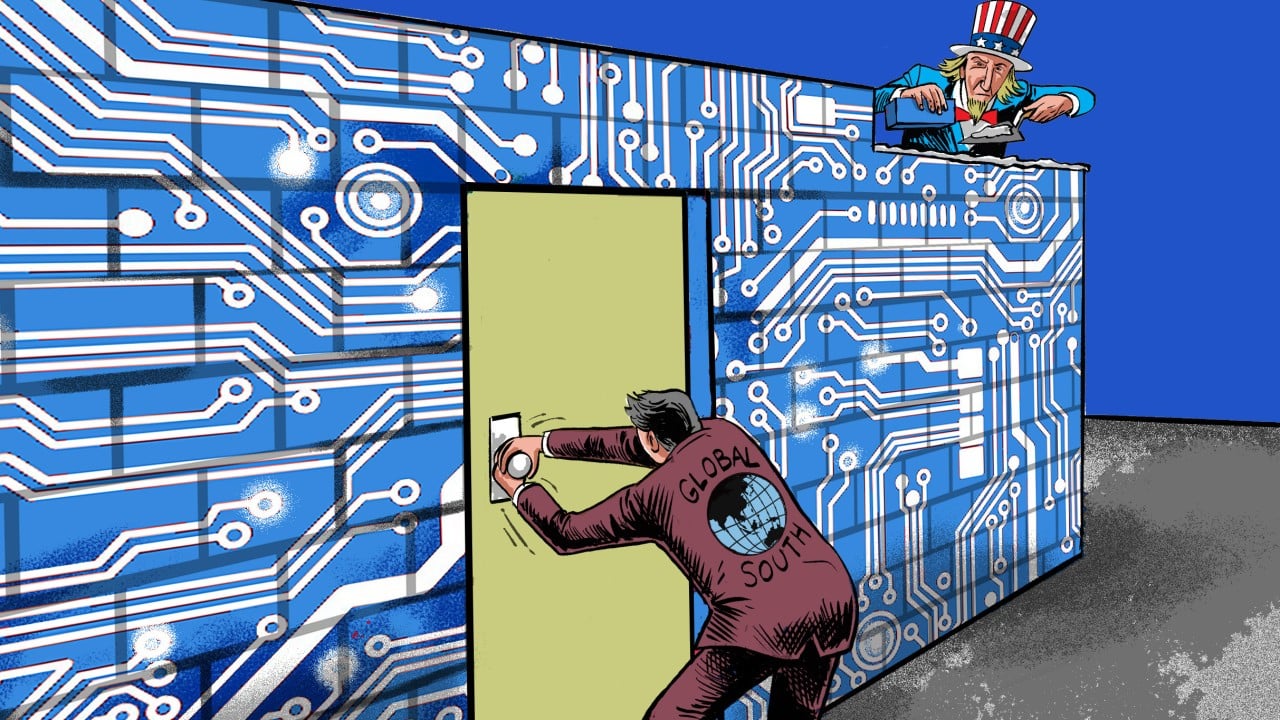
The narrative is as tired as it is predictable.
Academics and "digital sovereignty" activists claim the US tech stack is a digital noose around the neck of the developing world. They argue that Silicon Valley creates a "lock-out" effect, draining data from the Global South while selling back overpriced software. They cry "digital colonialism" and beg for local alternatives.
They are wrong. Dead wrong.
What they call a "lock-out" is actually the greatest wealth-transfer mechanism in human history. The "hegemony" of US infrastructure—AWS, Google Cloud, iOS, and the dollar-backed SaaS ecosystem—is the only reason the Global South is even in the race. Without this standardized, high-performance foundation, developing economies would be stuck building their own wheels while the rest of the world flies at Mach 2.
The real threat to the Global South isn't US dominance. It is the delusional pursuit of "technological independence" that leads to fragmented, substandard local systems that can't talk to the global market.
The Infrastructure Trap
The "lazy consensus" argues that the Global South is being exploited because it doesn't own its own underlying hardware or foundational code. This is like arguing a startup is being "exploited" because it rents an office instead of building a skyscraper.
Building a hyperscale data center isn't a matter of national pride; it’s a matter of brutal physics and even more brutal capital.
When a nation in Southeast Asia or Sub-Saharan Africa decides to "de-risk" by shunning US providers, they don't get a better product. They get a local version that is 40% slower, 100% more expensive, and infinitely less secure. I have sat in boardrooms in Lagos and Jakarta where companies burned through their Series A trying to build proprietary server stacks because they were afraid of "American overreach."
They all failed.
The smart money uses the US stack as a subsidized trampoline. By utilizing $100 billion worth of R&D from Microsoft or Amazon for a few cents an hour, a developer in Nairobi has the same compute power as a hedge fund manager in Manhattan. That isn't "locking them out." That is the total democratization of power.
The Myth of Digital Colonialism
Critics love to throw around the term "extractive." They claim US firms take data and give nothing back.
Let's look at the reality of the API economy. When a fintech app in Brazil integrates with a US-based payments processor or uses Google Maps for logistics, they aren't losing. They are skipping twenty years of infrastructure development.
The value isn't in the "data" being extracted—most of which is useless noise anyway. The value is in the abstraction.
The US has specialized in the "bottom of the stack"—the messy, expensive, low-margin stuff like operating systems, cloud storage, and foundational AI models. This leaves the "top of the stack"—the high-margin, consumer-facing, culturally specific applications—wide open for local entrepreneurs.
Look at Gojek in Indonesia or Mercado Libre in Latin America. They didn't succeed by building their own operating systems. They succeeded by being "colonized" by the US tech stack and then building brilliant, localized services on top of it. They weaponized the hegemony.
Why "Local Alternatives" are a Death Sentence
When governments try to mandate local tech, they aren't protecting their citizens. They are protecting local monopolies.
Every time a country passes a "Data Localization" law under the guise of sovereignty, the cost of doing business for local startups triples. They are forced to use expensive local cloud providers owned by the cousins of the ruling party. This is "crony tech," and it is the fastest way to kill a burgeoning ecosystem.
Sovereignty is a luxury good. Most countries can't afford it.
If you are a nation with a GDP per capita under $10,000, your goal should not be "owning the stack." Your goal should be "using the stack" to generate enough capital so that in fifty years, you might have the luxury of building your own. China did this. They didn't start by banning the world; they started by being the world's factory, learning the rules, and then—and only then—building their own walled garden.
Most of the Global South is trying to build the garden before they have the seeds.
The Open Source Fallacy
The contrarian truth about Open Source is that it doesn't actually solve the "hegemony" problem.
Activists point to Linux or Llama 3 as the "great equalizers." They argue that if the code is free, the Global South wins. This ignores the "Compute Divide."
You can have the most open, democratic AI model in the history of the world. If you don't have $500 million worth of H100 GPUs to train or fine-tune it, the code is just text on a screen.
The US "hegemony" provides the only viable path to accessing this compute. Through cloud credits and distributed systems, US firms allow the Global South to "rent" the power they could never afford to buy.
Stop Crying, Start Coding
The most dangerous lie being fed to the Global South is that they are victims of a system designed to fail them.
This victimhood mentality is a parasite. It leads to protectionist policies that drive away talent. If I am a top-tier engineer in Vietnam, and my government makes it impossible for me to use the best global tools because of "digital sovereignty" concerns, I am moving to Singapore or Palo Alto.
The "lock-out" is self-imposed.
The path to dominance isn't through resisting the US tech stack; it’s through mastering it better than the Americans do. The Indians did this with IT services. They didn't complain that the US owned the hardware; they made themselves indispensable to the software.
The Brutal Logic of Standards
History is littered with the corpses of "superior" tech that lost because it didn't follow the dominant standard.
The US tech hegemony provides a global standard. It means a developer in Lagos can write code that works in London, Lima, and Los Angeles without changing a single line. This interoperability is a gift.
When you fight the hegemony, you are fighting the ability to scale.
Imagine a scenario where every region had its own "sovereign" internet protocol. The friction would grind global trade to a halt. The Global South would be the first to starve because they rely most on the frictionless export of digital services.
The Real Hegemony is Talent, Not Tools
The obsession with "US Tech" as a boogeyman ignores the real gap: the talent pipeline.
The US doesn't dominate because it has better dirt or better laws. It dominates because it is a vacuum for the world's smartest people. Instead of trying to build a "local Facebook," governments in the Global South should be asking why their best and brightest feel the need to leave to build it.
The tools are available to everyone with an internet connection. The "lock-out" is a myth. The door is wide open, but it’s a high-performance door.
If you want to beat the US, you don't do it by building your own slower, buggier version of their tools. You do it by using their tools to build something they never saw coming.
Stop trying to fix the "imbalance" of global tech. The imbalance is where the opportunity lives. Use the infrastructure. Rent the compute. Steal the methodologies.
The hegemony isn't your cage. It’s your toolkit.
Use it or get out of the way for someone who will.