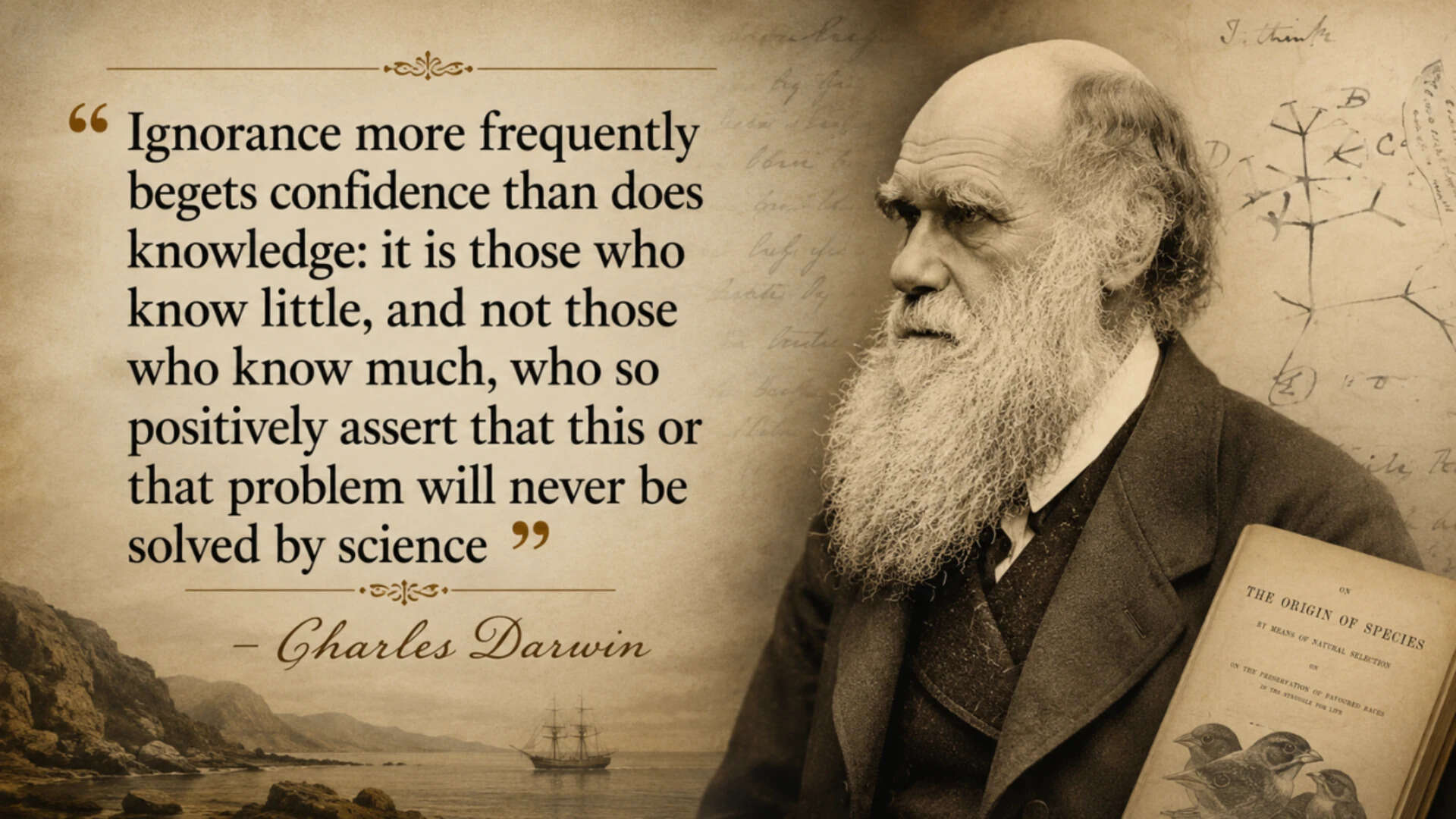
In 1871, a man sat in a dimly lit study in Kent, England, surrounded by dried specimens, stack upon stack of notebooks, and the quiet weight of a revolutionary idea. His name was Charles Darwin. He was a scientist who spent decades obsessing over barnacles, earthworms, and finches. Yet, as he penned The Descent of Man, he paused to record an observation about human nature that had nothing to do with feathers or beaks.
He wrote that ignorance more frequently begets confidence than does knowledge.
It was a sharp, almost cynical observation. But Darwin was not aiming to insult. He was observing a pattern he had seen play out across academies, pubs, and parlor rooms. The people who knew the least about a subject were almost always the first to shout their convictions from the rooftops. Meanwhile, the actual experts were trapped in a maze of caveats, nuance, and endless self-doubt.
We like to imagine that confidence is a sign of mastery. We trust the loudest voice in the room. We hire the speaker who never stutters, follow the influencer who claims to have solved every life problem, and nod along when someone offers a crisp, three-step solution to a complex geopolitical crisis.
We are dead wrong.
The Illusion of the First Step
Picture a beginner taking up chess.
In her first week, Sarah learns how the pieces move. She learns a quick opening trap. She wins three games in a row against her younger brother. Suddenly, she feels unbeatable. Chess, she decides, is simple. It is merely a matter of aggression and tactical speed. She feels a surge of absolute certainty.
Then, she joins a local club.
In her first match against a seasoned player, her aggressive opening is dismantled in six quiet, devastating moves. She looks at the board, completely bewildered. She did not even see the attack coming. In that single moment, her confidence vanishes. It drops off a cliff. She realizes that beneath the basic rules of chess lies a vast, terrifying ocean of positional strategy, endgame theory, and psychological warfare.
Psychologists eventually gave this trajectory a name: the Dunning-Kruger effect.
In 1999, researchers David Dunning and Justin Kruger published a study that confirmed what Darwin had intuited more than a century earlier. When people are incompetent in a given domain, they suffer a dual burden. First, they make mistakes. Second, and far more insidiously, they lack the very capacity needed to recognize that they are making mistakes.
They are trapped at the top of a peak built entirely on air.
The Cost of Loud Certainty
This is not just an academic curiosity. The gap between what we know and what we think we know shapes every corner of modern existence.
Consider the boardrooms where multimillion-dollar decisions are made. The most convincing executive is rarely the one with the most rigorous data. They are the one who speaks without hesitation. They offer bold predictions about market trends, dismiss risks as minor inconveniences, and sweep away complexity with magnetic charisma. The quiet analyst in the corner, who understands the volatile, unpredictable variables of the market, hesitates. They use words like "probably," "contingent upon," and "margin of error."
To a room hungry for reassurance, the analyst sounds weak. The overconfident novice sounds like a leader.
The same dynamic plays out across social media feeds every second of the day. A complex scientific discovery is flattened into a ten-second video. A nuanced economic debate is stripped down to an angry headline. The algorithms do not reward hesitation. They do not amplify the person who says, "It depends." They amplify the person who screams, "This is the absolute truth."
Ignorance moves fast because it travels light. It carries no burden of proof, no weight of contradictory evidence, and no fear of being wrong.
Knowledge is heavy. It accumulates baggage. It carries the weight of every edge case, every failed experiment, and every alternative explanation.
The Valley of Despair
If you have ever tried to master a skill, write a book, start a business, or understand a deep scientific concept, you have likely met the monster that lives in the valley.
At first, the climb is thrilling. You read one article on personal finance, and suddenly you feel like a wall street veteran. You watch a few videos on carpentry, and you are ready to build a dining table from scratch. This is the honeymoon period of learning.
Then comes the collapse.
As you dive deeper, the sheer scope of what you do not know comes crashing down. You realize that personal finance involves tax codes, risk mitigation, asset allocation, and macroeconomics. You realize that woodworking requires an intimate understanding of grain direction, moisture content, and joinery mechanics.
This is where most people quit.
When confidence plummets, it feels like failure. We assume that because we feel confused, we must be bad at the task. But confusion is not a sign of failure. It is the price of admission. It is the precise moment where superficial awareness begins to transform into real comprehension.
The true expert does not stay at the peak of easy certainty. They descend into the dark, messy valley of nuance. They spend years crawling through it, making mistakes, revising their assumptions, and slowly building a foundation made of genuine experience rather than unearned belief.
Reclaiming the Power of "I Don't Know"
We need to rewrite our relationship with doubt.
In a culture that demands instant answers, admitting that you do not know something feels like an act of cowardice. But in reality, it is the highest form of intellectual courage. It is the shield that protects us from falling under the spell of smooth-talking charlatans and dangerous oversimplifications.
When Charles Darwin proposed his theories, he did not claim to have unlocked every secret of the natural world. He spent decades agonizing over the gaps in his record. He welcomed criticism. He meticulously documented every objection to his own work before his critics could even raise them. His genius was not born from overwhelming confidence; it was forged in relentless, humble inquiry.
The next time you hear someone speak with absolute, unshakeable certainty about a complex issue, step back. Ask yourself what lies beneath that wall of confidence. Is it decades of quiet, painstaking study? Or is it simply the light, weightless air of someone who has not yet realized how deep the water really is?
Real wisdom rarely shouts. It sits quietly at the workbench, staring at the evidence, comfortable with the vastness of what remains unknown.