Silence.
When a company crosses a valuation threshold that rivals the gross domestic product of G7 nations, the air inside its headquarters stops behaving like normal air, turning instead into something dense, pressurized, and fiercely guarded by everyone who breathes it. In other developments, we also covered: The Deindustrialization of British Electric Vehicle Manufacturing.
You can feel that pressure before you even clear the lobby security desk in Santa Clara. Having spent a decade covering corporate governance and the quiet machinations of Silicon Valley boardrooms, I have walked into dozens of tech campuses during moments of acute reputational crisis, and the sensory signature never changes. The espresso machines still hiss at the exact same pitch, the glass walls still gleam under California sunlight, and engineers still shuffle between buildings wearing badges on branded lanyards—yet every eye contact lasts half a second shorter than it should, and every conversation drops an octave whenever an outsider steps near an elevator bank.
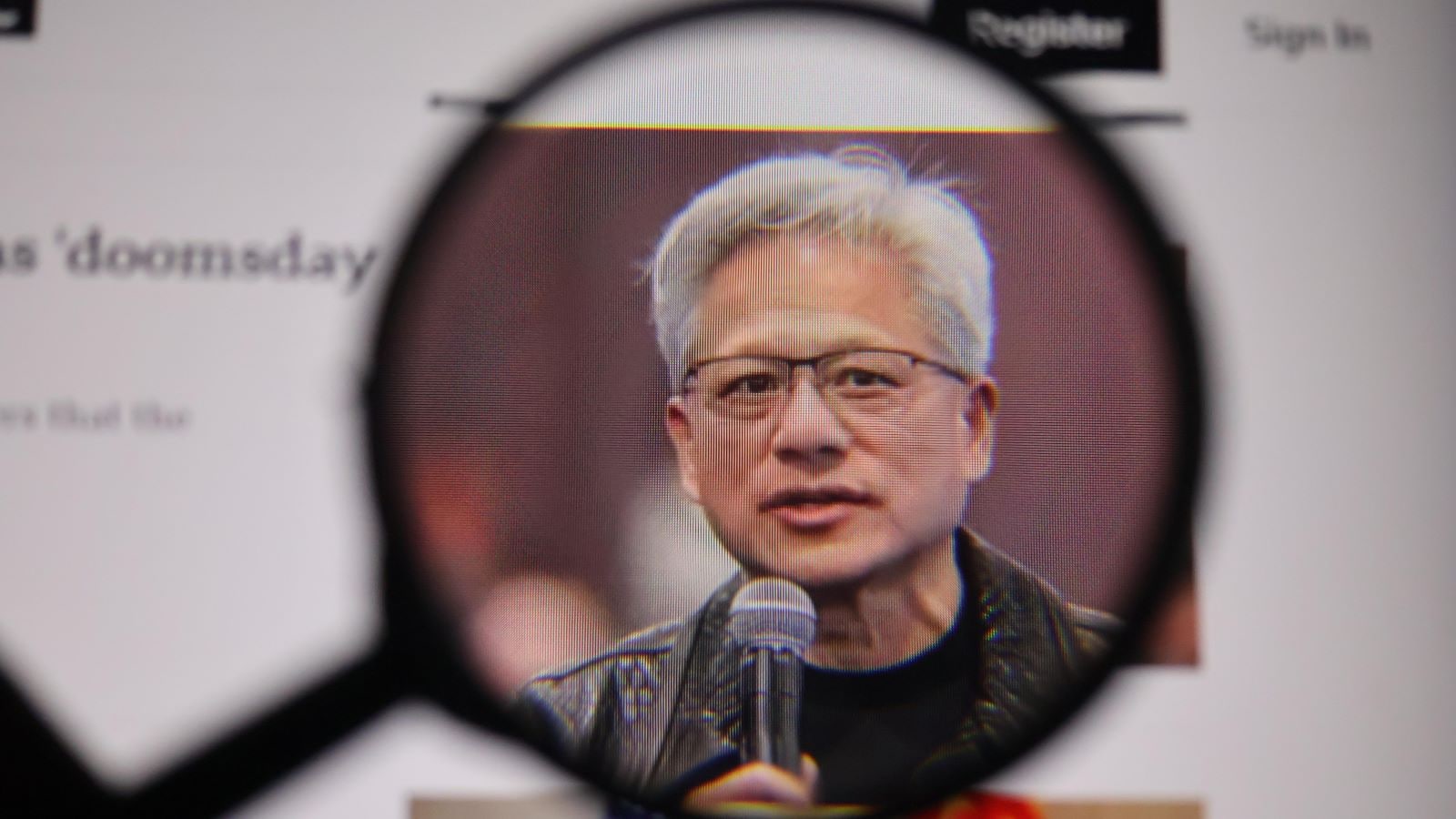
Into that pressurized atmosphere drops a simple, devastating sentence from a major financial news report alleging that Nvidia founder and chief executive Jensen Huang had a relationship with a second employee. Investopedia has also covered this critical topic in extensive detail.
Read those words again without the blinding glare of Nvidia’s stock ticker, and strip away the black leather jacket, the keynote stages, the hundreds of billions of dollars in market capitalization, and the breathless coverage of artificial intelligence chips that have turned one Taiwanese-American engineer into a generational icon. What remains is an old, deeply human collision between absolute organizational authority and personal intimacy—a collision that corporate boards spend millions trying to prevent because, once it happens, nobody inside the building can ever be entirely sure where merit ends and favoritism begins.
The Architecture of Absolute Power
To understand why a report about two workplace relationships carries such seismic weight at Nvidia, you have to understand how Nvidia actually operates, because it does not look like the sprawling, middle-management-heavy tech giants of the previous decade.
Most mega-cap corporations rely on layered bureaucracy to absorb shock, building buffers of vice presidents, regional directors, and compliance committees between the chief executive and the rank-and-file workforce. Huang famously rejected that architecture years ago, flattening Nvidia’s organizational chart until dozens of senior executives reported directly to him, and cultivating a culture built around extreme transparency, ruthless speed, and personal proximity to the founder. When the CEO sits in on granular engineering reviews, sends rapid-fire emails at midnight, and personally shapes product roadmaps from the ground up, proximity to Jensen Huang is not merely a perk of the job. It is the currency of the realm—wait, scratch that—it is the oxygen of the entire enterprise.
Consider a hypothetical scenario that illustrates how this dynamic plays out on a Tuesday afternoon inside a flat, founder-led company. Imagine a fictional senior product manager named Maya who has spent four years grinding through sixty-hour weeks to bring a next-generation networking architecture to market, watching her peers burn out while she holds her team together through supply chain bottlenecks and impossible deadlines. One afternoon, Maya walks into a closed-door budget review expecting to receive the headcount she needs to finish the project, only to discover those engineering slots have been quietly reassigned to a peer whose access to the executive suite extends beyond quarterly business reviews. Maya has no proof of impropriety, no paper trail of unfairness, and no way to audit the unspoken chemistry of the executive floor, yet she leaves that conference room carrying a poison that no human resources memo can ever extract: doubt.
Does she work harder next quarter, or does she update her resume?
Multiply Maya’s quiet disillusionment across thirty thousand employees, and you begin to see the invisible stakes behind a headline that casual readers might dismiss as corporate gossip. In knowledge-driven industries where competitive advantage depends entirely on whether the brightest minds on earth choose to stay or walk across the street to a rival lab, trust in the fairness of the promotion engine is not a soft cultural metric. It is the foundation of shareholder value.
What History Tells Us About the Corner Office
Silicon Valley loves to believe it has transcended the messy rules that govern traditional corporations, convincing itself that genius engineers operate on a higher plane where ordinary human vulnerabilities do not apply. History tells a far less flattering story.
Over the past twenty years, some of the most consequential boardroom upheavals in modern business began not with an accounting scandal or a missed earnings target, but with a revelation about a chief executive’s personal entanglement inside the building. In 2005, Boeing forced out CEO Harry Stonecipher after an internal investigation uncovered an affair with a female executive, concluding that the relationship impaired his ability to lead and compromised the company's ethical standards despite Boeing's strong financial performance at the time. A decade later, Best Buy CEO Brian Dunn resigned amid an investigation into an inappropriate relationship with a subordinate, leaving a struggling retailer rudderless during a critical turnaround. Even more famously, McDonald’s fired CEO Steve Easterbrook in 2019 over a consensual relationship with an employee, only to later sue him when investigators discovered additional undisclosed relationships and evidence that he had approved hundreds of thousands of dollars in stock grants for one of the women involved.
Look closely at the pattern connecting those cases, because it reveals a truth that corporate governance experts understand instinctively: the danger rarely lies in the romance itself. Adults meet at work, shared intensity breeds emotional attachment, and long hours spent solving hard problems together have sparked countless legitimate marriages across every industry in America—including Huang’s own marriage to his wife, Lori, whom he met as an engineering lab partner at Oregon State University decades ago.
Rather, the danger lies in asymmetry.
When one person holds the power to set compensation, allocate stock grants, shape career trajectories, and define corporate reality, consent inside the workplace becomes entangled with institutional gravity. Think of a chief executive’s authority like a massive gravitational field bending light around a star: even when the star intends no harm, everything in its orbit curves toward its mass, making it nearly impossible for anyone standing nearby to walk a straight line. A subordinate cannot simply say no without wondering what that refusal might cost in the next performance cycle, and a peer cannot watch from the sidelines without wondering whether a colleague’s rapid ascent reflects brilliance or proximity.
The Boardroom Tightrope
Which brings us to the quiet room where the real drama unfolds whenever a report like this surfaces: the board of directors.
If you have never sat through a governance committee emergency session, it is easy to imagine directors as omnipotent referees blowing whistles the moment a rule is bent, yet the reality is far messier and far more human. Independent directors at a company like Nvidia are staring at two competing realities simultaneously, and both of them are terrifying.
On one side sits the fiduciary duty to enforce consistent standards of conduct across the organization, ensuring that the rules written in the employee handbook apply just as strictly to the person whose name is on the patent filings as they do to a junior software engineer in Austin or Taipei. Most corporate codes of conduct either prohibit reporting relationships between supervisors and subordinates outright or require immediate, formal disclosure so the board can insulate reporting lines, audit compensation decisions, and eliminate conflicts of interest. When a report alleges a relationship with a second employee, directors must immediately ask a series of sharp, uncomfortable questions: Was the relationship disclosed when it began? Did a direct or indirect reporting line exist? Were compensation reviews, equity awards, or promotions audited by an independent committee? And crucially, why are we reading about a second relationship in the press?
On the other side sits the brutal math of key-person risk.
Nvidia is not a interchangeable consumer brand where one seasoned operator can smoothly replace another without missing a quarterly beat. For more than three decades, Jensen Huang has served as the company’s sole chief executive, surviving near-bankruptcy in the 1990s, betting the entire firm on parallel computing architectures long before the market understood their value, and steering Nvidia to the center of the global economy. To strip away or destabilize a founder of that magnitude over a personal matter—especially if no legal violation or coercion occurred—risks triggering a market panic that could wipe out hundreds of billions of dollars in retirement funds, pension portfolios, and institutional wealth overnight.
Pause and sit with that tension for a moment, because I will admit something that tidy business school case studies rarely confess: there is no clean, painless exit from this trap. If a board looks the other way because a founder is too valuable to discipline, it signals to every employee and regulator that rules at the top are optional, eroding the moral authority of the institution from the inside out. Yet if a board overreacts to public pressure without establishing concrete harm, it risks destroying the very engine of innovation it was elected to protect.
Beyond the Headline and the Hype
The temptation in modern financial media is to treat every revelation about a prominent founder as either a moral crusade or a meaningless distraction, reducing a complex human and institutional dilemma into partisan noise. Both reactions miss the point entirely.
What makes the report regarding Jensen Huang and a second employee worth examining closely is not prurient curiosity about a billionaire’s private life, nor is it an excuse to diminish the historic engineering achievements that built Nvidia into a computing titan. Instead, it is a rare window into what happens when a founder-led company outgrows its own informal operating system.
Startups thrive on personality, intuition, and blurred boundaries because survival requires total devotion from a small band of true believers. Great institutions, however, survive across generations only when they replace personal gravity with durable structure—clear reporting lines, transparent disclosure protocols, independent oversight, and a culture where no single individual’s favor outweighs objective performance. Every legendary founder eventually reaches a crossroads where the habits that built the empire threaten to fracture its foundation, and the hardest leadership test is never designing a faster chip or winning a larger market share.
The hardest test is proving that the rules apply to you when nobody inside the building has the power to make you follow them.
Late at night in Santa Clara, long after the commuter shuttles have emptied and the parking structures have gone quiet, the lights inside Nvidia’s triangular headquarters still burn through the glass, illuminating empty hallways where millions of lines of code and trillions of dollars of expectation rest on the judgment of one man.