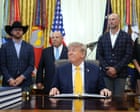
President Donald Trump signed an executive order directing the Department of the Interior to review and initiate the removal of Endangered Species Act protections for gray wolves and Mexican gray wolves. This directive puts the future of America's most contentious apex predator back in the political crosshairs. Interior Secretary Doug Burgum has a strict three-month window to formulate a recommendation on whether these populations have officially recovered enough to warrant full delisting or downlisting. At the same time, the order compels federal agencies to press individual states to repeal their own local wildlife protections while making it significantly easier for ranchers to legally kill predators caught near livestock.
The move immediately reignited a decades-long trench warfare between rural agricultural communities and wildlife conservationists. Decades ago, government-backed eradication campaigns drove gray wolves across the Lower 48 states down to a mere fraction of their historical range. Decades of intensive federal management under the Endangered Species Act successfully pulled numbers back from roughly 1,000 individuals to more than 6,000. Yet that biological recovery triggered an entirely different social and economic crisis. Western ranchers and agricultural groups argue that soaring predator populations devastate profit margins, threaten family livestock, and destroy vulnerable rural livelihoods.
The Mechanics of Federal Overreach
To understand why this executive order matters, one must look past the fiery rhetoric coming out of Washington and examine how wildlife policy actually functions on the ground. For years, federal management has collided head-on with state-level sovereignty. Proponents of the executive order, including grassroots organizations like Hunter Nation, argue that federal protections have become outdated instruments of urban overreach. They point out that in places like the Great Lakes and parts of the Northern Rockies, gray wolf numbers have vastly exceeded initial recovery goals set by biologists decades ago.
Under the current legal framework, ranchers find their hands tied by federal restrictions. Even when wolves linger near pastures or harass cattle, federal statutes impose steep criminal penalties for unauthorized lethal takings.
"You're not allowed to protect yourself, right? Or your company, your cattle," President Trump remarked during the Oval Office signing ceremony, surrounded by agricultural stakeholders sharing firsthand accounts of herd losses.
This friction exposes a profound philosophical fracture in American conservation. Is wildlife a national trust managed by federal scientists, or is it a local resource managed by the people who share a fence line with it? By directing federal departments to streamline lethal removal standards and urge states to drop their own shields, the executive order attempts to shift the balance of power decisively toward rural landowners.
The Biological Reality and the Courtroom Horizon
Environmental advocates view the administration's directive through an entirely different lens. Groups like the Center for Biological Diversity and the Sierra Club argue that targeting gray wolves is a transparent political distraction. They note that subspecies like the Mexican gray wolf still hover at fragile numbers—totalling roughly 317 individuals in the wild—and continue to face severe genetic bottlenecks. Weakening federal oversight now, conservationists warn, risks undoing generations of careful scientific work.
Furthermore, the legal landscape makes any rapid administrative exit nearly impossible. Previous attempts to strip protections face chronic gridlock in the courts. When the Trump administration previously delisted gray wolves across the Lower 48 states in 2020, a federal judge formally vacated the rule less than two years later. Environmental litigators are already preparing fresh injunctions, arguing that political pressure is replacing empirical science in violation of federal statute.
The three-month timeline given to Secretary Burgum guarantees that this fight will shift instantly from the Oval Office to the federal judiciary. As long as urban-rural divides dictate how Americans view the wilderness, the gray wolf will remain trapped between biological success and perpetual legal warfare.


