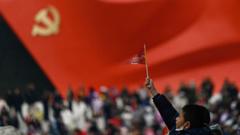
The air in Beijing during early March has a specific, sharp clarity. It is the kind of cold that clings to the wool of overcoats and makes the red flags over Tiananmen Square snap with a sound like rhythmic whip-cracks. Inside the Great Hall of the People, the silence is different. It is heavy. It is the silence of five thousand people waiting for a single voice to set the pulse of a nation.
This is the "Lianghui," or the Two Sessions. To a casual observer scrolling through a news feed, it looks like a sea of dark suits and synchronized tea-pouring. But look closer. Look at the hands of a delegate from a rural village in Yunnan, calloused from decades of tobacco farming, resting on a polished mahogany desk next to the manicured hands of a tech billionaire from Shenzhen. This is the only moment in the calendar where the granular struggles of the Chinese countryside collide head-on with the cold calculations of the state.
The Two Sessions are not a singular event, but a twin engine. On one side, you have the National People’s Congress (NPC), the highest organ of state power. On the other, the Chinese People’s Political Consultative Conference (CPPCC), an advisory body meant to represent the diverse "circles" of society—scientists, artists, religious leaders, and entrepreneurs. Together, they function as the grand reveal of China's annual roadmap.
The Number That Governs Lives
Every year, a number is released during the Government Work Report that dictates the fate of millions. It is the GDP growth target. While economists in London or New York debate this figure as a dry statistic, for a young graduate in Chongqing, that number is the difference between a career in engineering and a stint delivering packages on an electric scooter.
When the Premier stands at the lectern, the room holds its breath for that percentage. A target of "around 5%" isn't just a projection; it is a promise of stability. It signals how much credit will flow into the veins of the economy, how many new subway lines will be carved into the earth, and whether the property market—the place where most Chinese families store their life savings—will be allowed to breathe or be held in a tight, regulatory grip.
Imagine a father in a third-tier city who has spent twenty years saving for his daughter’s dowry. He doesn't read the 30,000-word report. He watches the evening news to see the tone. Is it confident? Is it cautious? The "Two Sessions" is the theater of certainty in an uncertain world.
The Shift to the "New Productive Forces"
There is a new phrase echoing through the high-ceilinged corridors this year. It sounds clinical: "New Productive Forces." But the reality is a frantic, high-stakes race for survival.
For decades, China’s engine was fueled by sweat, concrete, and steel. Now, the blueprint has changed. The focus has pivoted toward what the leadership calls "high-quality development." This means a shift toward the invisible. Quantum computing. Artificial intelligence. Green hydrogen. The manufacturing of things that the rest of the world hasn't even realized it needs yet.
This isn't just a business strategy; it is a geopolitical shield. As trade barriers rise and "de-risking" becomes the buzzword in Western capitals, the Two Sessions serves as the moment China doubles down on self-reliance. When the delegates discuss the "digital economy," they are talking about building a fortress. They are ensuring that if the world turns off the taps of technology, China has its own well to draw from.
The Ghost at the Table: The Demographic Debt
Despite the choreographed unity, there is a quiet anxiety that no amount of red carpet can hide. It is the demographic shift. For the first time in generations, the population is shrinking.
In the hallways between sessions, delegates from the health and education sectors pitch ideas to solve a puzzle that has stumped the smartest minds in Beijing: How do you convince a generation of overworked, cynical young people to have children?
The proposals vary. Some suggest tax breaks; others argue for better childcare. But the underlying tension is palpable. The social contract of the last forty years was built on an endless supply of young labor. Now, that labor is becoming expensive and scarce. The Two Sessions must address the reality that the "World's Factory" is graying at the temples.
The Invisible Stakes of the Budget
While the speeches grab the headlines, the real story is in the ledger. The defense budget usually sees a steady climb, a reflection of a world that feels increasingly hostile. But keep your eyes on the "Social Security and Employment" line item.
As the property sector—once the golden goose of local government revenue—continues to wobble, the central government is forced to step in. The Two Sessions is where the bill comes due. It is where the leadership decides which provinces get a lifeline and which ones must tighten their belts. It is a massive, national-scale balancing act between keeping the military strong and keeping the elderly fed.
Consider the local official in a province like Heilongjiang, where the "Rust Belt" reality has set in. For them, the Two Sessions is a plea for relevance. They need the central government to see them, to fund them, and to include them in the new vision of a high-tech future.
The Weight of the "Two Establishes"
To understand the political gravity of the room, one must understand the consolidation of power. The Two Sessions has increasingly become a venue to reinforce the "Two Establishes," a political shorthand for the central authority of Xi Jinping.
In years past, there might have been more public debate or "clashing of the cymbals" between different factions. Today, the harmony is absolute. This unity is presented as China’s greatest strength—a "whole-process people’s democracy" that moves with a singular will, contrasting it with the perceived chaos and gridlock of Western parliaments.
But unity carries its own kind of pressure. When there is only one captain, the entire crew watches the compass with an intensity that borders on the religious. Every word in the work report is parsed for "pivotal" shifts in direction. A single adjective change regarding Taiwan or the South China Sea can send ripples through the Pentagon and global shipping markets.
The Human Scale of the Grand Design
It is easy to get lost in the scale of it all. Five thousand delegates. A nation of 1.4 billion. Trillions of yuan.
But the Two Sessions eventually ends. The delegates pack their bags, leave the Great Hall, and vanish back into the vastness of China. They take the "spirit" of the meetings with them.
A schoolteacher returns to a mountain village with a promise of new digital textbooks. A factory owner in Zhejiang goes back to his shop floor knowing he must pivot to electric vehicle parts or face obsolescence. A scientist in an elite lab in Beijing receives the green light to push deeper into the mysteries of semiconductors.
The true impact of these meetings isn't found in the applause that echoes in the Great Hall. It is found weeks later, in the quiet conversations in provincial bank offices and on the bustling floors of tech incubators. It is found in the way a nation of a billion people collectively pivots its foot to face a new direction.
The red sun sets over the Forbidden City, casting long, dark shadows across the stone. The meetings conclude, the documents are filed, and the grand roadmap is set. The world watches the headlines, but the people of China watch the horizon, waiting to see if the promises made in the silence of the Great Hall will actually reach the kitchen tables of the millions who live in its shadow.
The machine has been tuned. The gears are turning. Now comes the long, hard work of moving a mountain, one inch at a time.