Europe is on the verge of choking its own green transition to death, blinded by a moral panic over forever chemicals.
Activists and sensationalist headlines are screaming that heat pumps and air conditioning systems are the primary source of PFAS (per- and polyfluoroalkyl substances) emissions on the continent. They want you to believe that the very machines meant to save us from climate catastrophe are poisoning our groundwater instead. Recently making headlines recently: The AI Sovereign Wealth Illusion and the Battle for Corporate Capture.
It is a neat, terrifying narrative. It is also fundamentally wrong.
This hyper-fixation on fluorinated greenhouse gases (F-gases) in HVAC systems misses the forest for the trees. By treating the refrigerants inside heat pumps as an immediate environmental execution sentence, regulators are preparing to pass sweeping bans that will ironically lock in millions of tons of carbon emissions for decades to come. Additional information regarding the matter are explored by The Verge.
We are trading a highly localized, manageable chemical containment challenge for a global atmospheric disaster.
The Containment Fallacy: Refrigerant is Not Teflon
The mainstream argument relies on a lazy conflation. Critics look at the sheer volume of F-gases used in heating and cooling and equate them directly to the PFAS found in non-stick frying pans, waterproof jackets, and firefighting foams.
There is a massive structural difference they ignore: containment.
When you buy a rain jacket coated in PFAS, those chemicals slough off into the environment every time it rains or goes through the wash. When a firefighter deploys aqueous film-forming foam, those chemicals go straight into the soil.
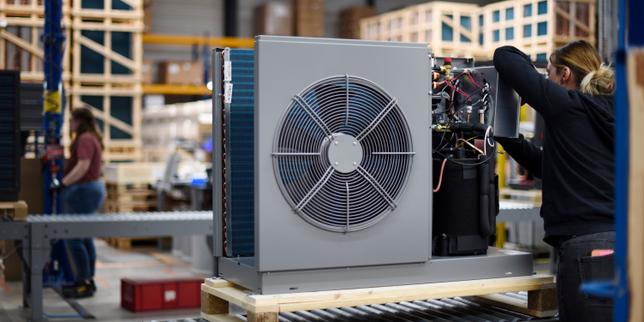
A heat pump is not a consumer consumable. It is a hermetically sealed, closed-loop industrial mechanism.
[Closed-loop Heat Pump Cycle]
Evaporator (Absorbs Heat) -> Compressor -> Condenser (Releases Heat) -> Expansion Valve
In a properly installed and maintained system, the refrigerant never touches the outside world. It circulates through copper pipes, changing phase from liquid to gas and back again, doing its job for fifteen to twenty years.
I have spent years auditing commercial building operations and reviewing mechanical lifecycles. Do systems leak? Yes, occasionally. But the industry standard leakage rate for modern, factory-sealed residential monobloc heat pumps is under 1% per year. The idea that these machines are actively pumping a steady stream of toxins into European rivers during their operational life is a mechanical lie.
The real issue isn't the technology; it’s the end-of-life disposal and the scrap-metal cowboys who cut lines instead of recovering gas. We don't need a chemical ban. We need brutal enforcement of recovery mandates.
The Propane Delusion
The popular counter-move pushed by NGOs is to force an immediate shift to "natural refrigerants" like propane (R290) or carbon dioxide (R744).
It sounds beautifully organic. It is a thermodynamic nightmare in reality.
Propane is highly flammable. To use it safely in high-capacity systems or indoor applications, you face strict charge-limit regulations. You cannot simply drop propane into an existing multi-family apartment building's HVAC infrastructure without triggering a cascade of fire safety codes, expensive architectural retrofits, and specialized installation requirements.
If we ban synthetic refrigerants tomorrow, we hit a hard thermodynamic wall:
- Lower Efficiency in Retrofits: Natural alternatives often require higher operating pressures or specific temperature deltas to match the efficiency of synthetic blends. In older European building stocks with traditional radiators, forcing a natural refrigerant can drop the system's Coefficient of Performance (COP) significantly.
- The Labor Bottleneck: Europe already lacks hundreds of thousands of certified HVAC technicians. Asking an entire workforce to overnight switch from handling non-toxic, non-flammable synthetics to explosive gases requires massive retraining.
- The Slowdown: If you make installations harder, more expensive, and legally fraught, deployments stall.
Imagine a scenario where a landlord wants to replace an old gas boiler. Under current rules, a standard synthetic heat pump goes in over a weekend. Under a draconian PFAS ban, the propane alternative requires external structural compliance, upgraded venting, and a specialized crew that is booked out for six months.
The landlord sighs, patches up the old gas boiler, and keeps burning fossil fuels for another ten years. That is the real-world consequence of ideological purity.
Dismantling the F-Gas Premise
Let’s look at the actual data driving the European Chemicals Agency (ECHA) proposals.
The REACH restriction dossier aims to eliminate a massive basket of thousands of substances under the PFAS umbrella. It bundles ultra-short-chain F-gases like R134a, R32, and HFOs (hydrofluoroolefins) like R1234yf into the same regulatory bucket as legacy toxins like PFOA.
But HFOs break down in the atmosphere into trifluoroacetic acid (TFA). This is the core weapon used by the anti-heat-pump lobby. They argue that TFA accumulates in rainwater and poses a long-term risk.
What they deliberately leave out of their press releases is the scale of comparison.
According to atmospheric research models, even if Europe fully electrified its heating footprint using HFOs, the resulting TFA concentrations in surface waters would remain orders of magnitude below any known threshold of eco-toxicity. Meanwhile, the burning of coal, oil, and gas releases a toxic cocktail of particulate matter, mercury, and sulfur dioxide that kills hundreds of thousands of Europeans prematurely every single year.
To delay the displacement of fossil-fueled heating out of fear of trace TFA accumulation is a profound failure of risk management. It is choosing a hypothetical, long-term ecological footnote over a clear, present, and deadly climate reality.
The Carbon Penalty Nobody Wants to Calculate
Let’s do the brutal math that the regulators avoid.
Heating and cooling account for roughly half of Europe’s energy consumption. The vast majority of that is still supplied by natural gas and oil. Every day a building remains hooked to a boiler because a green alternative was deemed too chemically complex, carbon floods the atmosphere.
+-------------------------+-----------------------------------+-----------------------------------+
| Metric                  | Synthetic Refrigerant Heat Pump   | Legacy Gas Boiler Retrofit        |
+-------------------------+-----------------------------------+-----------------------------------+
| Direct Emission Risk    | Minimal (Closed-loop containment) | Continuous CO2 and NOx venting    |
| Operational Efficiency  | High COP (Even in low ambients)  | Fixed sub-100% thermal efficiency |
| Supply Chain Readiness  | Mature, scalable immediately      | Declining, carbon-intensive       |
+-------------------------+-----------------------------------+-----------------------------------+
If Europe chokes the heat pump supply chain by banning hydrofluorolefins (HFOs) and certain hydrofluorocarbons (HFCs) before natural alternatives reach manufacturing parity, the continent will fail its 2030 climate targets. Period.
The manufacturing lines for these machines cannot be re-engineered on a dime. Component suppliers—compressor manufacturers, valve makers, electronics providers—operate on five-to-ten-year development cycles. A sudden, sweeping ban creates industrial paralysis.
I have seen manufacturing executives look at these shifting regulatory goalposts and simply freeze capital expenditure. Why invest fifty million euros in a new European heat pump assembly plant if the core chemical required to make it run efficiently might be illegal by the time the factory opens?
The capital flights to friendlier markets. The factories don't get built. The coal plants stay online.
Fix the Infrastructure, Not the Chemistry
The path forward isn't an outright ban that breaks the tools we need to survive. It is an aggressive, unglamorous focus on lifecycle accountability.
If we want to stop PFAS and F-gases from entering the environment, we don't outlaw the molecules; we outlaw the negligence.
- Digital Refrigerant Passports: Every single kilogram of synthetic refrigerant produced should be tracked via a decentralized digital ledger from the factory floor to the recycling cylinder. If a machine is decommissioned and its gas isn't legally accounted for, the installing company faces existential fines.
- Mandatory Hermetic Architectures: Regulators should mandate factory-sealed monobloc systems for residential use, heavily restricting split-systems that require field-charging and flare connections, which are the primary source of installation leaks.
- Subsidized Recovery Networks: Make returning used refrigerant highly profitable for technicians. If a canister of recovered R32 is worth more than a tank of gas, no technician will ever vent it into the atmosphere behind a building again.
Stop trying to fix the climate crisis with a bureaucratic sledgehammer that smashes our best defense mechanisms. The panic over heat pumps as an environmental hazard is a supreme distraction manufactured by a combination of well-meaning but thermodynamically illiterate activists and a fossil fuel lobby that loves nothing more than seeing its successor technology tripped up at the finish line.
The atmosphere does not care about our chemical purity tests if the planet burns in the process. Switch off the outrage machine, build the factories, and install the pumps.