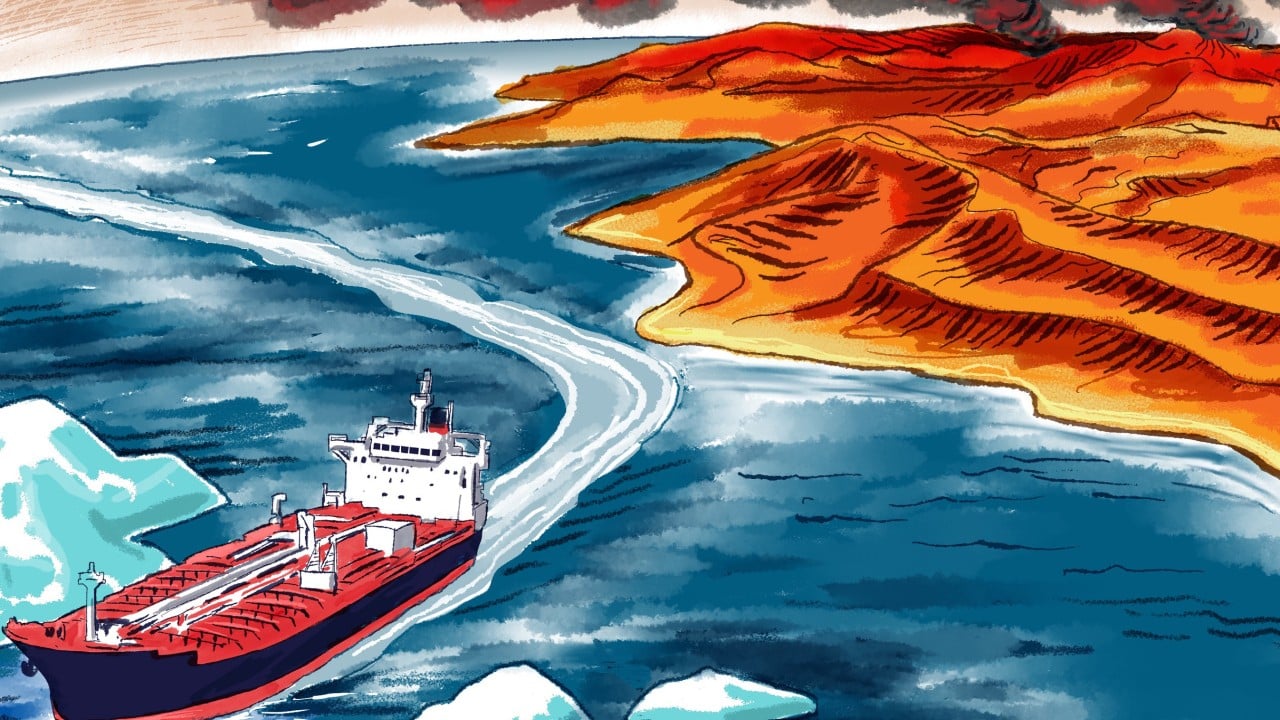
The traditional map of global trade is burning at the edges. For decades, the maritime industry operated on a simple, rigid geometry centered on the Suez Canal. That certainty evaporated the moment missiles began targeting commercial tankers in the Red Sea. While the world watches the immediate humanitarian and military crises in the Middle East, a colder, more calculated shift is happening in the high north. The Arctic is no longer a speculative frontier for the distant future. It has become the immediate, high-stakes fallback for a global economy that can no longer rely on the stability of the Mediterranean-Red Sea corridor.
This is not just about avoiding conflict zones. It is a fundamental recalculation of geopolitical risk. When the cost of insurance for a Red Sea transit spikes by 1,000 percent in a single month, the logistical "math" of the planet changes. The Northern Sea Route (NSR) and the Northwest Passage, once dismissed as icy graveyards or environmental pipedreams, are being rebranded as the only viable insurance policies for the West’s supply chains.
The Suez Vulnerability and the Arctic Math
The Suez Canal handles roughly 12 percent of global trade. That volume represents a massive, concentrated point of failure. When the Ever Given blocked the canal in 2021, it was an accident. Today’s disruptions are intentional, geopolitical, and seemingly indefinite. Shipping giants like Maersk and Hapag-Lloyd have spent months rerouting vessels around the Cape of Good Hope, adding 10 to 14 days to every journey and burning millions in extra fuel.
Now consider the Arctic alternative. A voyage from East Asia to Northern Europe via the Northern Sea Route is approximately 40 percent shorter than the route through the Suez. We are talking about a reduction from 21,000 kilometers to roughly 12,800 kilometers. In a world of carbon taxes and skyrocketing fuel prices, those 8,000 saved kilometers represent more than just time. They represent a structural advantage that is becoming impossible for boardrooms to ignore.
The "Arctic windfall" isn't just about shorter distances. It is about the sudden, desperate realization that the world’s most critical trade artery has a "kill switch" controlled by regional instability.
Russia's Cold Monopoly and the Western Dilemma
The most uncomfortable truth in this shift is the identity of the gatekeeper. Russia controls the vast majority of the Northern Sea Route. While the West has spent years trying to isolate the Kremlin through sanctions, the chaos in the Middle East has inadvertently handed Vladimir Putin his most powerful economic lever since the discovery of Siberian natural gas.
Russia is not just waiting for the ice to melt. They are actively building the world's most sophisticated fleet of nuclear-powered icebreakers. These ships are the heavy machinery of a new era, designed to keep the NSR open year-round. This creates a massive ethical and strategic friction point for Western corporations. Do they continue to pay the "instability tax" of the long route around Africa, or do they pay the "geopolitical tax" of navigating through Russian-controlled waters?
The data suggests the shift is already underway. Transit requests for the NSR have hit record highs, driven by a mix of Chinese demand and energy companies looking for a way to move liquefied natural gas (LNG) without passing through the Persian Gulf or the Red Sea.
The Hidden Players in the Arctic Gold Rush
While headlines focus on shipping lanes, the real money is moving into subsea infrastructure and mineral extraction. The instability in the Middle East has accelerated the search for "secure" sources of energy and rare earth metals. The Arctic holds an estimated 13 percent of the world’s undiscovered oil and 30 percent of its unmapped natural gas.
More importantly, the region is rich in the materials required for the energy transition. Cobalt, nickel, and copper are buried beneath the permafrost and the shallow continental shelves. If the Middle East is the world’s gas station, the Arctic is becoming its battery factory. This has triggered a quiet but aggressive land grab involving not just Arctic nations, but "near-Arctic" states like China, which officially declared itself a stakeholder in the region's future.
Infrastructure at the Edge of the World
To turn the Arctic into a viable trade corridor, trillions of dollars must be spent on infrastructure that can survive some of the harshest conditions on Earth. We are seeing a surge in investment for:
- Deep-water ports in locations like Kirkenes, Norway, and Nome, Alaska.
- Satellite communication arrays to provide high-speed data in latitudes where traditional geostationary satellites fail.
- Subsea fiber-optic cables that promise to link London and Tokyo with lower latency than ever before.
This isn't just theory. The "Polar Connect" projects are being fast-tracked because the traditional cables—many of which run through the Suez or the South China Sea—are increasingly seen as vulnerable to sabotage or regional war.
The Environmental Cost of Reliability
There is a dark irony in this transition. The very climate change that is melting the polar ice caps is what makes this "windfall" possible. As the ice thins, the cost of doing business in the north drops. However, the environmental risks are catastrophic. An oil spill in the Arctic would be nearly impossible to clean up compared to one in the Gulf of Mexico. The cold slows down the biological breakdown of hydrocarbons, and the lack of local infrastructure means a response team could take days or weeks to arrive.
The maritime industry is currently engaged in a massive greenwashing exercise, claiming that shorter routes mean lower total emissions. While the math on fuel consumption checks out, the introduction of heavy fuel oil soot—black carbon—onto the white ice of the north accelerates melting even further. It is a feedback loop that the industry is happy to ignore as long as the Red Sea remains a no-go zone.
Sovereignty and the New Cold War
The Arctic has long been a place of "High North, Low Tension." That era is over. The influx of commercial value has inevitably brought a military presence. NATO is expanding its footprint in the Scandinavian north, and Russia is refurbishing Soviet-era bases from the Kola Peninsula to the Bering Strait.
The conflict in the Middle East acted as the catalyst, but the result is a permanent shift in how sovereign power is projected. We are moving toward a bipolar maritime world. One side is the old, contested southern route; the other is the new, icy northern corridor where the rules of the game are still being written.
The Insurance Industry as the Ultimate Arbiter
If you want to know where the Arctic windfall is actually going, look at the insurance premiums. London-based underwriters are the ones who will ultimately decide the fate of the Northern Sea Route. Currently, the lack of standardized search-and-rescue protocols and the unpredictability of "growlers"—small, ship-sinking ice chunks—make Arctic insurance expensive.
But as the Red Sea stays "hot" with kinetic conflict, the "cold" risks of the Arctic start to look manageable by comparison. We are approaching a tipping point where the Arctic becomes the cheaper option for high-value cargo, even with the specialized hulls and ice-pilot requirements.
Beyond the Suez
The Suez Canal will not disappear, but its monopoly on the flow of goods between East and West is broken. The "Arctic windfall" is not a temporary spike in value; it is the birth of a secondary global nervous system. This transition is being funded by the chaos in the Middle East and accelerated by a desperate need for shorter, more secure supply chains.
The real winners won't just be the shipping companies that save five days on a voyage. The winners will be the nations that control the ports, the cables, and the icebreakers. For the first time in modern history, the center of gravity for global trade is moving toward the pole.
Companies should stop treating their Arctic strategy as a "long-term" project and start treating it as a current operational necessity. The ice is melting, the missiles are flying, and the map of the world is being redrawn in real-time. If you aren't looking at the North, you aren't looking at the future of business.
Start by auditing your supply chain's dependence on the Bab al-Mandab Strait and begin the process of vetting ice-class carrier partnerships for the 2027 season.


