The silt remembers what the rain forgets.
For months, the old men sitting by the wooden piers in Cernavodă had watched the mudbanks spread. They spat into the water and muttered about the old days, when the current ran deep enough to swallow a boat whole, when the great blue artery of Europe roared instead of whimpering. They saw the exposed stones. They smelled the stagnant breath of the shallows. But nobody expected the hum to die. Building on this theme, you can also read: Economic Leverage and State Violence The Strategic Anatomy of Trade Sanction Campaigns.
Nuclear reactors do not care about poetry. They care about physics. And physics demands an ocean of cold, relentless blood to keep from consuming itself.
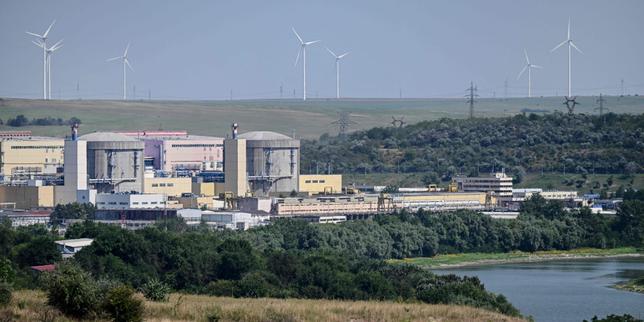
On a gray Tuesday, the heavy gray doors of Romania’s sole nuclear power plant clicked shut on their primary circuits. Unit 1. Then Unit 2. Two billion watts of steady, invisible energy—roughly a fifth of an entire nation's heartbeat—snapped off. Not because of a cyberattack. Not because of a cracked pipe or a rogue politician's decree. Analysts at BBC News have provided expertise on this matter.
The river simply ran out of breath.
The Thirst of the Atomic Beast
Imagine standing inside the turbine hall of Cernavodă. The scale is biblical. Massive steel rotors spin in a deafening symphony of industrial might, generating electricity that travels across thousands of miles of humming aluminum arteries to light kitchens, power hospitals, and spin the hard drives of a modern economy.
That symphony requires a sacrifice. To turn heat into electricity, you must reject heat. You must steal millions of gallons of cold water every single minute, pass it through condensers to cool the steam back into liquid, and return it slightly warmer to the source. It is an unyielding biological demand disguised as mechanical engineering. The reactor is a living organism with a fever, and the Danube is its only IV drip.
By late summer, that drip slowed to a cruel trickle.
Consider a hypothetical control room operator, a man named Mihai who has spent twenty-five years watching green digital readouts flicker against the dim panels. Let us call him a stand-in for the dozens of engineers whose stomachs dropped that morning. Mihai watches the intake temperature gauges creep upward. He watches the level sensors in the cooling basins hover near the red line. The mathematical models are unforgiving. If the river drops below a critical threshold, the intake pumps will suck air instead of water. The core will overheat. The fuel assemblies will buckle.
There is no heroics here. There is only a red button and a legal mandate.
When the river cannot drink, the lights must go out.
The Invisible Stakes
We treat electricity like oxygen. We breathe it in through our walls, our pockets, our dashboards, completely unaware of its presence until it is yanked away. We forget that every kilowatt-hour is tied to a physical reality.
When Cernavodă went dark, the shockwave was not immediate panic in the streets. Modern grids are resilient, spliced together with cross-border safety nets, emergency coal reserves, and sudden imports from neighboring states scrambling to patch the leak. Power was rerouted. Factories adjusted shifts. Households barely noticed the switch.
That is the terrifying part.
We have built a civilization so deeply insulated from nature that a river can fail, a nuclear colossus can fall silent, and the average citizen can keep scrolling on their phone without missing a beat. The crisis is masked by invisible wires and market arbitrage.
But the bill always comes due.
When a base-load nuclear plant drops off the grid, the void must be filled by something else. Often, that something else burns gas or coal, undoing months of carbon targets in a single afternoon. Or worse, it leaves the grid teetering on a knife-edge, vulnerable to the next heatwave, the next drought, the next fractured climate pattern.
We look at climate change as an abstract graph of parts per million. We watch polar ice caps melt on YouTube. We nod gravely at summit declarations in air-conditioned rooms thousands of miles away.
We do not think about the mud in the Danube. We do not think about an intake pipe gasping for water beneath a blistering July sun.
The Mirror in the Shallows
I remember standing by the Rhine during the great European drought a few years back. The smell of rotting algae hung heavy in the air, thick enough to chew. Cargo barges sat stranded in the middle of the channel, their hulls resting helplessly on dry earth like stranded whales. People took selfies. Tourists laughed.
Underneath the amusement, there was a quiet, paralyzing horror.
We are tethered to systems designed for a world that no longer exists. Every dam, every nuclear plant, every hydroelectric turbine, every municipal water treatment facility was engineered using historical hydrological data from a century of relative climate stability. Those blueprints assume the river will return. They assume the snowpacks in the Alps will melt on schedule. They assume the sky will keep its bargains.
The sky is breaking its bargains.
When Romania shut down Cernavodă, it was not an isolated incident. It was a warning shot across the bow of the global energy transition. We talk endlessly about building more reactors, expanding our grids, electrifying everything. We debate the politics of uranium versus wind, coal versus solar.
Yet we rarely ask the most fundamental question of all.
What happens when the water runs out?
The Final Reckoning
The river will rise again. Autumn rains will come. Melting snows will swell the Danube, and the great turbines of Cernavodă will spin back to life, humming their deep, steady song beneath the Romanian plains. The green lights will return to the control panels. Mihai will sip his coffee and watch the numbers stabilize.
Life will resume its comfortable illusion of permanence.
Step outside tonight and listen to the hum of the transformer down the street. Touch the warm plastic of the charger in your wall. Behind that simple, mundane act lies a fragile, desperate truce between human ambition and the erratic, fading memory of the natural world.
The river is watching. And the gauges are still ticking.