Dawn arrives differently when you are holding yesterday's history in your hands. The paper is cold. The ink is dark enough to stain a thumb if you press too hard. Years ago, before screens turned everything into a flat, glowing pane of glass, that stain was a badge of honor. It meant you had touched the world before the world had finished happening.
We forget the weight of things. We trade substance for speed.
Consider the daily ritual of the front page. Editors used to sit in smoke-tinted rooms, shouting over typewriters, trying to capture the singular heartbeat of a twenty-four-hour span. They had to choose. They had to decide whether the fall of a government mattered more than a miracle in a local hospital, or whether a photograph of a bruised earth could stop a commuter on a crowded train.
Today, the headlines arrive like shrapnel. A notification buzzes in a pocket. A banner flashes across a monitor. We skim, we swipe, we scroll. The news becomes an endless grey smear of crisis and distraction, digested in seconds and forgotten before the coffee cools.
Yet, every so often, a front page appears that halts the rotation.
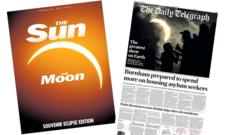
Look back at the timeless weight of newspaper front pages, specifically those unforgettable days when the British press captures the national mood. In newsrooms across Fleet Street or its modern successors, front pages like "The Sun, the Moon" and "The greatest show on Earth" do something extraordinary. They refuse to be mere conveyors of data. They become theater. They become poetry. They become mirrors held up to a society that desperately needs to see its own face, laughing, crying, or staring in sheer disbelief.
Imagine standing on a cold London pavement in the damp morning hours of 1999. The millennium is gasping its final breaths. People are nervous, exhilarated, and slightly terrified of what the digital clock change might bring. The front pages of the tabloids and broadsheets that morning did not just report solar eclipses or royal spectacles with dry bullet points. They framed the cosmos as a daily drama. They treated the movement of celestial bodies and the grand pageantry of human ambition as chapters in an ongoing epic.
That is the missing element in our modern digital feeds.
We have optimized the distribution of facts to the point of absolute starvation. We know the temperature in degrees Celsius to two decimal places. We know the stock market fluctuations down to the microsecond. But we have stripped away the narrative arc. We have forgotten that human beings do not run on data. We run on meaning.
To understand why a great front page matters, you have to look past the ink and examine the psychology of shared attention. When millions of people wake up to the exact same striking headline, the exact same provocative image, an invisible thread knits them together. On the bus, at the corner shop, across the office water cooler, strangers suddenly share a vocabulary. They have a shared reference point for wonder or outrage.
The digital age promised hyper-personalization. It promised that every individual could curate a bespoke reality tailored precisely to their tastes.
It worked.
And it nearly broke us.
When everyone lives inside their own custom-built information bubble, the center cannot hold. We stop looking at the same monuments. We stop arguing about the same focal points. The grand cultural tent collapses into a million isolated pup tents, each occupant shouting into a void of their own creation.
This is why looking back at iconic front pages feels like visiting an archaeological site of a lost civilization. It reminds us of what collective focus looks like.
Take the phrase "The greatest show on Earth." It is a grandiose claim. It evokes sawdust, roaring lions, trapeze artists defying gravity under a canvas tent, and the collective intake of breath from a thousand children pointing upward. When applied to the news—whether celebrating a monumental sporting victory, a royal milestone, or a breathtaking scientific breakthrough—it transforms the mundane churn of daily existence into spectacle.
Life is hard. Bills pile up. Trains run late. Governments stumble. If the news is nothing more than a relentless catalog of human misery and administrative failure, people eventually tune out. Compassion fatigue sets in. The mind builds a wall.
Great journalism understands this psychological defense mechanism. It knows that to reach the heart, it must sometimes bypass the brain's defense systems through wit, scale, beauty, or audacious theater.
Think about the sheer audacity required to place the moon and the sun on a front page and treat them like characters in a drama. Nature becomes a protagonist. The cosmos is invited into the kitchen while people butter their toast.
When you read a headline crafted with that level of literary muscle, something shifts inside. You remember that you are standing on a spinning rock hurtling through a vast, indifferent dark. You remember that beneath the trivial arguments of the day, there is a magnificent, terrifying theater playing out around us and within us.
We need that reminder. We need to be pulled out of our small, cramped worries and forced to look up.
The physical newspaper may be fading, pushed to the margins by glowing screens and algorithmic feeds. The ink may dry up entirely one day. But the underlying human impulse—the desperate, beautiful urge to capture the day's madness and beauty in a single frame of words and pictures—will never die.
The challenge for the modern storyteller, whether writing on newsprint or pixel, is to remember the magic. Do not just inform. Illuminate. Do not just report an event. Find the human pulse beneath the pavement. Make the reader stop, stare, and feel the ground moving beneath their feet.
The show continues, whether we are watching or not. But it is infinitely better when we watch it together.


