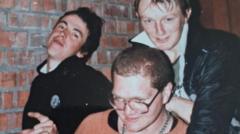
The entry of Anthony Slaughter into the Senedd represents more than a personal milestone for the Green Party; it marks a structural shift in the Welsh electoral mechanics. Success for a minority party in a devolved legislature depends on the convergence of three variables: electoral system elasticity, localized brand saturation, and the failure of the dominant incumbent to capture the "protest-plus" vote. The Slaughter campaign utilized a "Punk-Green" synthesis to bridge the gap between traditional environmentalism and the socioeconomic anxieties of the Welsh electorate. This analysis deconstructs the tactical components of this breakthrough and evaluates the long-term viability of Green expansion in a post-industrial political environment.
The Tri-Component Framework of Minority Party Scaling
For a party like the Greens to achieve legislative presence, they must navigate a high-entry-barrier environment. The Welsh political market is traditionally a captured market, dominated by Labor and Pled Cymru. Breaking this duopoly requires a specific operational strategy.
- The Identity Differentiator: Slaughter’s "punk" background functions as a cultural signaling device. It distances the party from the "middle-class academic" stereotype that often throttles Green growth in working-class constituencies. This creates a perception of authenticity—a high-value currency in Welsh politics.
- Resource Concentration: Minority parties suffer from high attrition when they spread resources across too many seats. Slaughter’s success is a product of hyper-localism, focusing financial and human capital on specific wards to create a "surround sound" effect for voters.
- The Policy Narrowing: Rather than focusing on global climate targets—which feel abstract to a voter in Cardiff or the Valleys—the campaign localized the Green agenda. Environmentalism was rebranded as a solution to local transport decay and housing quality.
Mapping the Senedd Electoral Elasticity
The Senedd’s Additional Member System (AMS) is the primary engine of Green viability. Unlike the First-Past-The-Post system used in UK General Elections, AMS allows for a "split-ticket" psychology.
Voters often give their constituency vote to a "safe" major party to ensure stability, while using their regional list vote to express a preference for ideological purity or radical change. Slaughter’s path to history relied on capturing this secondary vote. The Green Party’s strategy in Wales is effectively an arbitrage play: they are buying votes in the regional lists where the "cost" of a seat—in terms of the total vote percentage required—is lower than in the winner-take-all constituencies.
The structural advantage of the Greens in this cycle was the perceived stagnation of the Welsh Labor government. When a dominant party has been in power for over two decades, the "incumbency tax" becomes heavy. Voters seeking an alternative but wary of the Conservatives or Pled Cymru’s nationalist focus find a neutral, progressive harbor in the Greens. This is the "Protest-Plus" model: the vote is an act of defiance against the status quo, plus a vote for a specific set of values.
The Socioeconomic Pivot: Beyond Conservation
The traditional Green brand is often perceived as a luxury good—a set of policies that people care about once their immediate economic needs are met. Slaughter’s tenure and public positioning sought to invert this. The campaign focused on the "Circular Economy of the Valleys," a framework that links environmental sustainability directly to job creation and cost-of-living mitigation.
The Decarbonization Labor Link
The transition from a carbon-heavy industrial past to a green energy future in Wales creates a "skills vacuum." Slaughter’s rhetoric emphasizes that the Green Party is the only entity with a blueprint to fill that vacuum. By framing retrofitting and renewable infrastructure as the "new coal" (in terms of economic centrality, not environmental impact), the party targets the traditional Labor base.
Transportation as a Social Determinant
In many Welsh communities, the lack of reliable public transport is a hard ceiling on economic mobility. The Green focus on localized, electrified transit is not just about reducing emissions; it is a proposal to increase the "economic radius" of the average citizen. When Slaughter speaks on transport, he is addressing a bottleneck in the Welsh labor market.
Internal Party Professionalization and the "Punk" Paradox
The "punk pioneer" label is a double-edged sword. While it provides a brand hook, it creates tension with the need for legislative professionalism. Slaughter’s challenge is to maintain the outsider energy that won the seat while operating effectively within the bureaucratic constraints of the Senedd.
Political parties generally undergo three phases of maturation:
- Phase 1: Activist Core: The party is a pressure group with no real hope of power.
- Phase 2: The Breakthrough: A charismatic or high-energy candidate wins a seat through unconventional means.
- Phase 3: Institutionalization: The party builds a research wing, coordinates with civil servants, and becomes a reliable legislative partner.
Slaughter is currently navigating the transition from Phase 2 to Phase 3. The risk here is "Brand Dilution." If the Green Party becomes too integrated into the Senedd’s consensus-driven culture, it loses the "punk" differentiator that secured the protest vote. Conversely, if it remains too radical, it cannot pass legislation or influence the budget.
Logical Bottlenecks in the Green Growth Model
Despite the historical breakthrough, several systemic risks could cap the Green Party’s influence in Wales.
- The Pled Cymru Overlap: Both parties compete for the same progressive, young, and urban demographics. If Pled Cymru pivots more aggressively toward climate justice, the Green Party’s unique selling proposition (USP) evaporates.
- Resource Asymmetry: The Greens operate on a fraction of the budget of the major parties. Sustaining a presence in the Senedd requires a professional fundraising apparatus that the party has historically lacked.
- Geographic Concentration: Success in Cardiff Central or South Wales Central does not necessarily translate to the north or the rural west. The Greens risk becoming a "city-state" party, representative of urban intellectuals rather than a true Welsh cross-section.
Strategic Forecast: The Coalition Calculus
The most significant impact of Slaughter’s presence in the Senedd will be his role as a potential "kingmaker." In a legislature where no single party holds an absolute majority, a single Green seat carries disproportionate weight.
Labor’s ability to pass a budget or enact controversial environmental legislation often depends on the support of smaller parties. Slaughter’s leverage lies in his ability to offer Labor a "Green Shield." By supporting Labor’s policies in exchange for specific concessions (e.g., a ban on new road building or increased funding for biodiversity), he allows Labor to claim they are being "pushed" toward more radical climate action by their partners, which helps Labor manage their own internal factions.
The next five years will determine if Slaughter is an anomaly or a harbinger. To scale, the Green Party must move beyond the "pioneer" narrative and establish a repeatable "Constituency Win Blueprint." This involves building a bench of candidates who mirror Slaughter’s authenticity but can operate in different cultural contexts—from the rural farming communities to the post-industrial coastal towns.
The immediate tactical requirement for the Greens is the establishment of a "Shadow Delivery Unit." This unit must produce data-heavy, costed policy alternatives that challenge the Welsh Government’s civil service. By providing a higher level of intellectual competition than the official opposition, Slaughter can cement his position not just as a historical first, but as a permanent fixture in the Welsh power structure. The era of the "protest vote" Green Party is over; the era of the "governance-ready" Green Party begins with the utilization of this single seat as a laboratory for legislative influence.