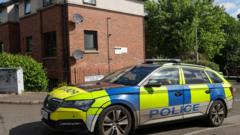
When a headline flashes across your screen announcing an arrest made as police attend scene of suspicious death, your brain instantly fills in the blanks. You probably picture a smoking gun, a clear-cut motive, and a closed case. It's clean. It's dramatic.
It is also almost entirely wrong.
In the real world, the phrase suspicious death is a legal and procedural safety net. It means the human body left behind cannot speak, the immediate environment raises massive red flags, and the clock is ticking. When authorities make an immediate arrest at the scene, it rarely means they have solved the mystery. Often, it just means they found someone who has a lot of explaining to do, or someone who poses an immediate flight risk.
Understanding what goes down behind those rolls of yellow plastic tape requires looking past the sensational evening news broadcast.
What Shocking Labels Like Suspicious Death Really Mean to Detectives
First responders do not walk into a home or an alleyway and instantly declare a homicide. They work through a strict classification process. A death is typically categorized in one of four ways: natural, accidental, suicide, or undetermined.
A suspicious death falls squarely into the undetermined bucket, but with a dark twist. It means the physical evidence at the scene strongly suggests foul play, or at least rules out an obvious medical emergency. Think unexplained trauma, forced entry, or a body found in a place it logically should not be.
Detectives treat every single one of these scenes as a homicide from second one. Why? Because you can always scale back a massive investigation if the medical examiner finds an hidden underlying health condition. But you can never recover contaminated forensic data if you treat a murder scene like a simple slip-and-fall for the first six hours.
The initial response is pure chaos managed by strict protocol. The first officers on the scene have one primary job: preserve life if there is a pulse, and freeze everything if there isn't. They log every person who steps across the threshold. They note the exact time. They don't touch doorknobs. They don't use the bathroom. They treat the entire area like a fragile glass sculpture.
Why an Immediate Arrest at the Scene Is Just the Starting Line
Seeing handcuffs click into place while the flashing blue lights are still reflecting off the wet pavement looks definitive. It satisfies our collective desire for swift justice. But from a legal and strategic standpoint, an early arrest changes the entire dynamic of an investigation, and not always in a good way.
When police make an arrest at the scene of a suspicious death, it usually happens under specific conditions:
- The suspect is caught holding a weapon or attempting to destroy physical evidence.
- A witness explicitly points out the individual fleeing the immediate area.
- The person present has an active, unrelated warrant, giving police the legal right to hold them while gathering more information.
This immediate action triggers a legal countdown timer. In most jurisdictions, authorities only have 24 to 48 hours to formally charge a person with a specific crime or let them walk. That puts immense pressure on the forensic teams and the medical examiner.
An arrest made during the initial response does not mean prosecutors have enough to secure a conviction. It means they have probable cause. That is a surprisingly low legal bar. It just means a reasonable person would believe a crime occurred and this specific individual was involved. Transforming that initial probable cause into proof beyond a reasonable doubt takes months of tedious, frustrating work.
How Forensics Explains the Silent Story of the Crime Scene
While an individual sits in an interrogation room refusing to talk, the physical scene undergoes a microscopic colon-free surgical extraction of data. This is where television shows lie to you. DNA results do not come back in twelve minutes. Fingerprint matches do not flash on a massive screen with a loud beep.
The real work is slow. Technicians use laser scanners to map the exact spatial geometry of the room. They measure blood spatter angles to calculate the trajectory and force of a blow. Every clothing fiber, every stray hair, and every microscopic drop of fluid is cataloged.
The most critical piece of the puzzle belongs to the forensic pathologist. The autopsy is the ultimate truth-teller in any suspicious death investigation.
The medical examiner answers three vital questions:
- The Cause of Death: The specific injury or disease that killed the person, such as a gunshot wound or asphyxiation.
- The Mechanism of Death: The actual physiological failure that caused life to stop, like internal bleeding or lack of oxygen to the brain.
- The Manner of Death: The legal determination, which flips the switch from suspicious to a formal homicide, suicide, accident, or natural causes.
If the autopsy reveals the individual died of a sudden, undetectable brain aneurysm two seconds before falling and hitting their head, the entire criminal case evaporates. The person arrested at the scene might still face charges for something else, but the murder investigation stops cold.
The Digital Footprint That Solves Modern Crimes
In 2026, the physical room where a body is discovered is only half the crime scene. The digital environment is just as telling. Investigators immediately look for the invisible trails left behind by modern technology.
Smart home devices constantly log ambient data. Thermostats track when people move past their sensors. Smart fridges note when doors open. Even simple Wi-Fi routers log the exact second a specific smartphone connected or disconnected from the network.
Then you have mobile phone location data. Detectives regularly secure warrants for tower dumps, which reveal every device that pinged nearby cellular towers during the critical window of time. If a suspect claims they were three towns away sleeping in their bed, but their phone logged into a router fifty yards from the scene, the alibi shatters.
This digital evidence is incredibly difficult for a defense attorney to dismantle. Human witnesses forget details, mix up timelines, or lie under pressure. Digital logs simply record what happened without emotion or bias.
What You Should Do If an Active Investigation Happens in Your Neighborhood
Discovering that your street has been turned into an active police investigation is jarring. It shatters your sense of security. Your immediate instinct might be to gawk, take videos for social media, or try to ask officers what happened.
Don't do that.
If you find yourself living next to an active investigation, follow a practical, level-headed protocol to stay safe and actually help the process.
First, stay behind the perimeter lines completely. Crossing that tape can contaminate evidence or get you detained for obstructing justice.
Second, check your own security systems. If you have a Ring doorbell, a driveway camera, or a dashcam that was running during the hours leading up to the police arrival, preserve that footage immediately. Do not edit it. Do not post it online.
Third, write down anything unusual you saw or heard over the last 24 hours. Did a car speed away at 3:00 AM? Did you hear a dog barking hysterically? Memories fade incredibly fast, especially when adrenaline spikes. Writing it down immediately keeps the details sharp for when detectives knock on your door.
Let the professionals do their jobs. The theatrical updates on social media groups usually contain wild rumors that hurt the family of the deceased and complicate the legal case. True justice relies on silence, science, and patience.