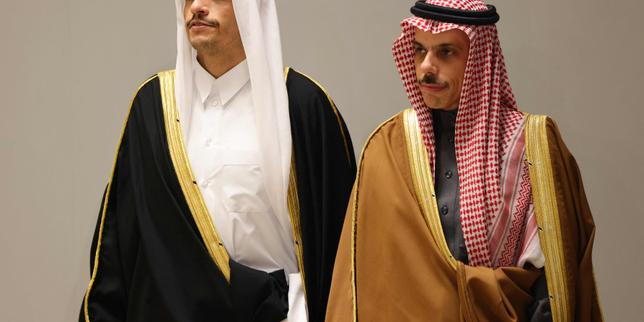
The current obsession with "eroding Gulf restraint" is a fundamental misunderstanding of how power functions in the Middle East. Analysts love the narrative of the "untenable" position. They claim that as tensions between Iran and Israel escalate, the Saudi-UAE-Qatari axis is being squeezed into a corner. They argue that the policy of de-escalation is a fragile glass house waiting for a single drone strike to shatter it.
They are wrong.
What the "experts" call a "policy of restraint" is actually a sophisticated, aggressive pursuit of economic sovereignty. It isn't a defensive crouch; it’s a calculated offensive. The Gulf states aren't "stuck" between Tehran and Washington. They have realized that the old security guarantees are historical relics and have moved on to a multi-polar reality that the West is struggling to comprehend.
The Mirage of the "Security Umbrella"
For decades, the consensus was simple: the U.S. provides the hardware and the "umbrella," and the Gulf provides the oil flow. That deal is dead. I’ve sat in rooms with regional strategists who no longer ask if the U.S. will pivot away, but how fast they can build a world where it doesn't matter.
When the Abqaiq-Khurais attacks happened in 2019, the silence from Washington was deafening. That was the moment the "restraint" myth was born. But it wasn't restraint out of fear. It was the realization that kinetic warfare is bad for the IPO of Aramco and the construction of NEOM.
The "lazy consensus" suggests that a regional war is inevitable and that the Gulf will be dragged in. This ignores the massive shift in financial gravity. Riyadh and Abu Dhabi are no longer just "oil states"; they are the world's most active venture capitalists. You don't burn down the neighborhood when you own half the real estate on the block.
Why "De-escalation" is a Power Move
Mainstream media views the 2023 Saudi-Iran normalization—brokered by China, notably—as a desperate attempt to avoid fire. In reality, it was a tactical decoupling. By removing the immediate threat of direct proxy war, the Gulf states effectively neutralized Iran’s primary leverage: the ability to disrupt the global energy market at the source.
- Iran's Strategy: Keep the region in a state of controlled chaos to prevent economic integration that excludes Tehran.
- The Gulf's Counter: Build so much economic momentum that war becomes an unthinkable cost for every global player, including Iran's patrons in Beijing.
If you think the UAE is "quiet" because they are afraid of Hezbollah or the Houthis, you aren't paying attention to the trade volumes moving through Jebel Ali. They aren't staying out of the fight; they are winning a different fight—the one for the next century of global trade.
The Fallacy of the "Untenable" Position
The argument that the Gulf’s position is "increasingly untenable" assumes that there are only two choices: total alignment with the West or total submission to regional threats. This is a binary trap.
The "People Also Ask" sections of the internet are filled with queries like "Will Saudi Arabia go to war with Iran?" or "Is the Middle East on the brink of total collapse?" These questions are flawed because they assume the players are irrational.
The Gulf is currently the only adult in the room. While the West oscillates between isolationism and interventionism, the GCC is practicing cold-blooded Realpolitik. They are hedging with China, trading with India, and keeping a back channel to Tehran while maintaining a defense relationship with the U.S. This isn't "restraint." This is a masterclass in strategic autonomy.
The Cost of Neutrality (and why it's worth it)
Is there a downside? Of course.
- Credibility Gaps: You risk being seen as an unreliable ally by both sides.
- Internal Friction: Not every GCC member sees the threat landscape the same way (e.g., Qatar vs. the UAE).
- The Proxy Trap: You can't always control the militias on your doorstep.
But compare these risks to the alternative: a multi-trillion dollar regional conflict that resets the developmental clock by fifty years. The "untenable" position is actually the only logical one.
The "Insulated" Economy is the New Deterrent
We need to talk about the math. War in the Gulf isn't just about $150 oil anymore. It’s about the collapse of the global sovereign wealth landscape. Between the PIF, ADIA, and QIA, we are talking about trillions of dollars in global equities.
If a major conflict erupts, the first casualty isn't a refinery; it's the global stock market. The Gulf has successfully "weaponized" its wealth. They have made themselves "Too Big to Fail" on a planetary scale. This is a far more effective deterrent than a dozen carrier strike groups.
The status quo isn't being "threatened" by the lack of a kinetic response to Iran. The status quo is being replaced by a system where economic interconnectedness is the primary security layer.
Stop Asking if They Will Fight
The question "When will the Gulf states finally act?" misses the point. They are acting. They are building ports in Africa, investing in AI in Silicon Valley, and creating a tourism corridor that rivals the Mediterranean.
Every time a commentator says their neutrality is "strained," they are applying 20th-century logic to a 21st-century problem. The Gulf doesn't need to pick a side in the Iran-Israel shadow war because they are busy building a side of their own.
Western analysts are looking for a "pivotal" moment where the Gulf joins a coalition. They are waiting for a "robust" military response. They won't get it. They will get more trade deals, more diplomatic summits, and more "restraint" that looks suspiciously like winning.
The next time you read that the Gulf's policy is "falling apart," ask yourself who benefits from that narrative. Usually, it's those who want to sell more hardware or those who can't stand the idea of a Middle East that doesn't take orders from the Atlantic.
The "restraint" isn't a sign of weakness. It’s the sound of a region outgrowing its old masters.
Build the city. Secure the trade route. Ignore the noise.
That is the only strategy that survives the coming decade. Everything else is just a headline for people who still think the world is unipolar.
Stop looking for the explosion and start looking at the balance sheets. That is where the real war is being won.