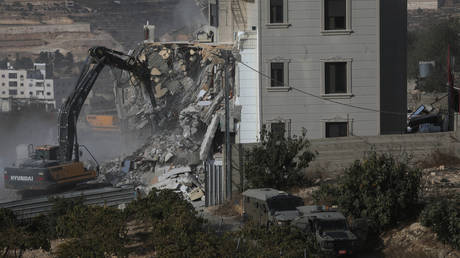
A directive leaves a desk in Jerusalem with three words that sound almost neat on paper: security, closure, containment. Ten miles away, or twenty, or forty, a metal gate drops across an asphalt highway. An engine dies in a line of idling sedans. A father checks his watch, then checks the fuel gauge, then looks at his daughter in the back seat who has a fever she has carried since dawn.
Stop. Look at the word blockade.
When readers see a headline about Benjamin Netanyahu ordering a blockade or sweeping closures in the West Bank, it is easy to treat it like weather—a sudden front rolling across a satellite map, grey and abstract, something happening inside a wire-service dispatch rather than inside a kitchen, a hospital corridor, or a delivery truck. I will be candid with you: covering and studying this region for years has taught me that words like closure and blockade often hide more than they reveal. Sometimes they describe a total seal of a city or district; other times they describe an intense web of flying checkpoints, earth mounds, iron gates, and permit freezes that choke movement without ever looking like a single unbroken wall from orbit. The terminology itself can confuse people watching from afar, and I do not pretend to hold a crystal ball over every military order issued in real time.
Yet the ground truth is rarely abstract. When high-level orders tighten restrictions across the West Bank, the shockwaves move along roads everyone knows by name—Route 60 winding through the hills, the approaches to Nablus, Hebron, Jenin, and Ramallah, the crossing lanes that link Palestinian towns to work, clinics, and markets.
The Anatomy of a Sudden Stop
To see what a closure order actually does, picture a hypothetical composite family I will call the Haddads—a construction foreman named Tariq, his wife Lina, and their nine-year-old son Samer, living outside Nablus with relatives across the hills toward Ramallah. This family is a fictionalized composite built from real patterns of daily life documented across the West Bank over decades of movement restrictions, curfews, and road closures; they are not a single real household, though every constraint they face echoes documented realities.
On a Tuesday morning, Tariq wakes before sunrise because the sun rises hard and bright over limestone terraces and olive groves, turning dust gold before seven o'clock. Normally, his commute takes under an hour. On a morning when an emergency security directive or full closure order hits the northern West Bank, that hour can stretch into four, or six, or vanish altogether.
Think of a highway network like the circulatory system of a living body. A main artery carries oxygen and nutrients to distant limbs; smaller capillaries feed every neighborhood. Now imagine someone clamping half the vessels shut all at once while leaving a few narrow valves half-open. Pressure spikes in one place. Starvation creeps into another. Even a detour through steep village backroads burns extra diesel, wears down suspension springs on rough rock, and turns a routine errand into an endurance test.
Tariq sits behind the wheel as exhaust fumes shimmer in the heat rising off the hood. Ahead of him, cars sit angled slightly sideways, drivers leaning out windows to trade rumors—a gate is locked near Hawara, soldiers are checking every ID at a junction, a taxi turned back ten minutes ago. Nobody knows how long the line will hold. Uncertainty is its own kind of weight. When you cannot tell whether a road will open in twenty minutes or stay shut until nightfall, you cannot promise an employer you will arrive, cannot promise a teacher your child will make an exam, and cannot promise a doctor you will reach the clinic before a condition worsens.
Why Orders Like This Happen
Why do prime ministers and defense establishments reach for closures and blockades in the first place? To understand the friction without flattening it, we have to look at the competing logics colliding at the barrier.
From the perspective of Israeli leadership—including Netanyahu's governments across years of recurring security crises—closures are framed as an immediate defensive measure following attacks, warnings of militant activity, or broader regional escalations. In that view, restricting movement is meant to slow down attackers, disrupt smuggling or coordination, and project deterrence when intelligence points to danger. Officials argue that when lives are on the line, a government cannot wait for tragedies to unfold before tightening control over roads and crossings.
Critics, human rights monitors, and Palestinian residents read the exact same barrier through a very different lens. They point out that collective movement restrictions rarely stop only the people named in a security brief. Instead, they sweep up tens of thousands of ordinary civilians whose only crime is trying to earn a wage, visit an aging parent, or get to a hospital. Over time, repeated closures fracture an already divided territory—splitting the West Bank into isolated pockets, driving up unemployment, stalling trade between neighboring cities, and feeding deep bitterness that makes calm harder, not easier, to sustain.
Both claims live inside the same reality. Ignoring the security fears that prompt a directive leaves out half the political equation; ignoring the human toll on civilians who have no say in cabinet rooms leaves out the lived truth of the street.
What Quietly Breaks Behind the Gates
Listen closely to what happens when a blockade or sweeping closure drags on past a single afternoon. The drama is not only at the yellow gate or the concrete block. It happens in quiet rooms.
Consider another hypothetical composite character—let's call her Dr. Nadia Mansour, a clinic administrator and physician working in a district hospital where supplies arrive from outside cities. Again, Nadia is a composite figure drawn from documented medical logistics during West Bank closures rather than one real individual. When main roads tighten, ambulances face longer routes and delays at checkpoints, medical staff commuting from other towns get stuck miles away, and routine shipments of medicines or lab supplies fall behind schedule. A patient with a manageable asthma flare or kidney issue suddenly faces a sharper cliff because a twenty-minute drive now demands an impossible workaround.
Or look at the household budget. A blockade does not just block people; it blocks commerce. A farmer whose produce sits in the back of a truck under a hot sun watches tomatoes soften and lose value before reaching market. A shopkeeper whose suppliers cannot cross a closed route sees shelves thin out while fixed bills—rent, electricity, school fees—keep arriving on schedule. When wages dry up or travel costs triple because drivers must hire local rides on the far side of a barrier, families stretch savings that were already thin.
Even schooling unravels at the edges. Teachers miss morning bells. Students walk long stretches along unpaved tracks when minibuses stop short of a closure point. Childhood shrinks to what can be reached on foot within a few miles of home.
The Memory of Walls That Never Truly Vanished
History matters here because nothing in the West Bank happens on a blank slate. Anyone who has spent time in Jerusalem, Ramallah, Bethlehem, or Hebron knows that restrictions on movement are not an invention of a single week or a single prime minister.
Over the decades since 1967—and especially since the Oslo arrangements carved the West Bank into Areas A, B, and C, followed by the construction of the separation barrier and a dense architecture of permanent and temporary checkpoints—movement has often felt conditional rather than guaranteed. During the Second Intifada in the early 2000s, prolonged curfews and closures brought daily life to a near standstill for months at a time, leaving scars on economies and memories that still shape how people brace for bad news.
When a new order comes down from Jerusalem today, people do not experience it in a vacuum. They read it against everything they have already lived through. A gate closing on a Tuesday feels different when you have seen gates close on dozens of other Tuesdays, when you know how quickly a "temporary" measure can stretch into weeks, and when you have watched an economy struggle to recover from the last round of restrictions.
Why Distance Makes It Easy to Look Away
If you are reading this thousands of miles away, perhaps on a quiet morning with coffee beside you and an open road outside your window, it is fair to ask why a road closure in another part of the world should hold your attention amid a crowded news cycle.
Because borders and barriers test a fundamental question about human life: how much collective punishment or daily disruption is normalized in the name of order, and what happens to a society when movement itself becomes a privilege granted or revoked from above? When a government orders a blockade or wide-scale closure, it is drawing a line not just across tarmac, but across people's time, livelihoods, and dignity.
I have sat in enough waiting rooms and roadside queues to know how quickly people adapt on the surface while carrying exhaustion underneath. Humor appears where you least expect it—drivers joking about who knows a secret goat path around a military jeep, neighbors sharing water when a car overheats in gridlock. Yet humor is armor, not a cure. Underneath the jokes sits a quiet, grinding fatigue: the fatigue of planning your life around a rumor, of watching plans dissolve because a barrier dropped twenty minutes before you reached it.
Beyond the Headline
A headline can tell you an order was given. It cannot tell you what it feels like to watch the clock tick past an appointment while traffic sits dead still in the glare of afternoon sun.
Next time you see a brief dispatch about a blockade or closure in the West Bank, look past the neatness of the phrase. Look for the people waiting on both sides of the line—the families trying to stay safe, the workers trying to keep food on the table, the doctors trying to reach patients in time, and the political leaders pulling levers whose human costs echo long after the cameras move on.
A gate across a road takes seconds to lower. Untangling what it breaks can take years.


