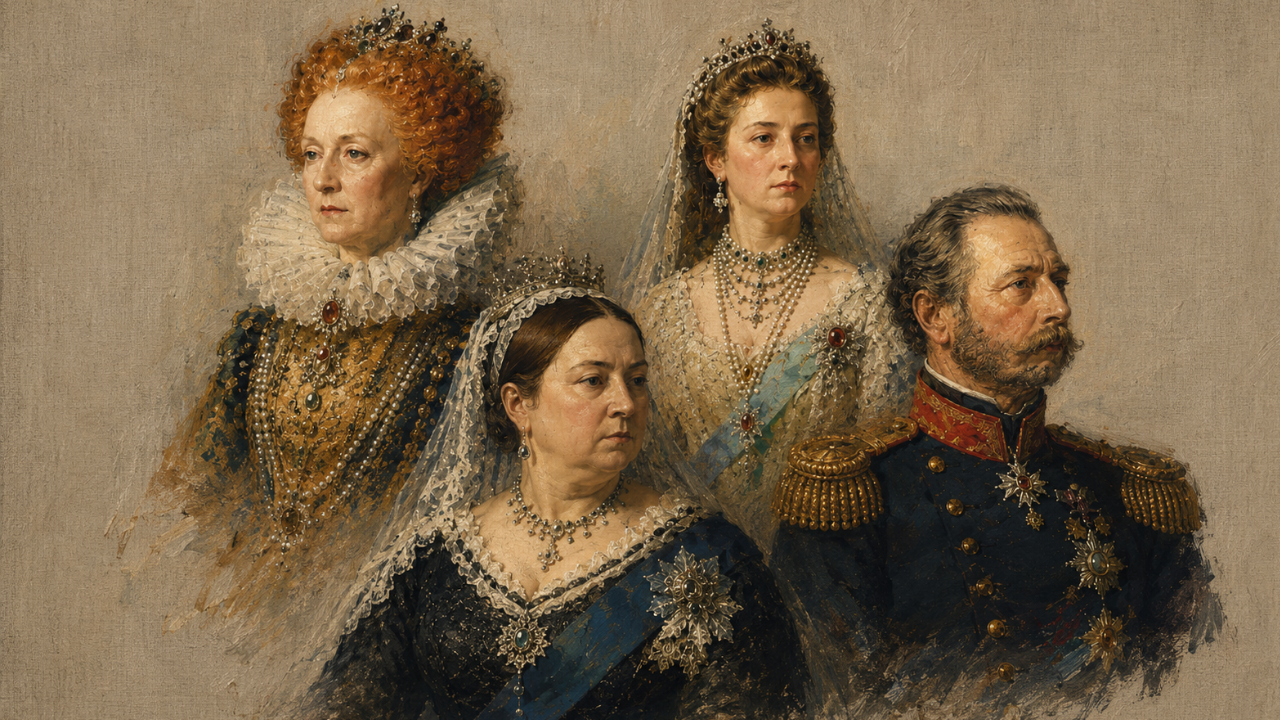
The rain in London does not care about the anxieties of a monarch. On a cold November evening in 1558, inside the drafty stone walls of Whitehall Palace, a young woman sat watching the firelight dance across the tapestry-lined walls. She was twenty-five years old. Her sister, Queen Mary, was dying. The weight of an fractured, bankrupt, and deeply paranoid kingdom was about to drop squarely onto her shoulders.
Elizabeth Tudor did not look at her ministers for answers that night. She did not consult her bishops. Instead, she sent a trusted messenger through the muddy streets of London to find a mathematician who spoke to stars.
His name was John Dee. He was a man of immense intellect, a pioneer in navigation, and a philosopher who believed the alignment of the planets held the blueprints of human destiny. Elizabeth needed to know the exact date and time she should place the crown upon her head to ensure a long, prosperous reign. Dee calculated the charts, pointed to January 15, 1559, and said, This is your hour. She listened. She ruled for forty-four years, anchoring an golden age.
We look back at the Renaissance and call it superstition. We sit in our air-conditioned offices, staring at spreadsheet data and algorithmic forecasts, feeling entirely insulated from the ancient impulse to seek signs in the dark. But history has a strange habit of repeating itself, particularly in the corridors of absolute power. The crown is heavy. The public gaze is suffocating. When the entire world is watching your every move, where do you turn when human intellect simply isn't enough?
Consider the modern echo of Elizabeth’s late-night consultations.
Centuries later, across the North Sea, another royal family found itself navigating the boundary between the earthly and the unseen. Princess Märtha Louise of Norway, fourth in line to the Norwegian throne, grew up under the same intense, unforgiving spotlight that has shone on royalty since the dawn of civilization. Every outfit analyzed. Every word weighed. Every expectation rigid.
For years, she tried to fit into the conventional box of royal duty. But inside, she felt a profound disconnect from the material world her status demanded she represent. She claimed to have psychic abilities from childhood, a sensitivity to the energies of others that she could neither switch off nor explain to the satisfaction of the press.
Imagine standing before a firing squad of flashbulbs, knowing that the thoughts in your head do not match the script in your hand. Isolation does strange things to the human psyche. It makes the tangible world feel intensely fragile.
Märtha Louise eventually walked away from her royal duties to pursue a path that left traditionalists scratching their heads. She founded an alternative therapy center, colloquially dubbed an "angel school," aimed at helping people connect with their divine light. Later, her life took an even more dramatic turn when she partnered with, and eventually married, Durek Verrett, a self-proclaimed sixth-generation shaman from California.
The public backlash was swift and fierce. The Norwegian media painted the relationship as a circus of eccentricity. To the spreadsheet-driven modern mind, a princess marrying a shaman looks like a PR disaster, a regression into medieval fantasy.
But look closer at the human element. Strip away the titles and the tabloid headlines, and what you find is a timeless psychological survival mechanism.
The crown isolates. It cuts individuals off from the normal ebony and flow of human vulnerability. When you are a royal, you cannot simply vent to a coworker over coffee or find a therapist who doesn't see you as a historical artifact. The supernatural offers something that traditional structures cannot: an absolute authority that sits higher than the parliament, the press, or the public opinion.
It is a quest for agency.
To understand why a modern princess or an Elizabethan queen would lean into the mystical, we have to look at the unique pressure cooker of hereditary power. In ordinary life, we make choices. We choose our careers, our partners, our locations. Royals choose nothing. Their lives are mapped out from the moment of their first breath to the stone vault where their bodies will eventually rest.
In that environment, the unseen world becomes a sanctuary of radical freedom.
Think of a young Prince Michael of Kent in the United Kingdom, who has spent decades quietly exploring his own deep fascination with the esoteric and historical mysteries. Or look at King Charles III, a man who spent his long tenure as the Prince of Wales championing organic farming, talking to his plants, and exploring Sufi mysticism and traditional philosophy long before sustainability was a corporate buzzword. He was mocked for it. The press called him eccentric, a man out of touch with the hard-nosed realities of modern science.
Yet, there is a distinct difference between being out of touch and being desperately in search of touch.
When you spend your life surrounded by stone palaces and rigid protocol, the living, breathing earth—and the mysteries that lie just beneath its surface—offers a visceral connection to reality. If the soil has a soul, if the stars have a voice, then perhaps the lonely individual wearing the velvet robes is not quite so alone.
The intersection of royalty and the supernatural is not a collection of bizarre anecdotes. It is a mirror. It reflects our own deeply human discomfort with uncertainty.
We live in an era that worships data. We track our steps, quantify our sleep, and use predictive text to finish our thoughts. We like to believe we have conquered the unknown. But when a crisis hits—a sudden illness, a financial collapse, a global shift—the algorithms offer cold comfort. We find ourselves looking at the sky, or looking for a sign, wishing for a John Dee to step through the door and tell us exactly which day to take our next big step.
The monarchs of the past and the unconventional royals of the present are simply playing out this human drama on a massive, theatrical stage.
The stakes for them are just infinitely higher. A bad decision by a president might lose an election; a bad decision by a monarch historically meant the downfall of a dynasty or the starvation of a nation. The weight of that responsibility creates a specific kind of vertigo. When you look down from that height, the ground disappears. You have no choice but to look up.
This isn't about validating every claim of angel communication or validating every astrological chart ever cast. It is about empathy. It is about understanding that the human heart, when pushed to the absolute brink of isolation and pressure, will always seek a language that transcends the mundane.
The next time you see a headline mocking a royal for their spiritual eccentricities, look past the cynicism of the ink. Look instead at the quiet rooms behind the castle windows.
Picture a young queen in 1558, shivering by a fire, betting her entire future on the placement of Jupiter. Picture a princess in the twenty-first century, turning her back on ancient protocol to find a sense of spiritual peace that no royal decree could ever grant her. They are not distinct from us. They are just lonely travelers on a very old, very strange road, trying to find a map in a world that forgot how to read the stars.
The fire in Whitehall eventually burned down to ash. The stars that John Dee tracked that night continued their slow, silent rotation across the dark European sky, entirely indifferent to the empires rising and falling below them. They shine exactly the same way tonight, watching over palaces and suburban homes alike, keeping secrets that no crown can ever buy.