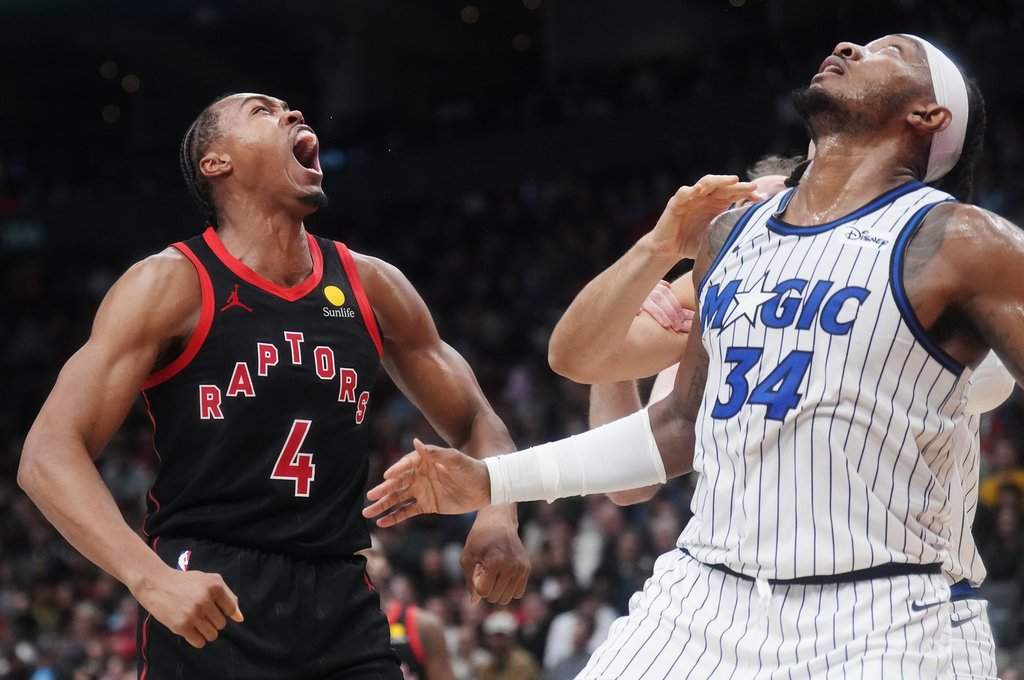
Silence.
That is what greets you when the arena lights finally dim, the last squeak of rubber on hardwood fades into the rafters, and the roar of twenty thousand strangers collapses into the hum of industrial air conditioning. Most people think a career night feels like fireworks. They imagine champagne, chest bumps, and the intoxicating rush of watching a ball drop through a nylon net forty-one times in a single evening. They see the box score glowing on their phone screens—forty-one points, a new personal zenith, a statistical monument—and they assume the man who built it must be floating three feet above the locker room carpet.
He wasn't.
When Scottie Barnes sat at his stall after pouring in a career-high forty-one points, there was no victory lap in his eyes. No grin. No breathless celebration of his own brilliance. Just the heavy, damp towel draped over his shoulders, the quiet thrum of ice bags being taped to bruised knees, and a blunt, almost dismissive refusal to care about the number beside his name. He was unmoved. Completely, stubbornly unmoved.
To understand why a twenty-something phenom would shrug off the most prolific scoring night of his professional life, you have to stop looking at the scoreboard and start looking at the weight he is carrying.
The Illusion of the Box Score
Basketball has a seductive lie baked into its DNA. We measure greatness in digits. Points, rebounds, assists, true shooting percentages—we stack them up like gold coins and declare the man with the tallest pile the winner. I spent years covering games from the baseline, close enough to hear the leather slap against calloused palms and smell the sharp tang of wintergreen liniment cutting through the sweat. Early on, I fell for the same trap every fan does. I thought big numbers meant big joy.
I remember sitting in a cramped press room years ago, watching a veteran forward stare at a stat sheet after dropping thirty-eight points in a seven-point loss. He didn't even fold the paper. He just slid it across the table with one finger, like a bad hand of poker, and walked out without taking a single question. At the time, I thought he was being melodramatic. Now, I know better.
A career high achieved in the shadow of a defeat—or amidst a season where every possession feels like pushing a boulder uphill—is not a trophy. It is an autopsy of everything else that went wrong.
Think of it like a master carpenter working furiously to frame a house while a hurricane tears the roof off the other side. You can admire the precision of his hammer swings. You can measure the perfection of his joints. You can marvel at how fast he works, sweat pouring down his temples, muscles screaming as he drives nail after nail into the timber. Yet when the storm passes and the structure is still standing crooked, the carpenter does not throw a party to celebrate how many nails he hammered. He looks at the warped walls and wonders why the foundation couldn't hold.
That is the exact emotional math Scottie Barnes was doing in that locker room.
Forty-One Points of Friction
Watch the tape of a forty-one-point performance closely, and you realize it rarely looks effortless. Against modern NBA defenses—long, switching, hyper-athletic schemes designed specifically to take away a primary creator's favorite spots—scoring forty-one points requires violence. Not malice, just relentless physical collision.
Every single basket is a negotiation paid for in cartilage and oxygen.
There is the drive into the teeth of a seven-foot shot blocker, absorbing a forearm to the ribs mid-air while twisting your spine to kiss the glass. There is the baseline turnaround over a frantic closeout, landing off-balance on someone else's size-fourteen sneaker. There is the sprint back on defense three seconds later, lungs burning like you swallowed crushed glass, trying to wall off a guard who has been resting in the corner while you did all the heavy lifting on the other end.
Multiply that exertion by forty minutes.
Let's strip away the box score and look at what forty-one points actually represents in the ecosystem of a basketball game:
- The Burden of Creation: When an offense stalls, the ball inevitably finds the franchise cornerstone with six seconds left on the shot clock. Those points aren't rhythm shots; they are bailouts.
- The Gravitational Pull: Scoring thirty forces a double team. Scoring forty forces a frantic, desperate swarm. Every pass out of that trap is a test of trust in teammates who might be cold, hesitant, or simply outmatched.
- The Emotional Whiplash: You hit a three-pointer to cut the deficit to four, the crowd erupts, adrenaline floods your bloodstream—and ten seconds later, a blown defensive rotation gives up an uncontested layup. The air rushes right back out of the building.
Barnes did not set out that night chasing a personal milestone. Nobody who plays the game the way he does wakes up thinking about forty. His entire basketball identity—from his days at Montverde Academy to Florida State to his Rookie of the Year campaign in Toronto—has been built on connective tissue. He is a pass-first engine trapped in the body of a power forward, a player who genuinely prefers whipping a no-look dime to a cutting teammate over isolating at the top of the key.
When a player wired for orchestration is forced to become a solo act just to keep his team breathing, high scoring isn't liberation. It's an emergency measure.
The Shift from Prodigy to Pillar
There is a specific, terrifying threshold every young star has to cross. It happens the exact moment the training wheels come off and the organizational excuse of "rebuilding" expires.
For the first couple of years in the league, the expectations are gentle. You are allowed to be bright, energetic, and raw. If you score twenty-five points and lose, people pat you on the back and talk about your ceiling. They project your trajectory onto five-year timelines and marvel at your potential.
Then, suddenly, you sign the max extension. The veteran mentors get traded away. The front office clears the deck and hands you the keys to the franchise.
Consider a hypothetical young chef—let's call her Maya—who spends three years as the sous-chef at a beloved neighborhood bistro. When she invents a brilliant special on a Tuesday night, she gets all the praise, even if the dining room is half-empty. She isn't responsible for the rent, the supplier contracts, or why the front-of-house staff is overwhelmed. Then the head chef leaves, Maya takes over the kitchen, and on her first Friday night, she cooks the best steak of her life—while the walk-in freezer breaks, two line cooks walk out, and half the tables send back cold appetizers. Nobody asks Maya how proud she is of that one steak. And if she bragged about it, her kitchen would lose all respect for her.
Scottie Barnes is in Maya's kitchen now.
At twenty-three, he is no longer the joyful little brother on a veteran roster full of champions. He is the face on the billboards outside Scotiabank Arena. He is the voice the media crowds around when a losing streak stretches past a week. When things go right, he gets the credit; when the defense collapses in the fourth quarter, his posture, his body language, and his leadership are dissected under a microscope.
I've watched this transition break talented players. Some retreat into their stats, quietly satisfied as long as their personal averages climb while the team sinks into the lottery. They become "empty-calorie" stars—men who collect All-Star appearances and lucrative endorsements while their franchises rot from the inside out. They smile at postgame podiums after twenty-point losses because, hey, they got theirs.
Barnes refusing to smile after forty-one points is the exact opposite of that disease. It is proof that his internal compass is still pointing north.
Why Modern Fans Misread Stoicism
We live in an era of relentless highlight culture. Within ninety seconds of Barnes's forty-first point hitting the bottom of the net, a two-minute reel of his best buckets was already circulating across social media, set to aggressive bass lines and punctuated by fire emojis. To someone scrolling on their couch at midnight, the story of the night was simple: Scottie Barnes went nuclear.
Because we consume sports in bite-sized clips, we lose the connective tissue of the four quarters. We don't see the missed box-out in the second period that gave away three second-chance points. We don't see the frustration on Barnes's face during a third-quarter timeout when the defensive scheme broke down for the fourth time in five trips. We only see the heroics, so we expect the hero to act like he won the war.
When he doesn't—when he sits in front of the microphones looking exhausted, speaking in low, clipped sentences about needing to be better on the glass and closing out possessions—it jars people. Some mistake his flat affect for apathy. Others read it as anger at his teammates.
Neither is true. What you are seeing is the quiet, unglamorous birth of accountability.
In the history of the NBA, almost every superstar who eventually hoisted a championship trophy went through a phase where their best individual performances left them sick to their stomach. Kobe Bryant famously despised the narrative surrounding his eighty-one-point game for years, not because he wasn't proud of the craft, but because the necessity of it underscored just how flawed that Lakers roster was. LeBron James spent his first stint in Cleveland routinely dropping forty-point triple-doubles in playoff games only to walk off the court looking like he had aged five years in forty-eight minutes.
Greatness isn't defined by how loudly you celebrate when everything clicks. It is defined by what you refuse to accept when it doesn't.
The Invisible Weight in the Locker Room
Step inside an NBA locker room thirty minutes after a tough loss, and the air feels thick enough to chew. There is no music playing. The booming bass that rattles the floorboards before tip-off is gone, replaced by the low murmur of trainers wrapping ankles and the occasional clatter of a shower door.
Players sit in front of their cubbies scrolling silently through their phones, avoiding eye contact, trapped in the private replay loop of every shot that rimmed out and every rotation they arrived half a second late to make.
In that room, a career high is almost taboo. If Barnes had walked in grinning, slapping hands, and asking the equipment manager for the game ball to put on his mantelpiece, the temperature in that space would have dropped twenty degrees. Teammates know when a star is playing for the front of the jersey versus the back of it. They watch how he reacts when the confetti doesn't fall.
By treating forty-one points like an irrelevant footnote, Barnes sent a message to every single person in that organization—from the fifteenth man on the bench to the general manager watching from the suite upstairs. He drew a line in the sand: Personal milestones do not count as currency here.
It is easy to say those words during training camp in October, when everybody is undefeated and optimism is cheap. It is infinitely harder to live by them in the dead grind of the regular season, when your body aches, the travel schedule blurs cities together, and you just delivered the most explosive offensive showcase of your entire life.
What Comes After the Number
Eventually, the box score from this game will fade into trivia. Years from now, someone looking up Scottie Barnes's career progression will see the forty-one-point spike on his game log, nod appreciatively at the raw talent it took to produce it, and move on to the next row of numbers.
They won't remember the score of the game. They won't remember the bruised hip he played through in the fourth quarter, or the exasperated sigh he let out when a late defensive switch fell apart.
But Barnes will remember. Not the forty-one points—those were already forgotten before the tape was cut off his ankles. He will remember the hollowness of leaving everything he had on the hardwood and still coming up short. He will remember how heavy a career night feels when you have to carry it out of the arena alone.
Somewhere down the road, when the roster around him matures, when the defensive rotations snap into place without hesitation, and when the wins finally start stacking up in May and June, Barnes might have a night where he scores eighteen points, grabs nine rebounds, dishes out eleven assists, and walks off the court grinning from ear to ear.
Until then, the lights are out, the ice bags are melting, and forty-one is just another number that wasn't enough.


