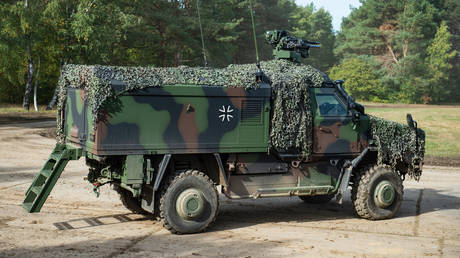
The sound of forty tons of steel losing grip on wet asphalt does not resemble an explosion. It sounds like a groan. A long, metallic shriek of protest as rubber surrenders to physics, followed by the dull, sickening thud of armored plating meeting guardrails, ditches, or the chassis of the vehicle twenty meters ahead.
Silence follows. Then the hiss of escaping air brakes.
When news broke that a German military convoy had crashed in Poland, the wire services treated it with the clinical detachment reserved for minor traffic delays. A few paragraphs. Mention of injured soldiers. A note about local emergency services clearing the highway. A reassurance from the Bundeswehr that an investigation was underway.
Read those four sentences and you might shrug, scroll past, and think of a fender-bender on a rainy Tuesday. You would miss the entire story. Because a military convoy crashing on a Polish highway is never just a traffic accident. It is a stress fracture in the most ambitious, fragile, and consequential logistical undertaking Europe has attempted since the fall of the Berlin Wall.
To understand what actually happened on that stretch of Polish road, you have to step out of the newsroom and into the cab of a heavy transport truck at three in the morning.
The Invisible Artery of European Defense
Imagine a hypothetical young driver—let’s call him Lukas, a 24-year-old corporal from Lower Saxony. Lukas has spent the last fourteen hours staring at the red taillights of the vehicle in front of him. His cab smells of stale coffee, wet wool, and diesel exhaust. Outside his windshield, the flat, featureless expanse of western Poland blurs into an endless ribbon of gray tarmac and pine trees.
He is not driving a commercial semi-truck hauling pallets of flat-pack furniture. He is piloting a multi-axle heavy equipment transporter loaded with an armored vehicle whose center of gravity sits dangerously high, whose stopping distance is measured in football fields, and whose blind spots could swallow a compact car whole.
Lukas is part of a steel caterpillar stretching across the North European Plain. Since Russia’s full-scale invasion of Ukraine rewrote the security architecture of the continent, the movement of German military convoys through Poland has ceased to be a rare, ceremonial exercise. It has become a relentless, grinding pulse. NATO’s eastern flank is no longer a theoretical line drawn on war-game maps in Brussels; it is a physical frontier in Lithuania, Latvia, Estonia, and eastern Poland that demands constant feeding.
Every bullet, every spare track link, every field hospital, and every Leopard tank deployed to deter aggression must travel overland. And almost all of it must pass through Poland.
Military planners have a clinical term for this: the Military Schengen. In theory, allied forces should move across European borders as effortlessly as tourists driving from Munich to Warsaw. In reality, moving an army across peacetime civilian infrastructure is like trying to push a freight train through a suburban cul-de-sac.
When Peacetime Roads Meet Wartime Weight
We tend to think of modern warfare in terms of satellites, hypersonic missiles, and autonomous drones. We forget that war—and the deterrence that prevents it—is ultimately governed by mud, concrete, bridge weight limits, and human fatigue.
Consider what happens when a Bundeswehr convoy enters Poland via the A2 or A4 highway corridors. These are modern, well-maintained arteries built for European commerce. They are designed for forty-ton commercial trucks moving at steady, predictable speeds, driven by professionals who know every curve, toll plaza, and rest stop between Frankfurt and Warsaw.
Now inject a column of military vehicles into that bloodstream.
Military convoys do not move like normal traffic. For security and command integrity, they travel in tight, disciplined formations. Civilian drivers, impatient and unfamiliar with military spacing rules, routinely cut into the gaps between armored transports, blind to the fact that a heavy tactical vehicle cannot brake like a sedan. Meanwhile, the convoy commanders are juggling strict diplomatic transit windows, custom clearances, and rigid arrival schedules at railheads or training grounds like Drawsko Pomorskie.
Add rain. Add black ice. Add the grinding monotony of night driving after days of mobilization prep.
In past incidents along Polish highways—whether involving Bundeswehr columns near Wrocław, American Stryker brigades near Toruń, or multinational convoys heading toward the Suwałki Gap—the root causes rarely trace back to a single catastrophic mechanical failure. Instead, they reveal an accumulation of micro-stresses. A sudden braking maneuver by a civilian car ahead. A wet patch of asphalt on an unfamiliar exit ramp. A driver whose reaction time has been shaved down by two hundred milliseconds because he has slept four hours in two days.
When the lead vehicle brakes hard, a wave of kinetic panic ripples backward through the column. Physics does not care about military discipline. A chain-reaction collision in a convoy happens in slow motion for the people inside the cabs and in an instant for everyone watching from the roadside.
The Ghost of Infrastructure Past
I remember standing on the shoulder of a regional road in eastern Poland two winters ago, watching a multinational logistics column crawl past in freezing sleet. What struck me wasn't the intimidating silhouette of the armor on the flatbeds. It was how narrow the road suddenly looked. The outer wheels of the transporters were mere inches from the soft, waterlogged verge. Every time an oncoming logging truck roared past in the opposite lane, the air pressure rocked the high-sided military cabs like small boats in a harbor wake.
The local Polish mayor standing beside me shook his head and pointed toward a concrete overpass a kilometer down the road. "That bridge was built in 1978," he told me quietly. "It was built for tractors and Lada sedans. Now we ask it to carry the weight of the Western alliance."
This is the quiet vulnerability that keeps NATO logistics officers awake at night. For thirty years after the Cold War, Europe dismantled its military mobility infrastructure. Tank-turning pads were paved over. Rail sidings were torn up. Bridges were engineered to civilian weight tolerances rather than the seventy-ton load classes required by modern main battle tanks.
Germany, in particular, spent decades treating its armed forces as an expeditionary police force rather than a territorial defense army. When Berlin announced its historic Zeitenwende—a turning point in defense policy backed by a hundred-billion-euro special fund—the headlines focused on fighter jets and air defense systems. Nobody wrote front-page stories about heavy-duty recovery vehicles, convoy escort protocols, or cross-border highway signage.
Yet when a German convoy crashes in Poland, those unglamorous details suddenly become front-page news.
The Human Toll Behind the Metal
It is easy to look at photographs of crumpled olive-drab fenders and twisted guardrails and see only the hardware. We forget the teenagers and twenty-somethings sitting behind the steering wheels.
Modern soldiering requires an unnatural compartmentalization. In peacetime, a young Bundeswehr driver is bound by strict German and Polish road traffic laws. If he scrapes a guardrail, he faces administrative inquiries, insurance assessments, and disciplinary reviews. Yet he is simultaneously told that his mission is vital to European security, that the equipment on his trailer is urgently needed on the eastern frontier, and that delays are unacceptable.
Caught between bureaucratic caution and operational urgency, young drivers carry an invisible psychological weight.
When an accident occurs on foreign soil, that weight doubles. Suddenly, Polish police, local paramedics, military police (Feldjäger), and curious bystanders with smartphones surround the wreckage. Language barriers complicate emergency triage. Local traffic backs up for ten kilometers, fueling frustration among Polish commuters who already feel the daily strain of living on the front line of a geopolitical crisis.
For the injured soldiers—bruised, concussed, or pinned inside deformed cabs—the crash is a stark reminder that military service carries lethal risks long before anyone hears a shot fired in anger. Across NATO armies, more personnel are injured and killed in training and transit accidents during peacetime than in actual combat operations. Asphalt and gravity remain the most relentless adversaries any army ever faces.
Why Kremlin Propagandists Love a Fender-Bender
There is another reason a seemingly routine convoy crash in Poland matters far beyond the immediate wreckage. We live in an era where every twisted bumper is weaponized before the tow trucks even arrive.
Within hours of any incident involving German or American troops in Poland, the photos appear on Telegram channels and social media feeds stripped of context. Russian information operations thrive on precisely these moments. The narrative is predictable, surgical, and surprisingly effective: Look at NATO. They cannot even drive down a highway without crashing into each other. How do you expect them to defend Warsaw or Vilnius?
It is a cynical distortion, of course. Moving tens of thousands of vehicles across thousands of kilometers will statistically produce traffic accidents, just as commercial trucking fleets experience collisions every single day. The sheer volume of military transit across Poland has multiplied exponentially over the last three years; an uptick in road incidents is a mathematical certainty, not evidence of systemic incompetence.
Yet perception in deterrence is half the battle. Deterrence only works if an adversary believes you possess both the will and the capability to arrive on time, intact, and ready to fight. Every time a convoy stalls in a ditch, every time a transport jackknifes on a slick Polish motorway, it feeds a corrosive narrative of Western fragility—and tests the patience of the Polish public whose roads bear the brunt of allied solidarity.
Rebuilding the Arteries Before the Storm
The real story of the German convoy crash in Poland is not that an accident happened. The real story is what Europe is doing—and failing to do—to ensure the next column makes it through safely.
Across Brussels, Berlin, and Warsaw, quiet revolutions in military logistics are underway, though they rarely make the evening news:
- Reinforced Corridors: Engineers are systematically mapping and upgrading critical highway bridges and rail lines across the east-west transit routes to handle extreme military load classifications without bottlenecking civilian traffic.
- Integrated Escort Protocols: Polish military police (Żandarmeria Wojskowa) and German Feldjäger are increasingly operating in joint command cells, standardizing warning signage, night-transit windows, and civilian traffic diversion procedures so convoys are no longer swallowed by commuter rush hours.
- Rail Over Road: Strategists are investing heavily in dual-use rail infrastructure—expanding loading ramps and standardizing rolling stock—because moving a brigade by train is safer, faster, and infinitely less taxing on exhausted drivers than rolling hundreds of heavy trucks down public highways.
Still, progress moves at the speed of permits, environmental reviews, and parliamentary budgets, while geopolitical urgency moves at the speed of crisis.
For now, the burden still falls on the shoulders of young drivers gripping thick steering wheels in the dark, squinting through rain-streaked glass at red taillights ahead, praying that the car in the passing lane doesn't swerve, that the bridge ahead holds, and that forty tons of steel stays between the white lines until dawn.
Long after the recovery cranes haul the twisted metal off the Polish asphalt and the traffic cones are stacked back into the beds of highway maintenance trucks, the fundamental truth remains etched into the tarmac: an alliance is only as strong as the roads it can survive driving down.


