Israel possesses arguably the most sophisticated integrated air defense network on the planet, yet it is currently being humbled by a piece of technology that costs less than a used sedan. The Iron Dome, David’s Sling, and the Arrow system were built to intercept high-velocity ballistic missiles and Katyusha rockets—threats that follow a predictable, parabolic arc. Hezbollah’s shift toward low-altitude, slow-flying kamikaze drones has effectively bypassed this multi-billion-dollar shield by exploiting the fundamental physics of radar and the geography of Northern Galilee.
The primary issue isn't a lack of firepower. It is a problem of detection and classification. When a drone flies at 100 feet through a mountain valley, it disappears into the "clutter" of the ground. Radar waves bounce off hills, trees, and buildings, making it nearly impossible for automated systems to distinguish between a fiberglass UAV carrying five kilograms of explosives and a large bird or a civilian Cessna. Hezbollah has mapped these blind spots with disciplined precision, turning the rugged terrain of South Lebanon into a launchpad for "invisible" strikes that give Israeli civilians and soldiers mere seconds of warning, if any at all.
The Physics of Failure
To understand why the world's best defense is struggling, you have to understand the Doppler effect. Traditional radar looks for objects moving at high speeds. A rocket is a fast, hot, metal object. It screams across the sky, making it an easy target for sensors to lock onto.
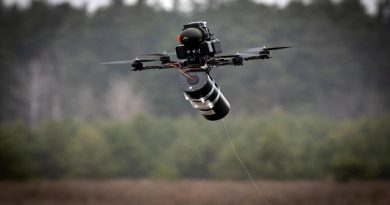
Hezbollah’s new favorite weapon, often based on the Iranian Ababil or Mirsad architectures, is the opposite. These drones are made largely of carbon fiber or plastic, which have a low radar cross-section. They move slowly. In some cases, they move so slowly that radar software filters them out as "background noise" to prevent the system from firing at every gust of wind or flock of migratory storks.
When these drones are launched from the thick brush of Southern Lebanon, they don't climb. They stay low, hugging the contours of the Earth. By the time a drone clears the final ridge and appears on a radar screen, it is often already within a few kilometers of its target. For a drone traveling at 150 kilometers per hour, that leaves a defensive window of less than sixty seconds. In that minute, the system must detect the threat, confirm it isn't a friendly aircraft, and launch a Tamir interceptor that costs $50,000 to take out a $2,000 plastic wing.
The Cost Curve Insurgency
The math of this conflict is fundamentally broken. Hezbollah is engaging in a war of economic attrition just as much as a kinetic one. If the IDF fires two interceptors at every drone to ensure a kill, they are spending six figures to negate a threat that Hezbollah can mass-produce in a garage.
This is not a temporary glitch in the system. It is a structural shift in modern warfare. We are seeing the democratization of precision strike capabilities. You no longer need an air force to conduct surgical strikes behind enemy lines; you just need a GPS chip, a lawnmower engine, and a rudimentary understanding of terrain masking.
Beyond the Iron Dome
Israel is now scrambling to retro-fit solutions for a problem they didn't prioritize a decade ago. The "Iron Beam" laser system is frequently cited as the silver bullet. The logic is sound: a laser moves at the speed of light and costs only a few dollars per "shot" in electricity.
However, the Iron Beam is not a finished product. Atmospheric conditions like fog, smoke, or heavy rain—common in the mountainous north during winter—defuse the laser's energy. Even if the technology were perfect today, the power requirements and cooling needs mean it cannot be deployed in the numbers required to cover every square mile of the border.
The Return of the Flak Jacket
Because high-tech interceptors are struggling, the IDF has been forced to look backward. There is a renewed interest in electronic warfare (EW) and "soft kill" measures. These involve jamming the GPS frequencies or the radio links the drones use to navigate.
But Hezbollah has anticipated this. Many of their newer drones are programmed with inertial navigation systems. They don't need a constant link to a satellite or a pilot. They are told to fly a specific path based on landmarks and internal gyroscopes. If you jam the signal, the drone doesn't care; it keeps flying its pre-programmed route until it hits the coordinates it was given at launch.
There is also the heavy-handed approach: bringing back anti-aircraft guns. Systems like the Vulcan, which fires thousands of rounds of 20mm shells per minute, are being re-evaluated. They create a "wall of lead" that doesn't rely on expensive sensors. The irony is thick: the most technologically advanced nation in the Middle East may have to rely on 1970s-era flak cannons to stop 2024’s biggest threat.
The Intelligence Blind Spot
The hardware is only half the story. The real "secret sauce" of the Hezbollah drone program is their intelligence-gathering cycle. They aren't just flying drones into targets; they are using them to map the very defenses meant to stop them.
Hezbollah uses small, off-the-shelf quadcopters for reconnaissance to bait Israeli sensors. When an Iron Dome battery activates to engage a decoy, it reveals its position. A second, "kamikaze" drone then follows a different flight path to strike the battery itself or a nearby high-value target while the system is reloading or distracted.
This tactical layering shows a level of sophistication that goes beyond mere "terrorism." It is a coordinated, multi-domain strategy designed to overwhelm the cognitive load of Israeli defense operators. They are forcing the IDF to make impossible choices: do you fire at the drone over an empty field and risk wasting an interceptor, or do you wait and risk it being a lethal strike on a school or military base?
The Northern Ghost Town
The effectiveness of these "invisible" killers isn't measured only in casualties. It is measured in displacement. Over 60,000 Israelis have been forced to leave their homes in the north. The constant threat of a silent, low-flying explosive that can bypass the sirens has turned prosperous towns into ghost cities.
Hezbollah has achieved a strategic objective without ever having to launch a full-scale ground invasion. They have created a "buffer zone" inside Israeli territory. As long as the drone threat remains unsolved, those citizens cannot return. The psychological toll of an enemy you cannot see and a defense system you can no longer fully trust is the most potent weapon in Hezbollah's arsenal.
The Global Blueprint
What is happening on the Lebanon-Israel border is a laboratory for the rest of the world. From the plains of Ukraine to the shipping lanes of the Red Sea, the era of the "cheap and slow" weapon is upending the military-industrial complex.
The primary lesson is that air superiority is no longer a given. Even if you own the skies at 30,000 feet, you can still lose the war at 50 feet. The shift toward autonomous, low-cost attrition means that the traditional model of building fewer, more expensive defensive systems is obsolete.
Israel’s struggle proves that the next decade of defense spending won't be about bigger missiles or stealthier jets. It will be about the "boring" tech: acoustic sensors that can hear a drone engine from miles away, AI-driven cameras that can spot a plastic wing against a cloudy sky, and high-capacity kinetic guns that can fire thousands of rounds for the price of a single missile.
The aura of invincibility surrounding integrated air defense has been pierced. The gap between the threat and the solution is widening, and for the people living under the flight paths in the Galilee, the sound of a small, buzzing motor has become more terrifying than the roar of a jet engine.
Fixing this requires more than just a software patch. It requires a total reimagining of what "securing the skies" actually looks like when the sky starts at the treetops. Until that happens, the advantage remains with the actor willing to fly under the radar. Moves must be made to decentralize sensor networks and deploy point-defense systems at a scale previously thought unnecessary for a modern state. The border is no longer a line on a map; it is every valley, every roof, and every blind spot in the radar's sweep.