Canada’s ambitious plan to build a high-speed passenger rail line between Toronto and Quebec City has hit a stubborn, concrete wall of rural resistance. Across the fertile plains of the St. Lawrence Valley, Quebec farmers are warning that the proposed Alto high-speed rail corridor will bisect centuries-old family farms, destroy complex subsurface drainage networks, and permanently strip away some of the province’s best agricultural soil. While federal planners pitch the multibillion-dollar megaproject as a clean-energy transit triumph, producers along the north shore of the St. Lawrence River see an existential threat to their livelihoods and regional food security.
The conflict comes down to basic geometry. High-speed trains cannot make sharp turns. To sustain speeds of up to 300 kilometres per hour, engineers require sweeping, gentle curves and dedicated, fenced-off rights-of-way with zero at-grade crossings. You cannot simply lay these tracks alongside existing freight lines or winding rural highways. Instead, planners must carve brand-new, straight-line corridors directly through the heart of the countryside. In Quebec, that countryside happens to be the St. Lawrence Lowlands—a narrow band of flat, nutrient-rich earth that accounts for the vast majority of the province's agricultural output.
The Anatomy of a Severed Farm
To a transit planner in Ottawa or Montreal, a 60-metre-wide rail corridor looks like a thin pencil line on a digital map. To a dairy or grain producer in Lanaudière or Mauricie, that line is an impenetrable wall.
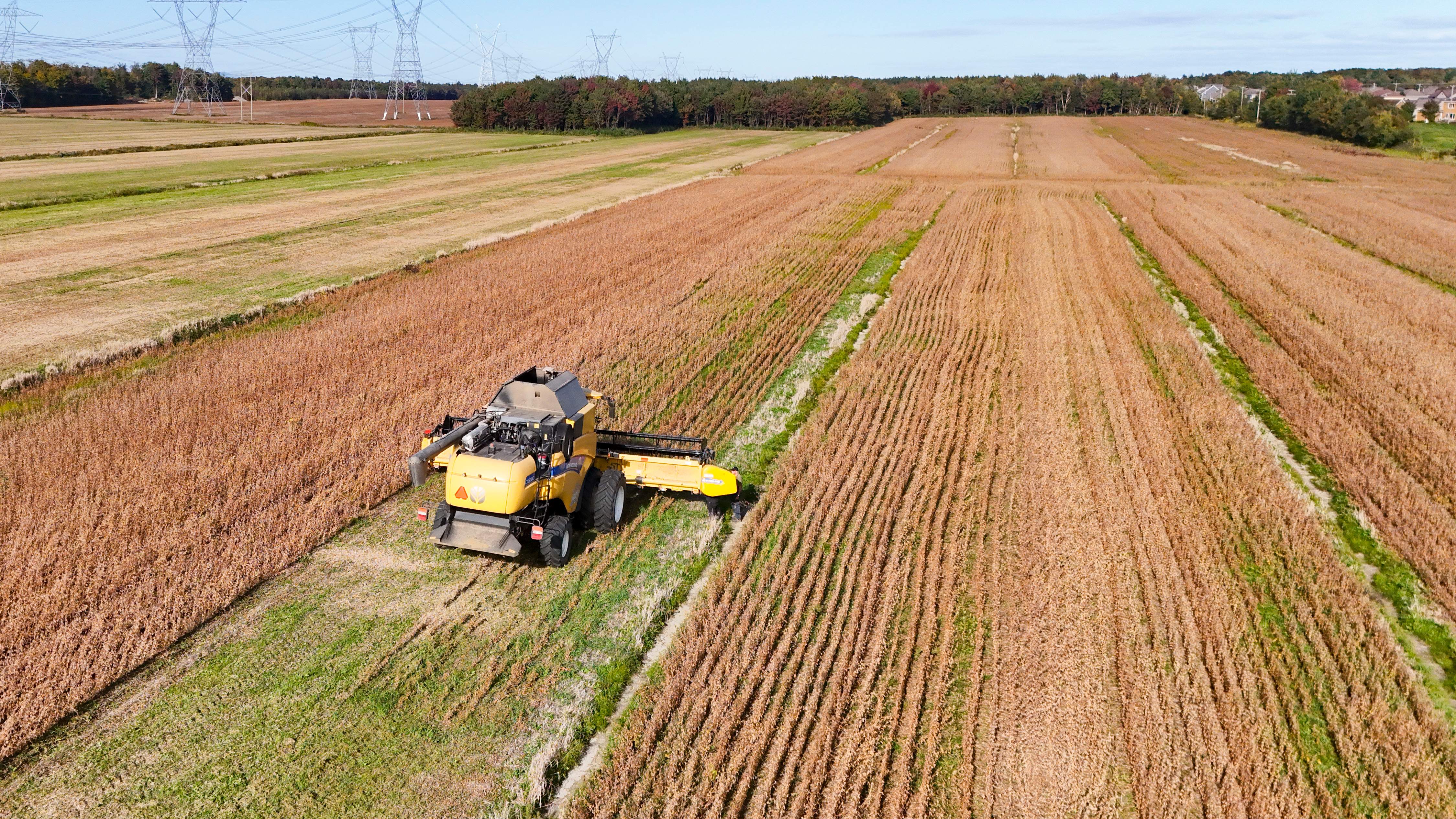
Modern farming relies on economies of scale and uninterrupted acreage. When a fenced high-speed rail line cuts diagonally across a 200-hectare property, it creates what agricultural economists call severed parcels. Suddenly, a farmer cannot drive a combine harvester or a manure spreader from the barn to the back fields without loading heavy machinery onto trailers and hauling it miles out of the way to the nearest highway overpass.
Consider a hypothetical example to see how the math breaks down. Imagine a grain operation where 30 percent of the tillable land ends up on the far side of the tracks. If the nearest crossing is eight kilometres away, moving equipment back and forth during a tight autumn harvest window burns extra diesel, eats up precious daylight hours, and accelerates wear on machinery. Over a decade, those added operational costs can turn a profitable family farm into a money-losing enterprise, even if the government wrote a fair check for the initial strip of expropriated dirt.
The Hidden Infrastructure Beneath the Soil
The damage goes deeper than the surface. Literally.
Much of the St. Lawrence Valley consists of heavy clay soils that naturally retain water. Over the past fifty years, Quebec farmers have invested hundreds of millions of dollars into installing subsurface tile drainage—intricate, laser-leveled grids of perforated plastic pipes buried roughly a metre underground. These systems pull excess spring meltwater out of the root zone, allowing farmers to plant weeks earlier and dramatically boosting crop yields.
When heavy construction crews excavate a rail bed, compact the earth to support high-speed ballast, and dig deep drainage ditches along the tracks, they slice right through those underground pipe networks. If a main collector pipe is severed or crushed by heavy machinery, water backs up across dozens of hectares upstream, turning productive fields into swamps. Re-engineering and re-leveling a broken drainage system across an entire concession is an engineering nightmare that standard expropriation payouts rarely cover in full.
Why Existing Corridors Won't Work
Whenever rural communities push back against greenfield rail routes, the immediate counter-argument from the public is always the same. Why not just use the tracks we already have?
The answer lies in the physics of rail transport and the realities of North American freight ownership. Existing rail lines between Montreal and Quebec City are owned primarily by Canadian National (CN) and Canadian Pacific Kansas City (CPKC). Those tracks are built for heavy, slow-moving freight trains hauling timber, grain, aluminum, and shipping containers.
- Track Geometry: Freight tracks have tight curves and steep grades that would derail a high-speed passenger train or force it to slow to a crawl, defeating the entire purpose of the project.
- Safety and Aerodynamics: Running a 300 km/h passenger train on tracks adjacent to slow freight cars creates massive aerodynamic pressure waves and catastrophic collision risks. International safety standards strictly prohibit mixing true high-speed rail with heavy freight on shared tracks.
- Right-of-Way Width: Existing corridors running through towns and farms are hemmed in by buildings, roads, and waterways, leaving zero room to widen the rail bed for two additional dedicated passenger tracks.
Because sharing tracks is a non-starter, the federal Crown corporation overseeing the project—rebranded from VIA HFR to Alto after the government pivoted from a slower "high-frequency" concept to true high-speed rail—has been forced to look at new alignments. And in Quebec, the most direct path between Montreal, Trois-Rivières, and Quebec City cuts straight through Zone Verte—land legally protected under Quebec’s Act Respecting the Preservation of Agricultural Land and Agricultural Activities (LPTAA).
The Legal Collision Between Ottawa and Quebec
This sets up a classic Canadian constitutional clash. Under the Constitution Act of 1867, interprovincial railways fall squarely under federal jurisdiction. Technically, Ottawa has the legal authority to expropriate land and build a railway regardless of provincial zoning laws.
Politically, however, steamrolling Quebec’s agricultural zoning laws is radioactive. Passed in 1978, the LPTAA was created specifically to stop urban sprawl from devouring the province’s scarce farmland—less than two percent of Quebec’s massive landmass is suitable for agriculture. For nearly five decades, the Commission de protection du territoire agricole du Québec (CPTAQ) has strictly policed every driveway, housing development, and commercial project proposed on zoned farmland.
Farmers rightly ask why they must jump through bureaucratic hoops to build a new equipment shed on their own property while a federal megaproject can carve a permanent scar across thousands of hectares of prime soil. The Union des producteurs agricoles (UPA), Quebec’s powerful farm lobby, has already mobilized its regional federations, demanding that Ottawa prioritize routes along existing highway corridors—like Autoroute 40—even if doing so increases construction costs or forces trains to slow down slightly through certain curves.
The Economic Blind Spot in Megaproject Math
Infrastructure planners have a well-documented habit of underestimating the true cost of rural disruption. Standard cost-benefit analyses assign a dollar value to passenger time savings, reduced highway congestion, and lower carbon emissions from short-haul flights and car trips. Those numbers look great on a spreadsheet.
What rarely shows up in the top-line budget is the permanent loss of agricultural capital. Farmland is not an infinite commodity that can simply be replaced by clearing forest further north. The climate and soil chemistry of the St. Lawrence Lowlands cannot be replicated in the Canadian Shield. Once high-grade clay loam is buried under crushed granite ballast and concrete ties, its food-producing capacity is gone forever.
Furthermore, agriculture in regions like Lanaudière and Mauricie supports an entire ecosystem of local businesses—seed suppliers, tractor dealerships, veterinarians, grain elevators, and food processors. When a major rail corridor fragments dozens of farms in a single municipality, it shrinks the local customer base that keeps those rural towns economically viable. Expropriation laws in Canada are designed to compensate individual landowners for the fair market value of the lost land and immediate damages, not to reimburse a regional economy for decades of diminished agricultural output.
Lessons From Europe and the Cost of Getting It Wrong
Canada is hardly the first country to run high-speed trains through prized farmland. France’s TGV network and Spain’s AVE lines faced fierce rural backlash when they were built. In France, prolonged blockades by farmers forced the state rail operator, SNCF, to fundamentally change how it negotiates with rural communities.
European rail builders eventually learned that throwing cash at individual landowners isn't enough. To get tracks built without decades of litigation and civil disobedience, authorities had to adopt comprehensive land consolidation programs—known in France as remembrement. Under this model, the government buys up available land in the surrounding area and swaps parcels among neighbors so that every farmer ends up with contiguous fields on one side of the tracks or the other, eliminating the need to cross the rail line at all.
They also had to overbuild rural infrastructure, constructing dedicated agricultural underpasses every few kilometres specifically sized for modern wide-body farm equipment, and funding independent hydrogeological surveys to rebuild severed drainage networks before a single track was laid.
Right now, Quebec farmers see few guarantees that Ottawa is prepared to pay for that level of mitigation. Early public consultations have left landowners frustrated by vague corridor maps and non-committal answers regarding compensation formulas and overpass spacing. Until federal planners put binding, fully funded commitments on the table to protect soil drainage and consolidate severed parcels, every surveyor stake driven into the St. Lawrence Valley will be treated as a declaration of war.