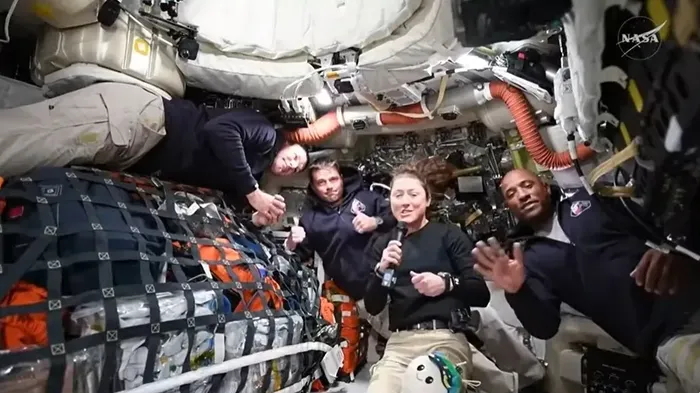
The four astronauts currently hurtling toward the Moon aboard the Orion spacecraft aren't just passengers on a pre-programmed trajectory. On Day 4 of the Artemis II mission, the crew transitioned from being monitored cargo to active pilots, executing a series of proximity operations and manual flight maneuvers that represent the most critical test of human-machine integration in fifty years. This isn't just a technical checkout. It is a calculated risk to ensure that if the automated systems—which are exponentially more complex than those of the Apollo era—fail in deep space, the humans on board can actually steer the ship back to Earth.
While much of the public's attention has drifted toward the poetic milestone of the lunar flyby or the holiday messages sent back to a distant blue marble, the engineering reality inside the capsule is far more grit than glamour. The crew performed the Proximity Operations Demonstration, using the spent ICPS (Interim Cryogenic Propulsion Stage) as a target. This maneuver forced Commander Reid Wiseman to manually orient the massive Orion capsule using only visual cues and joystick inputs, a task made infinitely harder by the physics of orbital mechanics where every action triggers a counter-intuitive reaction.
The Illusion of Automation in Deep Space
NASA has spent decades perfecting automated docking and flight, but Artemis II operates on a different philosophy. Modern avionics suites are designed to handle 99% of flight conditions, yet the remaining 1% is where crews lose their lives. By forcing a manual flight window on Day 4, NASA is acknowledging a hard truth learned from the Boeing Starliner hiccups and past International Space Station near-misses. Software is brittle. Human intuition, while prone to fatigue, remains the only viable redundancy when sensors are blinded by solar radiation or code hits an unhandled exception.
The manual handling tests specifically targeted the Optical Navigation system. In deep space, GPS doesn't exist. Orion must rely on its star trackers and cameras to determine its position relative to the Earth and Moon. If those cameras fail, the crew must be able to use a sextant-like digital interface to manually input data. Day 4 was the first time this was tested in a high-earth orbit environment where the stakes were immediate. If Wiseman or Pilot Victor Glover had miscalculated the thruster bursts, they risked a collision with the ICPS or, worse, an accidental burn that would require a massive fuel expenditure to correct.
The Brutal Physics of the Lunar Flyby Preparation
As Orion pushes past the 200,000-mile mark, the thermal management of the spacecraft becomes the primary silent antagonist. The crew spent a significant portion of Day 4 managing the "barbecue roll," a constant slow rotation of the spacecraft intended to distribute the sun's intense heat evenly across the hull. Without this, one side of the capsule would bake at 121°C while the other plunged to -150°C, potentially warping the primary structure or cracking the heat shield tiles.
Preparations for the lunar flyby aren't just about calculating the slingshot maneuver. They involve a meticulous audit of the life support systems. On Day 4, the crew verified the performance of the Environmental Control and Life Support System (ECLSS). Unlike the ISS, which can be resupplied or evacuated in hours, Orion is a closed loop with no escape hatch. If the carbon dioxide scrubbers underperform during the high-stress period of the lunar swing-by, the mission doesn't just fail—it becomes a tomb.
The data streaming back to Mission Control suggests the scrubbers are holding, but the margin for error is razor-thin. This mission uses a "free-return trajectory," meaning gravity does most of the work. However, the crew must execute a precise pericynthion burn to ensure they don't simply fly off into a permanent solar orbit. The manual drills conducted today were specifically designed to prep the crew for the "cold-dark" scenario where they might have to execute that burn with nothing but a stopwatch and a manual throttle.
Beyond the Easter Sunday Optics
The media has latched onto the Easter messages and the high-definition video of the crew eating and joking. These PR wins are necessary to justify the multi-billion dollar price tag of the SLS program, but they mask the physiological toll the mission is already taking. By Day 4, the effects of fluid shift—where blood moves from the legs to the head in microgravity—result in what astronauts call "puffy face bird legs" syndrome. This isn't just an aesthetic issue. It causes significant sinus congestion and can impair vision, making the very manual flight tasks the crew is practicing significantly more difficult.
The psychological pressure is also mounting. The crew is now further from Earth than any human has been since 1972. The latency in communication is becoming noticeable. A joke told by Wiseman takes seconds to reach Houston, and the silence in between is a constant reminder of their isolation. This "long-distance" reality is a precursor to Mars, but for Artemis II, it serves as a test of the crew's ability to operate autonomously. On Day 4, Houston intentionally slowed down their guidance, forcing the crew to make more independent decisions about power management and internal stowage.
Engineering Vulnerabilities Hidden in Plain Sight
While the mission has been a success so far, the Day 4 manual tests highlighted a specific concern regarding the Reaction Control System (RCS) thrusters. Data indicates that the thruster duty cycles are slightly higher than predicted in the simulator. This suggests that the Orion's mass distribution or the atmospheric drag at the edge of the exosphere during the initial phases of the orbit were not perfectly modeled. It isn't a mission-ending delta, but it is the kind of discrepancy that veteran analysts watch with a hawk's eye.
- Fuel Margin: The RCS fuel consumption is currently at 94% of the projected limit.
- Power Output: The solar arrays are over-performing by 5%, providing a much-needed buffer for the upcoming lunar shadow transit.
- Communication: The Deep Space Network (DSN) has maintained a 99.8% uptime, though solar flare activity predicted for Day 6 could threaten the high-bandwidth video feed.
The ICPS proximity operations were not merely a photo op. They were a validation of the Service Module, built by the European Space Agency. This is the first time an international component has been the literal heart of an American deep-space mission. If the Service Module's engines don't fire perfectly for the trans-lunar injection, the entire Artemis program stalls. By manually maneuvering Orion around the ICPS, the crew confirmed that the thruster response times are linear and predictable—vital for the docking maneuvers that will be required on Artemis III when they meet the SpaceX Starship HLS.
The Shadow of Apollo 13
Every manual maneuver on Day 4 was performed with the ghost of Apollo 13 in the room. The transition from "everything is fine" to "we are dying" happens in milliseconds in a vacuum. The specific drill involving the backup flight software—a stripped-down version of the primary code—was designed to ensure the crew can navigate using only the most basic telemetry.
We are seeing a shift in NASA's culture. For years, the agency moved toward "human-in-the-loop" as a secondary thought, favoring the perceived safety of automation. Artemis II is a pivot back to the pilot's seat. It recognizes that in the hostile environment between Earth and the Moon, the most sophisticated computer is still less adaptable than a well-trained human pilot with a clear view out the window and a steady hand on the controller.
The hardware is performing, but the true test starts now as they leave the Earth's magnetic protection and enter the high-radiation environment of deep space. The crew is no longer practicing. They are executing a flight plan that has no room for a second guess. The manual flight trials of Day 4 weren't a luxury; they were the final insurance policy for a mission that cannot afford to fail.
The path to the Moon is paved with code, but it is steered by hand.