A Sudden Flash of Metal
The asphalt along Florida’s interstate corridors retains heat long after the sun goes down, but in the early hours of the morning, the air turns heavy and damp. Tires hum against concrete. Diesel engines rumble like low thunder. For most drivers cruising through the state, these stretches of highway are merely dead space between point A and point B—a dull expanse of reflective signs and pine trees.
Then comes the screech of brakes.
It happens in a fraction of a second. A silhouette moves onto the road, stepping out from the shadows of an roadside embankment into the path of a multi-ton rig traveling at full speed. There is no time to swerve. No time to process what is happening. Just a brutal, violent collision that transforms a human life into a statistic in a police blotter.
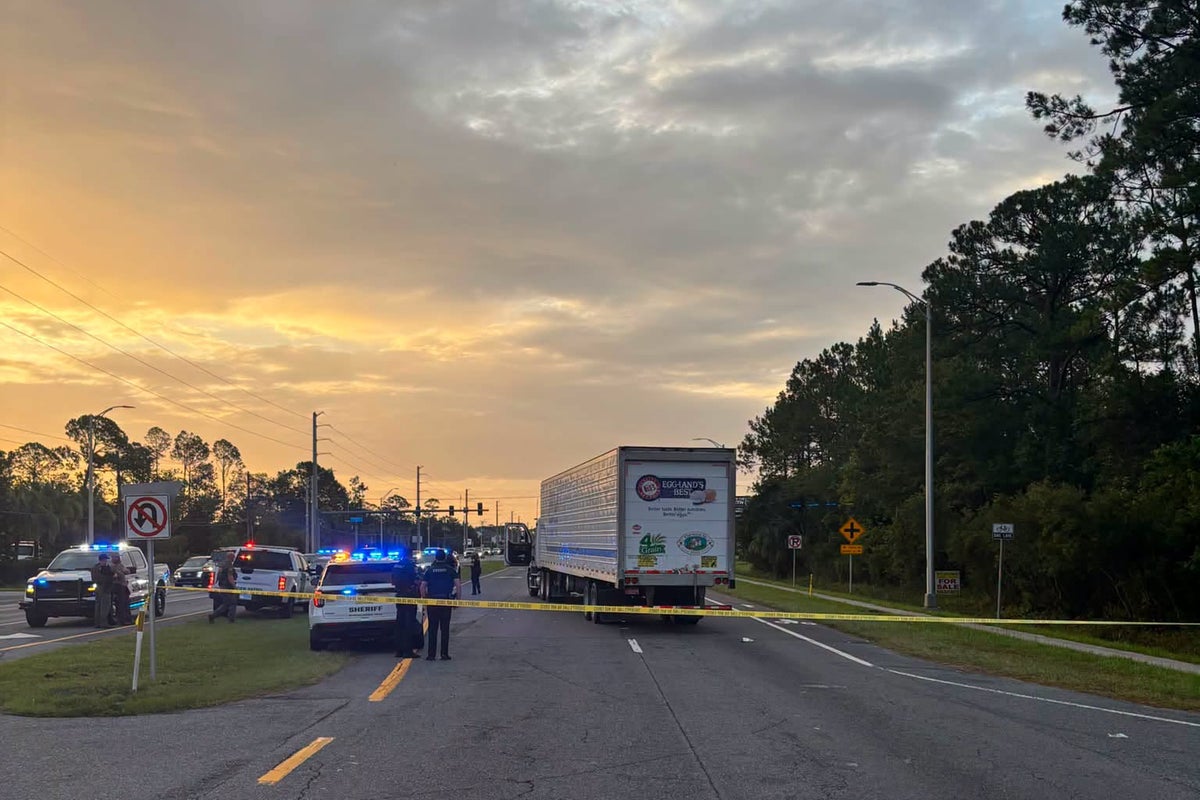
When local news outlets reported the incident, the headlines followed a familiar, sanitized template: an undocumented individual, fleeing from federal immigration enforcement officers, ran onto a nearby highway and was struck and killed by an oncoming tractor-trailer.
The report was factual. It was brief. It was cold.
Yet behind those few concise sentences lies a complex chain of human decisions, immediate panic, and a system where fear often dictates the final moments of a life.
The Mechanics of Panic
To understand how a person ends up on an active interstate in the middle of the night, one must consider the psychological state of being pursued.
Panic does not reason. Panic acts on pure instinct.
Imagine a hypothetical worker—let us call him Mateo—who has lived in the shadows for years. Every morning begins with a quiet, persistent calculation: Which route to work is safest? Which taillight needs fixing immediately? What happens if a squad car pulls up behind at a red light? This is not abstract policy; it is a daily, physical reality lived by hundreds of thousands of people across the country.
When law enforcement or immigration officers suddenly appear, that underlying baseline of anxiety instantly spike into sheer survival mode. Adrenaline floods the bloodstream. The brain's prefrontal cortex—the center responsible for logical reasoning, risk assessment, and long-term planning—effectively goes offline. The amygdala takes control.
In that state, a six-lane highway carrying sixty-five-mile-per-hour traffic does not register as a lethal hazard. It registers simply as an exit. Away. Anywhere else.
The tragedy on the Florida highway was not born of deliberate choice, but of a primal attempt to escape an immediate threat, real or perceived. When the human mind is consumed by terror, the danger in front of you always seems greater than the danger you cannot see in the dark ahead.
The Invisible Bystanders
Every time an incident like this occurs, the narrative quickly focuses on two sides: the agencies conducting the operation and the individual who died. But the blast radius of such an event extends far beyond those immediate actors.
Consider the driver of that tractor-trailer.
He was likely hours into a long shift, watching the white lines flicker past, thinking about his family, his cargo, or his next fuel stop. In an instant, through no fault of his own, he became the instrument of someone else’s demise. The trauma of striking a pedestrian on a highway is severe and long-lasting. Truck drivers involved in fatal collisions often suffer from deep psychological distress, insomnia, and post-traumatic stress that can end their careers.
Consider the officers on scene. What began as a standard enforcement action turned, in a matter of seconds, into a scene of fatal trauma.
Consider the local emergency responders who arrive in the aftermath to clean up the wreckage, secure the scene, and log the details for an official report that will barely scratch the surface of what actually happened.
When an enforcement action spills over into public spaces, the stakes expand instantly. What was intended as a targeted effort becomes a public safety hazard that leaves permanent scars on ordinary citizens caught in the crossfire.
The Systemic Fractures
It is easy to treat an event like this as an isolated accident—a tragic series of unfortunate choices by a single individual on a specific night. But patterns tell a different story.
Across the United States, enforcement actions conducted near busy thoroughfares, residential neighborhoods, or commercial centers carry an inherent risk of collateral impact. When high-stakes encounters take place in uncontained environments, the margin for error vanishes entirely.
Policy debates around immigration typically center on macro-level concepts: border security, visa quotas, economic impacts, and legal frameworks. These discussions take place in air-conditioned committee rooms and television studios, far removed from the physical realities of the enforcement ground level.
On the ground, policy is not an abstract debate. Policy is a high-speed chase. Policy is a flashing light in the rearview mirror. Policy is a desperate sprint through the brush toward an oncoming wall of traffic.
When enforcement mechanisms operate without adequate protocols to account for panic responses in public spaces, outcomes like the one on the Florida highway become statistically inevitable over time.
The Reality Left Behind
In the days following the collision, the highway reopens completely. The debris is cleared. The skid marks slowly fade under the weight of thousands of passing commuters who will never know that a man died on that exact patch of pavement.
The official news brief moves down the feed, replaced by newer, fresher headlines. The legal system will file its reports, process the vehicle damage, and close the file.
Yet somewhere, a phone rings in a home far away. A family learns that their son, brother, or father will not be coming back. A truck driver sits in a quiet room, replaying those final two seconds over and over again in his head, wondering if he could have reacted faster, even when physics made it impossible.
The story ends in a brief statement to the press, but the reality lingers on the hot Florida asphalt long after the flashing lights have gone out.