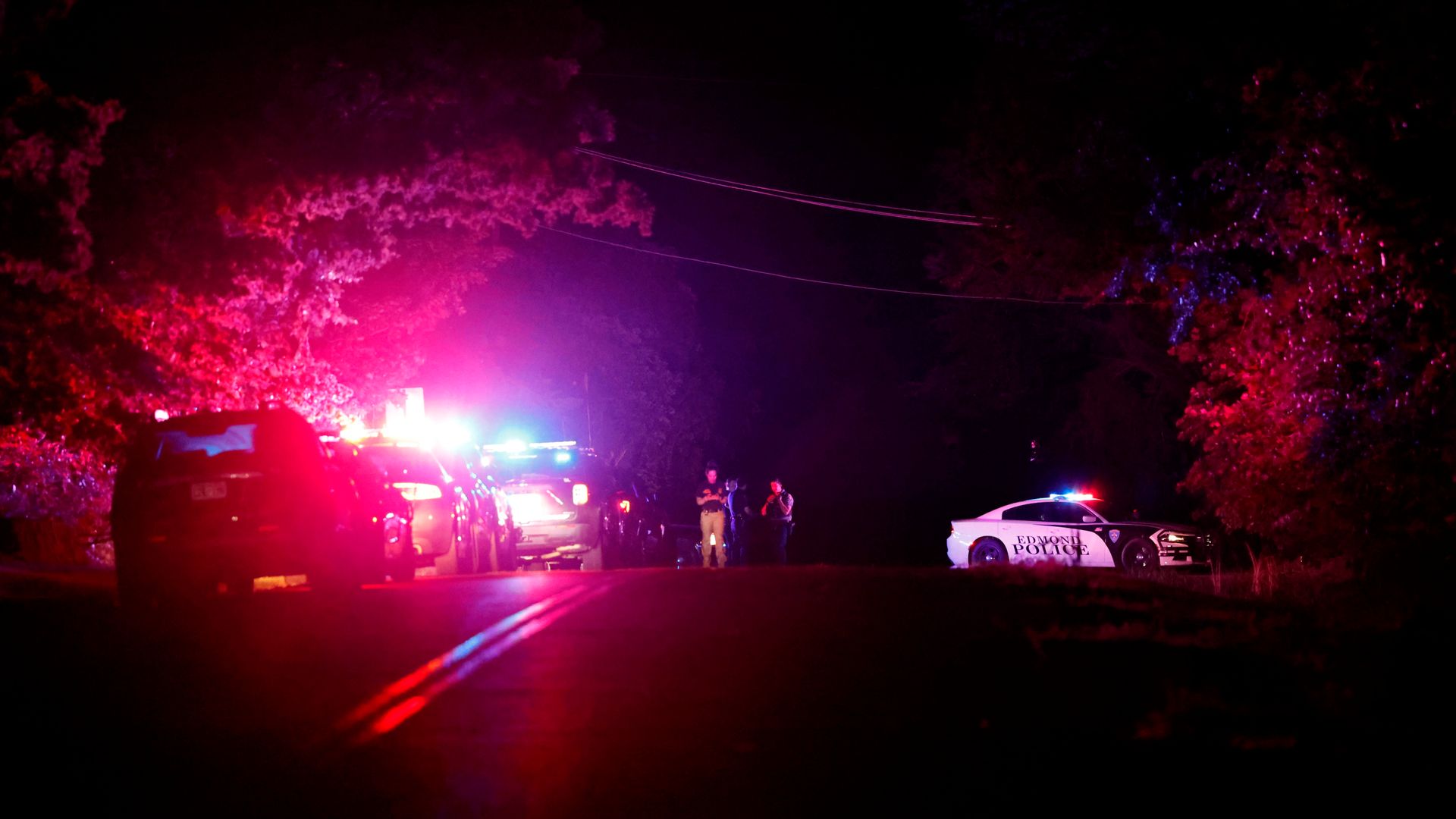
The headlines are already calcifying into the usual script. Twelve people shot at an after-hours party in Oklahoma City. The frantic sirens. The "thoughts and prayers" from local officials. The immediate, reflexive pivot to the national debate on gun control. It is a tired, predictable dance that obscures the gritty reality of what actually happened on that pavement. Most reporting treats these events as spontaneous eruptions of madness or failures of legislation. They are neither. They are the logical, inevitable result of a systemic failure in urban risk management and the professionalization of chaos.
Media outlets love the "senseless violence" angle. It sells. It feels tragic. But calling this senseless is a cop-out. It suggests we couldn’t see it coming. If you have spent any time in the trenches of municipal security or high-risk event planning, you know that an unlicensed, unpermitted gathering of several hundred people in a commercial district at 2:00 AM isn't an accident waiting to happen—it’s an invitation.
The Myth of the Random Shooter
The competitor coverage focuses on the shooter as a singular, demonic force. This is the first mistake. In environments like the one in Oklahoma City, the shooter is often a secondary factor to the environment itself. When you cram a high density of people into a space with zero security oversight, no egress plan, and no barrier to entry, you have created a "soft target" by design.
We need to stop talking about "mass shootings" as a monolithic category. A school shooting, a workplace grievance, and an after-hours party brawl are three entirely different sociological phenomena. By lumping them together, the media dilutes the solutions. The Oklahoma City incident was an escalatory conflict—a dispute that turned lethal because the environment allowed it to fester.
I have consulted on urban security projects where the data is clear: violence in these contexts follows a specific, predictable "flashpoint" curve. It starts with noise complaints, moves to verbal altercations, and ends in lead. The "lazy consensus" is that we need better background checks to stop this. The reality? We need better urban zoning enforcement and a brutal crackdown on the underground event economy that thrives on the fringes of our cities.
The Failure of the First Responder Fetish
We have a cultural obsession with the "heroic response." We track how many minutes it took for the police to arrive and how many surgeons were on standby at the local trauma center. While the medical response in Oklahoma City was technically proficient, the focus on it is a distraction.
Measuring the success of a city’s safety by its response time is like measuring a car’s safety by how well the airbags work during a head-on collision at eighty miles per hour. You’ve already lost. The trauma surgeons at OU Health are some of the best in the country, but their expertise shouldn’t be the metric we use to judge the health of our streets.
The real failure happened weeks before the first shot was fired. It happened when the "after-hours" culture was allowed to operate in a legal gray zone. In most mid-sized American cities, the police know exactly where these parties happen. They know which warehouses and storefronts are being used as unlicensed clubs. They don’t intervene because the paperwork is a nightmare or because the political will to "kill the vibe" doesn't exist. Then, when twelve people are hospitalized, everyone acts shocked.
The Broken Window of the Digital Age
Social media is the accelerant that the "standard" news reports ignore. These parties aren't organized by word of mouth; they are blasted out via encrypted apps and ephemeral stories. This creates a high-velocity influx of people from different neighborhoods, often with pre-existing tensions, into a neutral, unpoliced ground.
When you look at the geography of the Oklahoma City shooting, it wasn't a "bad neighborhood." It was a failure of digital-to-physical monitoring. The industry is currently obsessed with "predictive policing" software, but most of it is junk. It looks at historical crime data rather than real-time social signals. If you want to stop the next dozen people from ending up in a triage unit, you don't need more patrol cars; you need to hold the platforms and the organizers civilly liable for the carnage they facilitate.
The Cost of the "Safe" Narrative
The most dangerous part of the current reporting is the implication that this is a "uniquely American" problem that can only be solved at the federal level. This is a lie that lets local leaders off the hook. By framing every shooting as part of the "national gun crisis," we ignore the specific, granular failures of the Oklahoma City Police Department and the city council to manage their own backyard.
It is easier to blame a distant legislative body in D.C. than it is to explain why a known "hot spot" wasn't shut down for code violations six months ago. We are subsidizing violence with our own administrative laziness.
Stop Asking if People Feel Safe
"Do you feel safe in your city?" is the most useless question a journalist can ask. Feelings are irrelevant. Risk is a math problem.
The probability of a mass casualty event at an unvetted gathering is exponentially higher than at a regulated venue. Yet, we don't treat these organizers like we treat legitimate business owners. If a licensed bar had twelve people shot on its premises, it would be razed to the ground legally and financially within a week. The "underground" party in Oklahoma City? The organizers will likely vanish into the digital ether, only to pop up under a new handle next weekend.
The Uncomfortable Truth of Victimology
We hate talking about this, but it’s the nuance that the competitor’s article missed: the profile of the "party-goer" in these scenarios is often someone who is consciously opting out of regulated, safe environments in favor of "authentic," lawless spaces.
There is a thrill in the unregulated. There is a market for the unpoliced. Until we acknowledge that a segment of the population actively seeks out these high-risk environments, our "safety" measures will continue to miss the mark. You cannot protect people who are intentionally bypassing the systems designed to protect them.
The Logistics of the Lead
Let's talk about the hardware for a second, without the political baggage. The Oklahoma City shooting likely involved high-capacity magazines and rapid-fire exchanges. The "consensus" says "ban the guns." The contrarian reality? You can’t "ban" your way out of a logistical surplus of 400 million firearms.
The focus should be on the interdiction of the event, not just the weapon. If the event doesn't happen, the weapon stays in the waistband or the glove box. We are fighting the wrong battle on the wrong terrain. We are trying to win a war of attrition against inanimate objects while the tactical environment—the party itself—remains a wide-open flank.
The Liability Shift
If you want to disrupt this cycle, stop looking at the police and start looking at the insurance companies and the landlords. The "contrarian" fix for Oklahoma City isn't more cops; it's a massive shift in premises liability.
Imagine a scenario where the owner of a commercial property is held 100% financially responsible for every medical bill resulting from an unlicensed event on their property. No "I didn't know they were throwing a party" excuses. Total, absolute liability. The moment you make it more expensive to ignore the problem than to fix it, these venues vanish.
The reason these shootings continue is that the "cost" is currently externalized. The victims pay with their lives, the taxpayers pay for the police and the ER, and the organizers and property owners walk away with a clean slate.
The Mirage of Gun-Free Zones
The party in Oklahoma City was likely a "gun-free" zone by default or by some flimsy sign on the door. These zones are nothing more than psychological security blankets for the naive. In an unmonitored environment, a gun-free zone is actually a "predator-rich" zone. It guarantees that only the people willing to break the law will be armed.
I’ve seen high-end private security details handle crowds five times the size of the Oklahoma City party without a single scuffle. Why? Because they understand the "Threshold of Violence." They manage the queue, they scan for body language, and they maintain a visible, credible deterrent. When you rely on "policy" instead of "presence," you get twelve people in the hospital.
Dismantling the "Tragedy" Label
We need to stop calling these events "tragedies." A tragedy is an unavoidable act of God—a lightning strike, a sudden aneurysm. The Oklahoma City shooting was a failure of systems.
It was a failure of the Oklahoma City code enforcement.
It was a failure of the property manager.
It was a failure of the social media platforms used to organize the event.
It was a failure of a police department that prioritizes "response" over "disruption."
Every time we use the word "tragedy," we provide cover for the people whose incompetence allowed the event to happen. We give them an "out." We allow them to stand at a podium, look somber, and say, "There was nothing we could do."
There was everything you could do. You just didn't do it.
The Professionalization of the After-Party
The "underground" is no longer a few kids with a boombox in a basement. It is a sophisticated, multi-million dollar industry that thrives on bypassing the safety protocols that keep the rest of society functioning. It utilizes specialized promoters, illicit liquor distribution, and private "security" that is often just as volatile as the crowd.
The Oklahoma City shooting is the "market price" of our refusal to regulate this shadow economy. We want the "vibrant" nightlife and the "gritty" urban experience, but we don't want to pay the price of admission, which is rigorous, uncompromising enforcement.
If you were in Oklahoma City that night, you didn't see a "shooting." You saw the final act of a long-running play about administrative neglect and cultural delusion. The shooters are just the actors. The city government wrote the script. The property owners built the stage. And the media is providing the rave reviews.
Stop looking at the guns. Start looking at the floor plan.
Shut down the venue. Hold the landlord. End the spectacle.