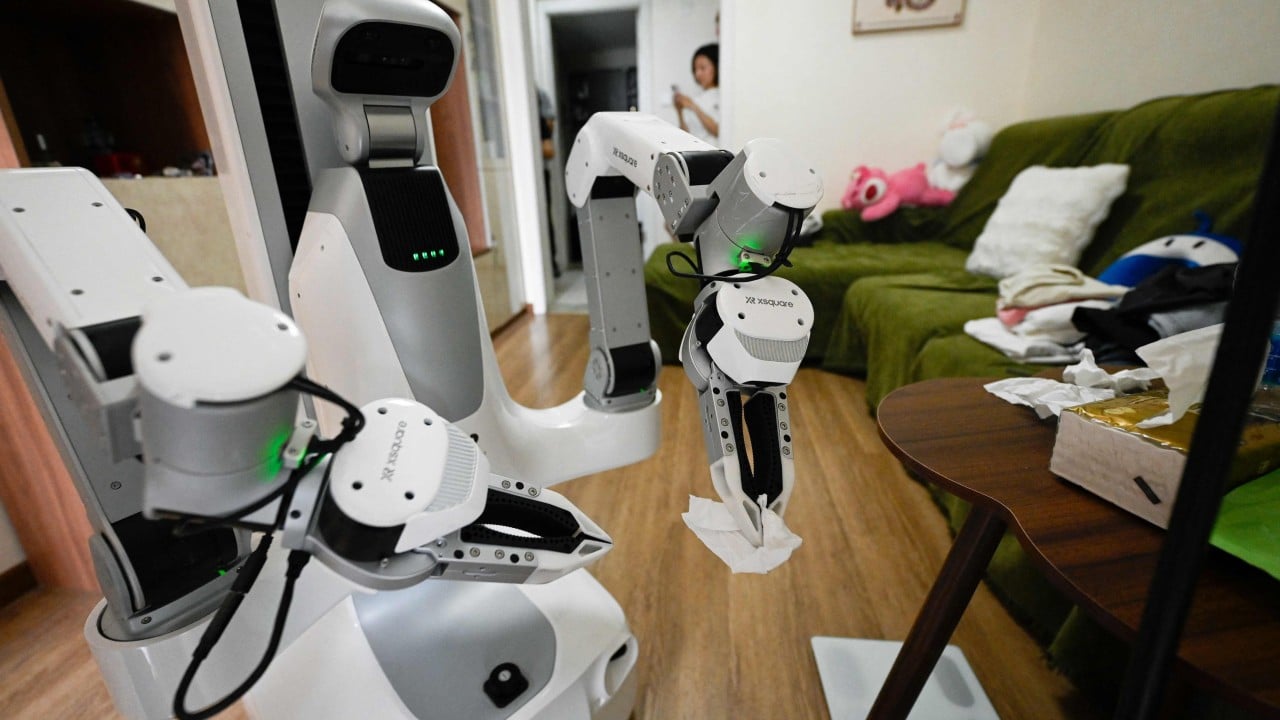
Wall Street and Asian financial media are hyperventilating over confidential IPO filings from Chinese embodied intelligence startups like X Square Robot. Analysts breathlessly point to multibillion-dollar valuations and massive funding rounds backed by tech giants as proof that physical artificial intelligence is the next massive consumer asset class.
They have completely missed the plot. You might also find this related story insightful: The Economics of Decarbonization Structural Mechanics and Capital Allocation.
I have watched venture syndicates pour billions into hardware companies before they solved basic operational reliability. Chasing a public listing while your core software stack still requires remote human teleoperation for basic asset sorting is not a commercial milestone. It is a desperate liquidity escape hatch.
The Software Illusion Behind the Hardware Hype
The lazy consensus treats robotics startups as hardware manufacturers with an AI bonus. That formula is inverted. Companies building general-purpose embodied intelligence models are software entities weighed down by heavy, depreciating metal. As extensively documented in detailed articles by Bloomberg, the implications are widespread.
Look closely at the technical architecture touted in these prospectuses. They champion "end-to-end world models" trained on real-world video data. What the brochures omit is the inference cost and latency penalty of running billion-parameter spatial models on edge hardware while trying to fold laundry or assemble an automotive component without crushing a human hand.
Imagine a scenario where a humanoid robot is deployed in an unregulated home environment. A minor sensor drift caused by household dust or changing ambient light turns a probabilistic grasping model into a liability vector. When your success rate on a multi-step manipulation task hovers below eighty percent in unstructured spaces, you do not have a product. You have an expensive remote-controlled appliance that requires an engineer standing by with an emergency stop button.
Why the Public Markets Are the Wrong Diagnostic Tool
Private equity has institutionalized the circular funding loop. Tech conglomerates and state-backed funds inject hundreds of millions into Series B and C rounds, inflating valuations past the twenty billion yuan threshold. When the private check-writers run out of dry powder or grow weary of burning capital on hardware iteration cycles, the bankers pivot to Plan B: Hong Kong.
An initial public offering in the current climate is rarely a sign of market-ready dominance. It is a structured liquidity event designed to let early venture backers offload risk onto retail investors and institutional funds hunting for technology exposure.
The financial logic is brutal. Building custom actuators, harmonic drives, and tactile sensors requires continuous capital expenditure. Unlike pure-play software enterprises that scale with zero marginal cost, every single unit rolling off a robotics assembly line costs actual raw materials, machine hours, and quality control overhead. When operating margins are squeezed by intense domestic price wars, management teams look to the public markets not to fund expansion, but to survive the burn rate.
Dismantling the Smartphone Fallacy
The most dangerous delusion in the robotics sector is the hardware comparison. Market commentators love to claim that if humanoid units can reach smartphone-level adoption at passenger vehicle price points, the total addressable market is infinite.
This comparison collapses under elementary scrutiny. A smartphone offloads complex computation to cloud servers, relies on human fingers for input, and sits passively in a pocket when unused. A robot operates in physical three-dimensional space where failure results in property damage or physical harm. The safety margins, compliance overhead, and liability insurance required for autonomous deployment in commercial or residential zones dwarf anything seen in consumer electronics.
If you buy into the narrative that a public listing on a tech-heavy board validates the immediate commercial viability of general-purpose bipedal machines, you are confusing stock market sentiment with physics.
The Contrarian Playbook
Do not look at the fundraising totals. Ignore the headline-grabbing valuation multiples tossed around by investment banks courting underwriting fees. Measure these firms by a single metric: gross margin per unit shipped independent of government subsidies or parent-company procurement deals.
Until an embodied AI startup can manufacture, deploy, and maintain a fleet in the field without continuous software patches and manual overrides while remaining cash-flow positive, every public listing is just a high-stakes game of financial hot potato.
Stop funding the illusion of autonomy. Watch who actually controls the proprietary real-world data loops, and ignore everyone else rushing to ring the exchange bell before the capital window slams shut.


.png?width=1200&auto=webp&trim=0%2C0%2C0%2C0)