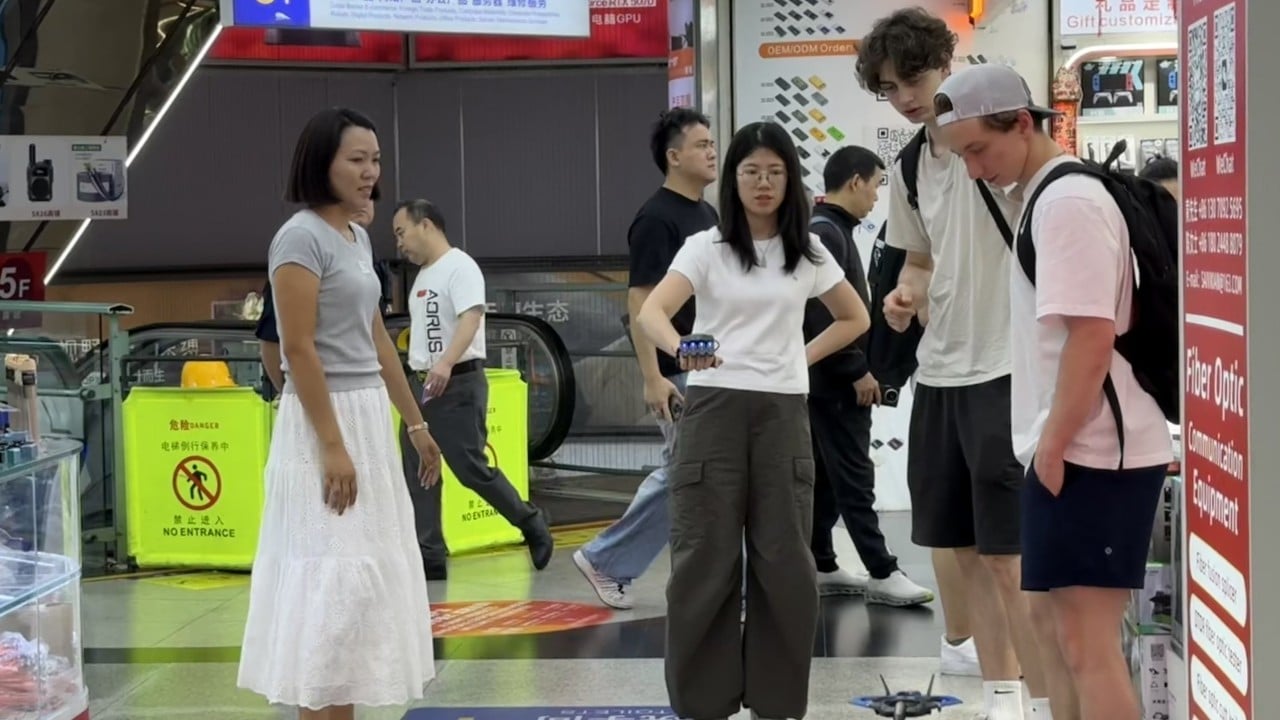
The narrative surrounding Shenzhen’s Huaqiangbei electronics market is currently undergoing a desperate face-lift. The "World’s Largest Electronics Market" is tired of being the place where you go to buy a knock-off iPhone charger or a refurbished mining rig. The new gospel being preached by local boosters and optimistic tech journalists is that Huaqiangbei is pivoting to AI hardware. They want you to believe that the same stalls that sold fidget spinners and shanzhai handsets are now the cradle of the next intelligence revolution.
They are wrong.
The assumption that "speed to market" translates to "AI innovation" is the most expensive mistake a hardware investor can make today. Huaqiangbei is built on the philosophy of the fast follow—the ability to reverse-engineer a trend and flood the market with cheap iterations. AI, however, is a game of deep integration, high-stakes silicon, and proprietary software moats. You cannot "shanzhai" a Large Language Model (LLM), and you certainly cannot build a world-class AI ecosystem on the back of gray-market H100s and plastic casings.
The Myth of the Agile Maker
The standard argument for Huaqiangbei’s AI pivot is its unmatched supply chain agility. The logic goes: if you need a specific sensor, a custom PCB, or a localized housing for an AI-powered wearable, you can get it done in Shenzhen in forty-eight hours.
I have spent a decade watching hardware startups burn through VC cash in these very streets. Agility is only a virtue if you are moving in a direction that actually creates value. In the AI era, the physical shell—the "hardware"—is rapidly becoming a commodity. The value has shifted entirely to the inference engine and the data feedback loop.
Huaqiangbei excels at "Productization." It fails miserably at "Invention."
When you see a stall in SEG Plaza selling "AI Glasses," you aren't looking at a breakthrough. You are looking at a standard pair of Bluetooth frames with a thin API wrapper around ChatGPT or DeepSeek. There is no proprietary R&D. There is no edge computing optimization. It is a skin. It is a costume.
The Silicon Ceiling
We need to address the elephant in the room: the United States Department of Commerce.
The optimistic "revival" story ignores the brutal reality of export controls. Huaqiangbei has long operated as a liquidity provider for restricted tech. If you had enough cash, you could find a way to secure a crate of high-end NVIDIA GPUs. But a "black market" for chips is not a foundation for an industry. It is a survival tactic for a dying one.
- Fragmented Supply: You cannot build a scalable AI hardware company on "fell off a truck" silicon.
- Thermal and Power Constraints: LLMs require massive compute power. The "makers" in Shenzhen are used to working with low-power mobile chips. Cramming AI into a consumer form factor requires sophisticated thermal engineering that doesn't exist in a 2x2 meter stall.
- Software Isolation: China’s domestic AI models are evolving in a separate biosphere. The interoperability that Huaqiangbei once enjoyed with the global Android and Windows ecosystems is fracturing.
The "innovations" being touted are largely hardware shells for software that the makers didn't write and don't control. If your "innovation" can be disabled by a remote API kill-switch from a company in San Francisco or Beijing, you don't own a product. You own a paperweight.
The Failure of "AI for Everything"
Walk through the Futian district today and you will see "AI-powered" everything. AI toothbrushes. AI pillows. AI coffee mugs. This is not innovation; it is a marketing tax.
The competitor piece suggests this "variety" is a sign of a vibrant ecosystem. In reality, it is a sign of saturation and lack of vision. When you don't know what to build, you slap a "Smart" or "AI" sticker on a legacy product and hope the novelty carries you through the quarter.
True AI hardware—think Humane’s AI Pin (despite its flaws) or Rabbit R1—requires a fundamental rethinking of the User Interface (UI). It requires an "AI-first" design language. Huaqiangbei is structurally incapable of this because its business model is "Component-first." They start with what is available in the bin and work backward to a product. To build the future of AI, you must start with the model and work forward to the silicon.
The Margin Trap
The most dangerous part of the Huaqiangbei myth is the belief that low costs will win the AI race.
In the 2010s, low margins were the weapon that allowed Chinese smartphone brands to decimate the competition. But AI is not a race to the bottom on price; it is a race to the top on utility.
- Compute Costs: Running inference on a device is expensive.
- Data Costs: Training and refining models requires massive investment.
- Talent Costs: The engineers who actually understand how to optimize a transformer model for edge devices aren't working in a market stall for five dollars an hour.
By the time a Huaqiangbei maker produces a "cheap" version of a high-end AI device, the software will have moved three generations ahead. The hardware will be obsolete before it hits the shipping container. The "Fast Follower" strategy works for phone cases and charging cables. It is a death sentence for AI hardware.
Why Investors Should Stay Away
I have seen companies blow millions trying to "tap into the Shenzhen speed." They fly in, get seduced by the 24-hour prototype cycle, and leave with a product that has no soul and no software moat.
The "global appeal" that boosters talk about is a relic of the past. The world no longer wants "more" electronics. We are drowning in them. The world wants "better" intelligence. You cannot buy intelligence by the kilogram in SEG Plaza.
If you are looking for the future of AI hardware, don't look at the people selling components. Look at the people building the custom ASICs (Application-Specific Integrated Circuits) that make general-purpose GPUs look like steam engines. Look at the labs working on neuromorphic computing. None of those people are operating out of a stall in Huaqiangbei.
The Shanzhai Ghost in the Machine
The irony of the "AI Revival" is that AI is actually the thing that might finally kill Huaqiangbei.
Generative AI allows for the automation of basic PCB design and CAD modeling. The very skills that made Shenzhen’s "makers" special are being codified into software. When a kid in Ohio can prompt a localized AI to design a custom motherboard and send the files to an automated factory, the "middleman" culture of the electronics market evaporates.
Huaqiangbei is a middleman economy. It thrives on friction, on knowing who has what part and where to get it. AI is the ultimate friction-remover.
Stop Asking the Wrong Question
The question isn't "Can AI revive Huaqiangbei?"
The question is "Why do we still think a physical marketplace is the right venue for a software-defined revolution?"
We are witnessing the final gasps of a 20th-century distribution model trying to dress up in 21st-century clothes. The "innovations" coming out of these stalls are the tech equivalent of a cargo cult. They see the shape of AI, they see the buzzwords, and they build physical replicas of what they think the future looks like. But there is no engine inside.
The real AI hardware revolution is happening in clean rooms and high-level software architecture meetings, far away from the shouting and the soldering smoke of Shenzhen’s back alleys.
Huaqiangbei isn't pivoting. It's pretending.
Stop buying the hype. The "World’s Electronics Capital" is becoming a museum of what used to be possible when hardware was all that mattered. In an AI world, hardware is just the tax you pay to run the code. And nobody wins by being the best at collecting taxes.
Get out of the market. Get into the model.