The Iranian national football team will enter the United States on June 14, landing directly in a geopolitical pressure cooker. In less than twenty-four hours, Team Melli is scheduled to step onto the pitch at the Los Angeles Rams’ stadium in Inglewood to face New Zealand. On paper, it is a standard Group G opening match. In reality, it represents the most compromised, politically fractured preparation in modern sports history, occurring while Iran is in a state of direct military conflict with the primary tournament host, the United States.
While a standard sports narrative focuses on tactical drills and fitness levels, the true crisis of the Iranian squad is psychological and bureaucratic survival. This is not about the traditional anxiety of a major tournament. It is about a squad forced to train in exile, navigating weaponized visa systems, while carrying the impossible burden of representing a nation currently under bombardment.
The core of the problem lies in the split identity of the team itself. To the ruling clerics in Tehran, the squad is a tool for projecting a facade of normal international relations during wartime. To millions of Iranians at home and in the massive diaspora of Southern California, the players are walking a tightrope between national pride and state complicity. The question is no longer whether Iran can advance past the group stage, but whether a team can function when its very existence satisfies no one.
The Geography of Exile
High-level athletic performance requires consistency, routine, and a controlled environment. The Iranian preparation has possessed none of these. Originally, the Football Federation Islamic Republic of Iran planned a training camp in Tucson, Arizona, designed to acclimate the players to the climate and time zones of the American Southwest. That plan collapsed.
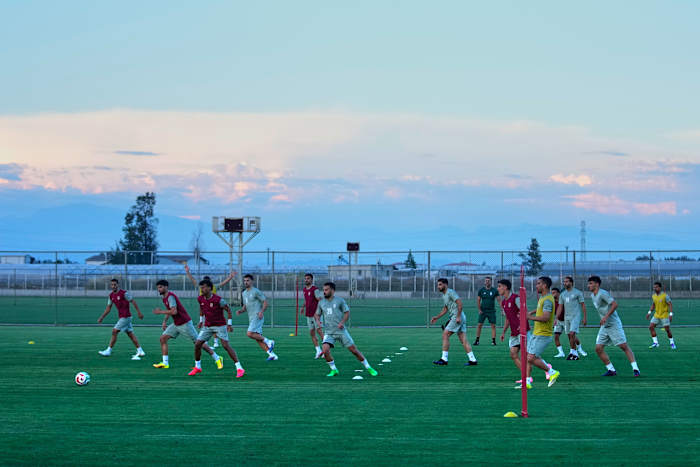
The United States visa apparatus effectively functioned as a defensive front line. Denials and severe processing delays forced the team to alter its entire itinerary. Instead of Arizona, the squad spent weeks sequestered at a coastal resort in Antalya, Turkey, operating under strict media restrictions and minimal access to international journalists. Players had to commute to the American embassy in Ankara just to submit paperwork, creating a disjointed camp where tactical sessions were routinely interrupted by bureaucratic obligations.
The logistical emergency culminated in a forced relocation of their tournament base to Tijuana, Mexico. The team will reside on the Mexican border, commuting across into California under intense security protocol just before match days. This is a severe disadvantage. Top-tier international squads spend years engineering seamless travel logistics to minimize physical fatigue. Iran’s players will be adjusting to a massive time zone shift and the ambient stress of border crossings while preparing to face peak athletic competition.
Midfielder Saeid Ezatolahi, entering his third World Cup, acknowledged the mental toll. Following the daily news from home while attempting to maintain tactical focus is an overwhelming psychological strain. The veteran players can compartmentalize to a degree, but younger members of the squad, like twenty-four-year-old Mohammad Ghorbani, are forced to mature under conditions that have little to do with football.
The War in the Stands
When Iran steps onto the pitch in Inglewood, they will not be met by a neutral crowd. Southern California is home to the largest concentration of Iranians outside of Iran, a population deeply hostile to the current regime in Tehran. The stadium will become an arena for internal domestic conflict.
The diaspora itself is fundamentally fractured over how to treat the team.
| Perspective | Core Argument | Stadium Action |
|---|---|---|
| The Dissidents | The team functions as a propaganda wing for a regime that just executed protesting athletes. | Active protests, boycotts, and anti-regime chanting. |
| The Nationalists | Football transcends the current government; the jersey belongs to the people, not the state. | Displaying the pre-revolutionary Lion and Sun flag. |
| The Escapists | Sports should offer a temporary reprieve from months of trauma and military bombardment. | Standard athletic support and neutrality. |
This internal division creates an unprecedented environment for the players. If they celebrate a goal too enthusiastically, they are viewed as agents of state propaganda. If they refuse to sing the national anthem—as they did during the 2022 tournament in Qatar—they face severe, immediate retribution from state security forces upon their return. Every movement, gesture, and glance at the stands will be scrutinized for political compliance or defiance.
The physical symbols within the stadium are already a flashpoint. FIFA has maintained its strict ban on the historical Lion and Sun flag, a symbol favored by opposition groups and the diaspora to signal resistance. This decision has drawn legal threats from human rights organizations and ensure that the security perimeters of the stadiums will be heavily contested zones before a ball is even kicked. The pitch is no longer a sanctuary; it is a stage where a geopolitical proxy war is being staged via athletic apparel and crowd control.
FIFA and the Myth of Neutrality
The international football governing body has long hidden behind the doctrine that sport and politics must remain completely separate. It is a philosophy that has completely shattered in the buildup to this tournament. FIFA’s silence regarding the execution and imprisonment of Iranian athletes during recent domestic uprisings has drawn intense internal and external criticism. Former national team icons, including Masoud Shojaei and Ali Karimi, have publicly condemned the organization for failing to protect the sporting community within Iran.
The hypocrisy is structural. When Russia invaded Ukraine, the response from western sporting bodies and FIFA was swift and absolute; teams were banned, contracts terminated, and flags removed. Yet, with Iran actively engaged in military hostilities against the United States, the team is permitted to play, provided they navigate a visa system designed to hamstring them. This creates a gray zone where the tournament allows participation but denies equity.
The athletic impact of this systemic stress cannot be overstated. Consider a hypothetical scenario where an elite athlete is placed under surveillance, denied a direct entry visa to their competition venue, forced to train in a third country, and subjected to public death threats against their family if they do not perform a state-mandated political ritual before the match. No sports psychologist would expect peak performance under those conditions. Yet, this is the baseline reality for the twenty-six men in the Iranian kit.
The Fractured Pitch
Football teams rely on collective cohesion, often referred to as a locker-room bunker mentality. But what happens when the external fissures run straight through the locker room itself? The squad is not a monolith. It contains players with varied proximity to state power, differing financial dependencies on domestic clubs, and distinct levels of international insulation.
Players holding lucrative contracts in European or Gulf leagues have a degree of protection that domestic-based players lack. They can afford to speak with slight nuance, or express subtle solidarity with the hardships of the population. For a domestic player whose livelihood and family safety depend directly on the good graces of the Football Federation and the Ministry of Sport, any deviation from the state line is professional and personal suicide. This disparity creates natural, unspoken fault lines within the squad.
The public pronouncements from camp are telling in what they omit. When Ghorbani speaks of bringing "joy to the people," it is a carefully managed phrasing designed to offend neither the regime censors nor the grieving public. It is the language of survival.
The physical toll of their exile preparation will likely manifest early in matches. The team has lacked high-quality international friendlies due to nations refusing to schedule matches with Iran during an active conflict. Tactical cohesion cannot be manufactured in a isolated resort in Antalya against limited opposition. While Belgium and New Zealand fine-tune their tactical shapes against elite competition, Iran has been playing against its own shadows, trying to keep its mind from drifting to the target packages falling on Tehran.
The Immediate Reality
The match in Los Angeles will offer no catharsis. It will provide no grand resolution to a decades-long conflict or the current war. Instead, it will expose the raw, uncomfortable truth that modern international sport is deeply entangled with state violence and geopolitical leverage.
Team Melli will cross the border from Tijuana, enter the stadium under armed escort, and play before a crowd that is simultaneously mourning, protesting, and cheering. The players are trapped in a zero-sum game where performance is co-opted by authoritarian power and failure is celebrated by those who wish to see the state humiliated.
They will run until their legs give out, because that is the only part of their lives they currently control. When the final whistle blows in Seattle on June 26 after their final group match against Egypt, the tournament will move on. The cameras will turn to the traditional powerhouses of the sport. The Iranian players will quietly board flights back to a reality where the stakes are infinitely higher than a place in the knockout rounds.