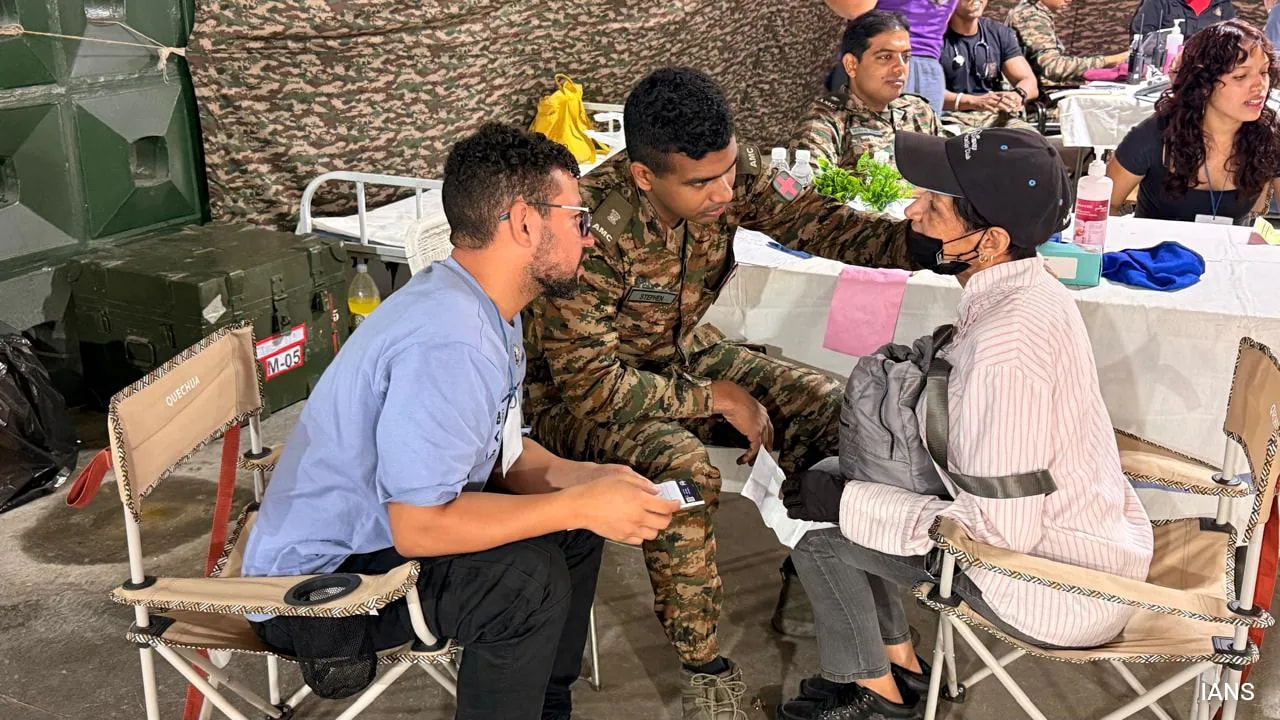
India just packed up its military medical camp in Caracas, and the global diplomatic community should take notes. On July 6, 2026, the Indian Army officially wrapped up Operation Amistad, closing down its specialized field hospital in Venezuela. The team left after days of intense, around-the-clock emergency operations following the horrific twin earthquakes that struck the South American nation on June 24.
When the 7.2 and 7.5 magnitude quakes hit, they shattered infrastructure across Venezuela, killing over 3,300 people and injuring thousands more. The local hospital system faced immediate collapse. Instead of just sending standard financial aid or cargo pallets of blankets, New Delhi flew an entire elite medical facility halfway across the planet.
This was not a standard deployment. It showed how fast modern disaster response can move when a country treats medical logistics like an active combat operation. The deployment proved that geographical distance does not matter anymore if you have the right tech and the muscle memory to move it.
The Quick Turnaround of Operation Amistad
When the ground shook on June 24, the devastation was immediate. Buildings crumbled in Aragua, Miranda, and La Guaira. The National Assembly reported that hundreds of structures collapsed completely, leaving over 16,000 people suddenly homeless. The sudden influx of trauma patients threatened to overwhelm the remaining medical centers in Caracas.
India responded within forty-eight hours.
Under the name Operation Amistad—the Spanish word for friendship—the Indian government ordered two Indian Air Force C-17 Globemaster transport aircraft to load up at Hindon Air Base near New Delhi. They carried a 41-member elite medical contingent from the 60 Para Field Hospital, alongside 66 tonnes of humanitarian supplies, emergency medication, and highly specialized surgical gear.
The flight path itself was a logistical nightmare. The planes flew over 14,000 kilometers, making a critical refueling stop at Côte d'Ivoire on the west coast of Africa before crossing the Atlantic to touch down in Caracas. By June 28, the camp was fully operational.
Many international aid missions take a week just to get permissions and clear customs. The Indian team bypassed the usual bureaucratic drag because they brought a self-contained ecosystem. They did not need to plug into the local grid to start saving lives.
Inside the International La Rinconada Racetrack Setup
The Indian team picked the International La Rinconada Racetrack in Caracas as their operating base. It was a tactical choice. You need wide open spaces with clear aerial access to run an effective disaster triage center, and a racetrack fits perfectly.
The camp operated 24 hours a day, offering all services entirely for free. The team included nine medical officers, specialized surgeons, anesthetists, orthopedists, and dental experts. They were not just handing out painkillers. They performed major surgeries on victims who had been pulled from heavy rubble days after the initial tremors.
Consider the case of a 79-year-old woman rescued from a collapsed house nearly a week after the disaster. She arrived at the racetrack facility with a badly fractured leg, severe peripheral arterial disease, and a painful arterial ulcer caused by days of entrapment. The surgical team stabilized her fracture, initiated advanced wound care, and saved her limb from amputation.
Local residents filled the waiting areas. By the time the hospital closed its doors, the personnel had treated hundreds of patients suffering from crushing injuries, open fractures, and deep psychological trauma. Venezuela’s Foreign Minister, Yvan Gil, visited the racetrack site personally to meet the doctors and thank the Indian government for stepping in during their worst crisis in a century.
High Tech Healing with BHISHM Cubes
The real star of this deployment was a piece of indigenous Indian technology called the BHISHM cube. Short for Bharat Health Initiative for Sahyog, Hita and Maitri, these are modular, mini emergency hospital units packed into compact, easily transportable crates. India sent two of these units to Caracas, and they changed how the triage unit operated.
A single BHISHM cube consists of 72 interconnected parts that can be unpacked and fully deployed in just 12 minutes. Think about that speed. Within a quarter of an hour, disaster responders went from having a pile of boxes to a fully functional mini-hospital featuring an operation theater, a ventilator, a patient monitor, and an independent oxygen generation plant.
The units use smart packaging to keep things organized under extreme stress. Every tool has a specific, color-coded slot. The power generation systems run independently, meaning the field hospital kept its lights and life-support machines on even when the surrounding city suffered massive power grid failures due to the 942 recorded aftershocks. Each cube can handle up to 200 trauma patients simultaneously, making them incredibly efficient for sudden mass-casualty events.
Winning Hearts and Minds in Caracas
Medical aid is a massive part of geopolitical soft power. The tangible impact on the ground creates deep emotional ties that formal treaties cannot match. As the Ministry of External Affairs shared updates during the operation, videos emerged of local Venezuelans expressing intense gratitude for the sudden arrival of these foreign military doctors.
One local mother, Lizzet Rodriguez, publicly thanked the team after her son received successful surgery for a fractured femur. Another survivor, Yoe Garcia, who suffered multiple fractures in La Guaira, noted that the swift surgical intervention on his arm and foot allowed him to walk out of the facility instead of facing permanent disability.
The presence of the 60 Para Field Hospital relieved immense pressure on the fractured Venezuelan public healthcare network. By taking over the primary trauma load in the capital district, the Indian army allowed local doctors to focus on restoring regular hospital services and managing the 80 temporary camps established for displaced citizens.
The Logistics Behind a Fourteen Thousand Kilometer Air Bridge
Deploying military assets across continents is something usually associated only with Western powers. India's ability to execute a flawless air bridge over 14,000 kilometers indicates a major shift in global disaster response capabilities. The Indian Air Force crews managed complex flight paths and rapid turnaround times without a hitch.
When the C-17s arrived, they did not just drop boxes and leave. The flight crews worked with local Venezuelan authorities and Indian Ambassador PK Ashok Babu to orchestrate immediate offloading and transport to La Rinconada. This required precise coordination with Venezuela's Head of Government for the Capital District, Nahum Fernandez.
The success of the operation rested on total self-reliance. The medical team brought their own water purification tablets, specialized rations, and communication gear. They did not drain a single resource from a city that was already starving for supplies. This is the gold standard for modern humanitarian assistance and disaster relief. You must be an asset, never a burden.
Moving Beyond Traditional Disaster Relief
Now that the tents are packed and the personnel are heading home, what happens next? The conclusion of Operation Amistad leaves a blueprint for how medium and rising powers can handle global crises.
If your country wants to build a reliable disaster response protocol based on the Indian model, here are the direct steps to implement right now.
First, stop relying on static supply chains. You need modular, deployable medical tech like the BHISHM cubes that can bypass damaged local infrastructure. Invest heavily in portable power and independent oxygen generation.
Second, run joint logistics drills that simulate long-range deployments. A 14,000-kilometer flight requires pre-negotiated refueling rights and rapid airspace clearance. Those agreements must be ironed out during peacetime, not while people are trapped under concrete.
Finally, integrate military medical units with civilian diplomatic teams. The seamless cooperation between the Indian Army, the Ministry of External Affairs, and Venezuelan regional heads allowed the racetrack hospital to open its doors in hours rather than weeks.
The field hospital in Caracas is empty now, but the strategic lesson is clear. Speed, self-containment, and high-tech modularity are the only things that matter when the earth starts shaking.