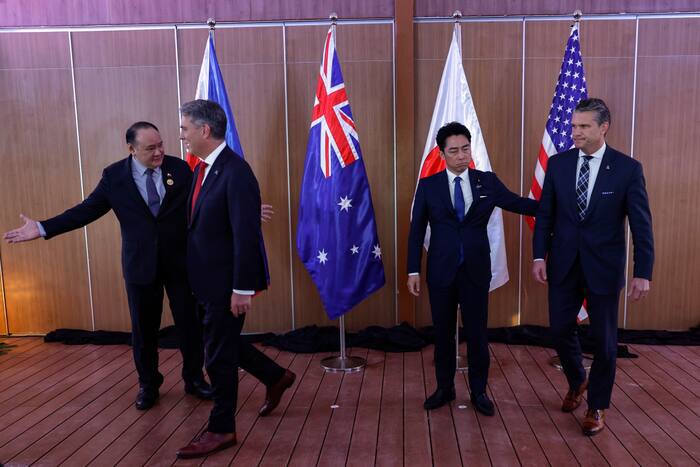
The agreement between the United States and Japan to establish a joint missile production facility in Japan is not merely a diplomatic milestone; it is a direct structural intervention to resolve an acute industrial bottleneck in the Indo-Pacific defense supply chain. By shifting a portion of advanced munition manufacturing—specifically targeting systems like the AIM-120 Advanced Medium-Range Air-to-Air Missile (AMRAAM) and the Patriot Advanced Capability-3 (PAC-3)—onto Japanese soil, Washington and Tokyo are attempting to bypass the single-source tooling constraints, raw material shortages, and trans-Pacific logistics vulnerabilities that currently cap allied deterrence capacity.
Standard geopolitical commentary treats co-production as an exercise in alliance signaling. That framing misses the operational math. In modern high-intensity warfare, munition expenditure rates exceed peacetime manufacturing throughput by an order of magnitude. When domestic defense primes hit hard ceilings on solid rocket motor casting and seeker head assembly, geopolitical treaties cannot generate interceptors. Only distributed, redundant industrial tooling can.
The Three Bottlenecks of Western Munitions Manufacturing
To understand why the Pentagon is willing to transfer sensitive manufacturing intellectual property to Japanese defense contractors such as Mitsubishi Heavy Industries (MHI), one must examine the specific failure points within the current US defense industrial base.
1. Sub-Tier Component Consolidation
Over the past three decades, post-Cold War consolidation reduced the number of prime defense contractors and hollowed out the sub-tier supplier network. While a prime contractor manages final assembly, a single precision-guided munition relies on hundreds of specialized sub-tier vendors for microelectronics, propellant precursors, and precision-machined casings. In the US, many of these sub-tier nodes operate as single-point-of-failure monopolies. Adding a second assembly line in Arizona or Alabama does nothing to accelerate output if both lines are waiting on the same sole-source supplier for energetic materials or traveling-wave tubes. Integrating Japan’s industrial base introduces parallel sub-tier capacity from firms already deeply embedded in high-precision commercial aerospace and automotive supply chains.
2. Solid Rocket Motor Casting Limits
The primary physical constraint on missile production is the curing and casting process for solid rocket motors. Propellant mixing requires hazardous-material facilities with strict safety isolation zones, specialized batch mixers, and lengthy non-destructive testing cycles (such as X-ray inspection for microscopic voids in the propellant grain). Expanding this capacity domestically takes years of environmental permitting and capital expenditure. Japan maintains an active, albeit small-scale, solid propellant manufacturing capability supporting its indigenous space launch vehicles (such as the Epsilon rocket) and domestic missile programs. Co-production unlocks this dormant throughput without waiting for greenfield US construction.
3. The Tyranny of Distance in Forward Logistics
A missile sitting in a warehouse in the continental United States has zero tactical utility during the opening phase of a contingency in the First Island Chain. Moving heavy munitions across 6,000 miles of open ocean requires strategic airlift—which is immediately diverted to high-priority troop and equipment deployments—or slow maritime sealift exposed to submarine and anti-ship ballistic missile interdiction. Forward-basing the manufacturing node inside Japan collapses the logistics tail from thousands of miles to hundreds, transforming Japan from a passive consumer of US security guarantees into an operational arsenal for the Western Pacific.
The Economics of Co-Production and Technology Transfer
Establishing a joint production facility requires navigating a complex trade-off between unit cost efficiency and supply chain resilience. From a pure microeconomic perspective, splitting production runs across two countries violates economies of scale. Tooling up a secondary facility in Japan requires massive upfront non-recurring engineering (NRE) expenses, duplicate test equipment, and specialized workforce training. Consequently, the initial per-unit cost of a Japanese-assembled AMRAAM or PAC-3 will exceed that of a unit produced on an established US line.
However, defense procurement does not optimize for minimum unit cost; it optimizes for surge capacity under contested conditions. The economic logic relies on three structural mechanisms:
- Capital Amortization Across Allied Budgets: Rather than the US taxpayer funding the entire expansion of global munition capacity, Japan’s defense budget absorbs the capital expenditure for facility construction, domestic tooling, and local labor. This effectively subsidizes the expansion of the broader allied industrial base.
- Dual-Use Industrial Crossover: Japanese manufacturing conglomerates operate at a scale in commercial electronics, precision robotics, and advanced materials (such as carbon-fiber composites) that dwarf pure-play defense firms. Co-production allows military manufacturing lines to draw upon commercial-grade process automation, reducing defect rates and stabilizing long-term unit costs once initial NRE is amortized.
- Export Control Realignment: Historically, Japan’s Three Principles on Transfer of Defense Equipment and Technology prohibited the export of lethal weaponry, effectively trapping any Japanese-built components inside domestic borders. Tokyo’s targeted revisions to these rules—specifically allowing the transfer of licensed defense products back to the country of origin—were the mandatory legal prerequisite for this facility. Without that regulatory shift, US primes could not legally integrate Japanese-built missiles back into global US stockpiles.
Operational Mechanics of a Joint Facility
Executing co-production on advanced guided missiles is vastly more complex than licensed assembly of airframes or ground vehicles. The operational workflow splits into distinct phases, each carrying specific technical and security friction.
- Knock-Down Kit Assembly (Phase One): Initially, a Japanese facility does not fabricate a missile from raw ore. It operates as a final assembly, integration, and test (FAIT) node. US primes ship "knock-down kits" containing the most sensitive subsystems—specifically the active radar seeker heads, cryptographic flight computers, and specialized warhead components—while Japanese workers assemble the airframe, integrate the wiring harnesses, and conduct environmental stress screening.
- Sub-Tier Localization (Phase Two): As quality assurance metrics stabilize, production shifts toward localizing non-sensitive mechanical components: fin actuators, airframe tubes, and battery units. This phase directly relieves pressure on US sub-tier machine shops, freeing them to focus on complex guidance assemblies.
- Propulsion and Energetics Integration (Phase Three): The final stage involves integrating domestically produced Japanese rocket motors and warhead fills. This requires rigorous cross-certification of chemical formulations to ensure that a Japanese-cast motor performs identically to a US-cast motor under extreme thermal and aerodynamic loads, guaranteeing seamless compatibility with existing fire-control software on Aegis destroyers and F-35 fighters.
Structural Risks and Execution Constraints
Treating joint production as an immediate solution to allied munition deficits ignores severe operational realities. Three structural constraints will dictate the actual output of this initiative over the next five years.
Intellectual Property and Cybersecurity Friction
US defense primes guard their proprietary manufacturing processes—particularly seeker calibration algorithms and stealth coatings—with extreme rigidity. Furthermore, US Defense Federal Acquisition Regulation Supplement (DFARS) rules mandate strict cybersecurity standards (such as CMMC) across the entire supply chain. Integrating Japanese sub-tier suppliers requires extensive security audits, compartmentalized facility designs, and bilateral cryptographic standards. Any misalignment in information security protocols will stall technology transfer licenses at the US State Department’s Directorate of Defense Trade Controls (DDTC).
The Shared Upstream Bottleneck
Localization does not guarantee independence if both nations rely on the exact same upstream raw materials. Advanced missile seekers and actuators require rare earth elements (such as neodymium, dysprosium, and gallium) and specialized precursor chemicals for explosives. Currently, global processing capacity for these inputs is heavily concentrated outside the US-Japan alliance. If a geopolitical crisis severs access to raw mineral refining, both the US and Japanese assembly lines will halt simultaneously, regardless of how many final assembly plants exist.
Physical Vulnerability of the Facility
Placing a high-value munitions factory inside Japan puts it directly within the engagement envelope of regional adversary theater ballistic and cruise missiles. Unlike factories in the continental United States, which enjoy geographic sanctuary, a Japanese production facility is an active military target from the first minute of a regional conflict. Unless the facility is constructed with hardened underground infrastructure, redundant power grids, and dedicated integrated air and missile defense (IAMD) coverage, its wartime survivability remains a critical vulnerability.
Strategic Execution for Defense Planners
To convert this bilateral agreement from a political announcement into measurable warfighting capacity, defense planners and prime contractors must execute three specific operational adjustments:
First, decouple sensitive seeker production from high-volume mechanical assembly. Do not delay facility activation waiting for full technology transfer on active radar seekers. Establish the Japanese line immediately as a high-throughput mechanical, propulsion, and airframe integration hub, shipping pre-sealed, black-box guidance sections from the US until bilateral cybersecurity audits are fully mature.
Second, mandate dual-qualification of raw material feedstocks. Both governments must jointly fund stockpiles of unrefined rare earths, ammonium perchlorate, and electronic-grade silicon outside contested supply chains, ensuring that Japanese sub-tier vendors are not drawing from the same vulnerable upstream pools as their American counterparts.
Third, integrate the facility’s physical defense into the broader bilateral force posture. Hardening the manufacturing infrastructure against ballistic missile strikes and electronic warfare must be treated as a primary line item in the facility's capital budget, ensuring that the industrial base designed to sustain deterrence can survive the initial kinetic exchange.