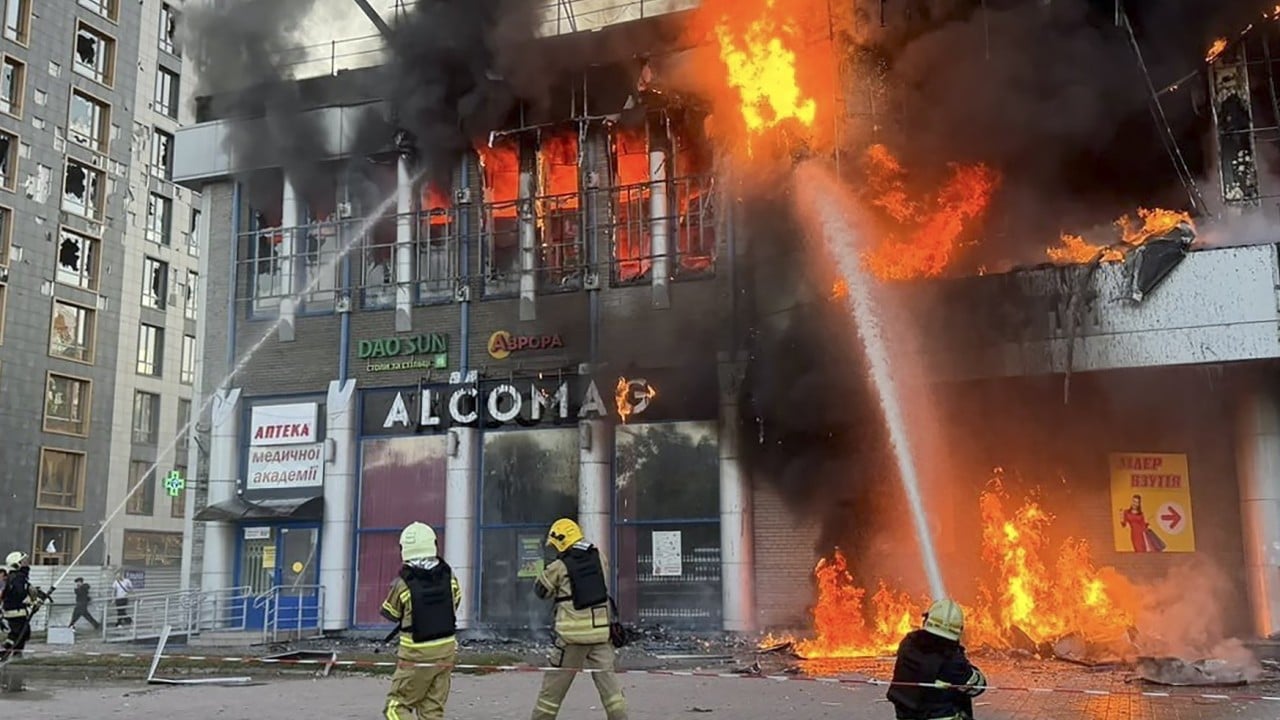
Four people are dead in Ukraine following a concentrated barrage of Russian missile and drone strikes targeting industrial cities. The recent assault marks another grim milestone in a conflict that has increasingly blurred the line between front-line combat and the systematic erosion of civilian infrastructure. When air raid sirens wail across regional manufacturing hubs, the objective is rarely accidental collateral damage. It is a calculated strategy designed to dismantle the economic backbone of a nation fighting to sustain its war effort under relentless pressure.
For months, military analysts have tracked a shifting pattern in targeting. Early phases of the conflict relied heavily on sweeping infrastructure strikes aimed at power grids and heating plants heading into winter. While those campaigns continue to exert psychological and logistical tolls, the recent focus on industrial centers points toward a different operational calculus. Factories, rail junctions, logistics depots, and municipal manufacturing yards are now prime targets. The goal is straightforward. Deprive the defense sector of domestic production capacity and force a complete reliance on foreign supply chains.
The Anatomy of a Dual Vector Strike
Understanding how these attacks succeed requires looking at the mechanics of modern aerospace warfare. Russian forces have increasingly paired high-precision ballistic and cruise missiles with low-cost, high-volume loitering munitions, commonly known as kamikaze drones.
The drones serve a dual purpose. First, they act as reconnaissance and saturation tools. By flying in staggered waves, they force regional air defense networks to expend valuable interceptor missiles. These interceptors are finite resources, often difficult to replenish quickly despite international aid packages. Second, the drones exhaust the radar operators and create predictable response patterns.
Once the air defense grid is saturated or forced to reposition, heavier precision assets strike. Hypersonic or supersonic cruise missiles follow pre-programmed trajectories designed to exploit gaps in radar coverage or terrain masks. When these warheads hit industrial facilities, the secondary detonations often cause more devastation than the primary payload. Chemical storage, heavy machinery, and fuel depots transform manufacturing floors into towering infernos.
Incoming Threat Matrix:
[Low-Cost Drones] -> Saturate Radar & Force Interceptor Depletion
[Cruise Missiles] -> Exploit Gaps in Defenses
[Ballistic Assets] -> Target Hardened Industrial Structures
The human cost in these targeted cities is immediate and devastating. Emergency services working in industrial zones face unique hazards. Unlike residential neighborhoods where rescue workers search for survivors beneath collapsed apartment blocks, factory strikes often involve hazardous materials, unstable heavy structures, and active secondary fires. First responders must balance the urgency of saving trapped workers with the very real danger of structural collapses and toxic leaks.
Economic Attrition as a Doctrine
Military history shows that protracted conflicts are rarely won solely on the battlefield. They are endurance tests of industrial capacity. Ukraine has worked tirelessly to decentralize its defense manufacturing, shifting critical components to underground workshops, smaller regional facilities, and allied territory. Yet, heavy industry cannot easily be hidden. Steel mills, heavy machinery repair shops, and large-scale assembly plants require vast footprints and stable electrical grids.
By targeting these nodes, the strategy aims to create persistent economic friction. Every hour spent repairing a blown transformer or rebuilding a collapsed assembly line is an hour diverted from producing critical equipment. The psychological dimension runs parallel to the economic one. Workers commuting to shifts in industrial zones live with the constant knowledge that their workplace is a designated target.
The Logistics of Defense
Countering this systematic targeting requires more than simply supplying interceptors. It demands an integrated architecture of mobile air defense units, electronic warfare suppression systems, and rapid repair protocols. Western-supplied systems have proven remarkably effective at intercepting incoming projectiles, but the sheer volume of attacks means that a small percentage will always breach the perimeter.
Furthermore, the economic disparity between the attackers and defenders remains a central challenge. Launching a barrage of low-cost drones and older missiles is economically sustainable for an aggressor with vast stockpiles and domestic production lines. Defending against them requires missile batteries whose individual costs often dwarf the value of the targets they destroy.
As the conflict grinds forward, the resilience of Ukraine's industrial workforce remains an unexpected variable. Despite repeated strikes, production lines resume operations with remarkable speed, debris is cleared within hours, and shifts adapt to the rhythms of air raid alerts. Yet, the cumulative weight of infrastructure degradation takes a toll. The four deaths reported in these latest strikes are a tragic human reminder that behind the abstract terminology of strategic targeting and economic attrition lie real communities bearing the brunt of a war of attrition.