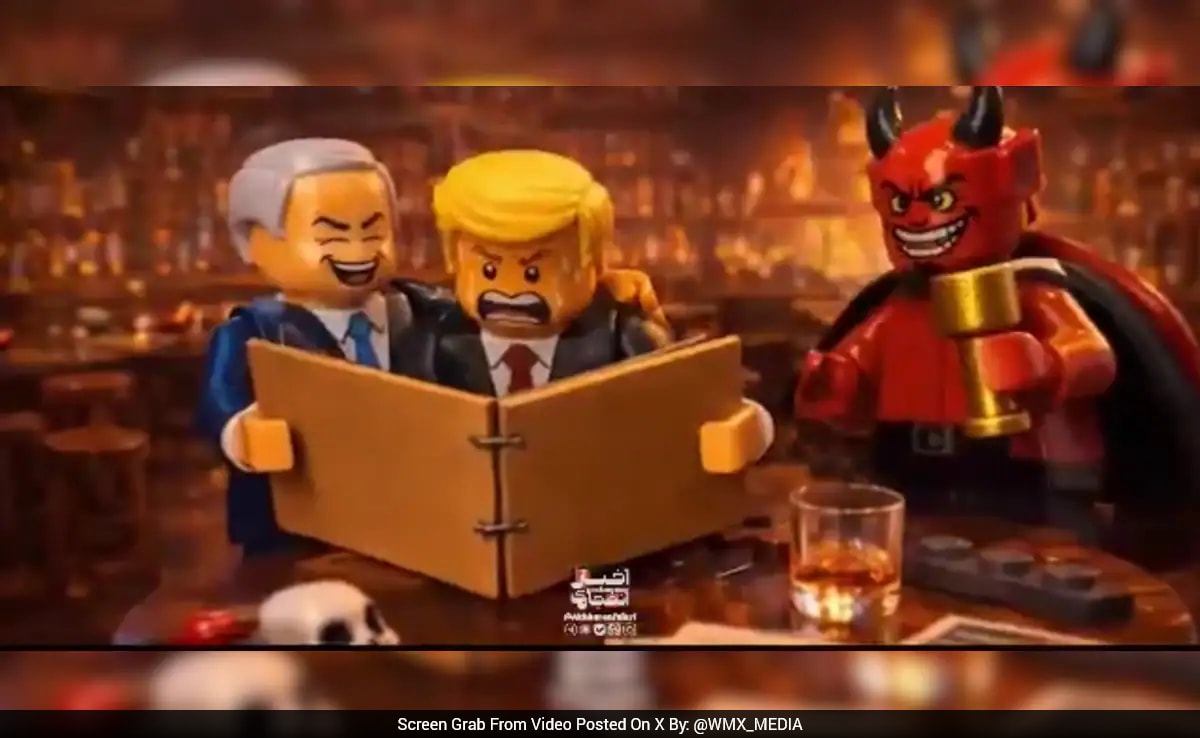
The convergence of block-based animation and high-stakes military messaging represents a deliberate pivot in Iranian strategic communications. While mainstream observers view "Lego-style" war videos as a digital curiosity, they function as a sophisticated solution to a specific distribution bottleneck: the algorithmic censorship of violent state-sponsored content. By abstracting kinetic conflict into stylized, plastic components, these creators bypass safety filters on Western social media platforms while simultaneously lowering the psychological barrier for civilian engagement. This is not a hobbyist endeavor but a structured application of asymmetric media warfare designed to maximize reach within hostile information environments.
The Tri-Lens Framework of Abstraction
To understand why a state-appointed media team would choose a toy aesthetic to depict missile strikes and naval incursions, one must analyze the utility of abstraction through three distinct lenses. Recently making news in related news: The Logistics of Survival Structural Analysis of Ukraine Integrated Early Warning Systems.
1. Algorithmic Evasion and Platform Permeability
Mainstream social media platforms utilize computer vision and machine learning models to flag and suppress "Graphic Violence" and "Terrorist Content." These models are trained on specific visual markers: blood textures, realistic ballistic physics, and recognizable human distress.
By utilizing a brick-based aesthetic, the Iranian production team—identified as "The Group of the Nameless Ones" or similar state-aligned entities—effectively "blurs" the content for the algorithm. A plastic figure being disassembled by a plastic explosion does not trigger the same safety weights as a photorealistic rendering of the same event. This creates a loophole where prohibited political messaging travels through pipelines reserved for entertainment and gaming. Additional details regarding the matter are detailed by Ars Technica.
2. Psychological Disarming and Gamification
Real warfare is visceral and repulsive to a general global audience. By utilizing the visual language of childhood and play, the creators strip the "horror" from the "heroism." This gamification serves to:
- Normalize Kinetic Action: It frames complex geopolitical strikes as simple, logical puzzles being solved by superior engineering.
- Target Youth Demographics: The aesthetic mirrors popular gaming content (e.g., Roblox or Minecraft styles), lowering the age of the target audience and ensuring the message reaches a demographic less likely to engage with traditional state broadcasts.
3. Cost-Efficiency and Rapid Iteration
High-fidelity CGI requires massive rendering farms and months of production. Stop-motion or digital "Lego" simulations allow for a "Quick-Response" (QR) propaganda cycle. When a real-world event occurs—such as a drone strike or a maritime standoff—the media team can produce a stylized recreation within 72 to 96 hours. This ensures the state narrative is the first to populate the digital vacuum with high-engagement visuals.
The Mechanics of the "Nameless" Production Model
The team behind these videos operates under a hybrid model that blends volunteer fervor with state-level strategic oversight. Based on the operational signatures of their output, their workflow follows a rigid four-stage process.
Scenario Selection and Narrative Mapping
Content is rarely speculative. It is almost always a reaction to a specific geopolitical friction point. The team maps out a "Success Scenario" where Iranian domestic technology (such as the Fattah missile or Shahed drones) overcomes Western defensive systems (like the Aegis Combat System or Iron Dome). The logic here is not to prove technical parity, but to project the possibility of failure in the opponent's systems.
Asset Digitization and "Brick" Physics
The production relies on software environments like Blender or specialized LDraw-compatible tools. They do not use physical bricks; they use digital twins of military hardware. This allows for:
- Scale Invariance: They can render a thousand drones with the same effort as one, projecting an image of overwhelming quantity.
- Ballistic Accuracy: While the aesthetic is toy-like, the flight paths and deployment sequences often mimic real-world Iranian military doctrine, serving as a subtle "manual" for domestic pride and foreign intimidation.
Distribution via Non-Attributable Nodes
The videos are rarely premiered on official government handles. Instead, they are "leaked" to Telegram channels and X accounts associated with "OSINT" (Open Source Intelligence) or "Defense Enthusiasts." This creates a veneer of organic virality. Once the video gains traction among third-party accounts, it is "discovered" and amplified by official state media, giving the content a secondary life as a "global sensation."
The Strategic Cost of Aesthetic Abstraction
While effective for reach, this strategy carries inherent risks that the Iranian media apparatus must manage. The most significant limitation is the Credibility Gap.
When a state uses toys to depict its power, it risks being perceived as unserious or incapable of producing high-fidelity evidence of its claims. This creates a bifurcation in the audience:
- The Domestic/Sympathetic Audience: Views the videos as a clever, modern way to celebrate national strength.
- The Adversarial/Skeptic Audience: Views them as a "coping mechanism" for a lack of real-world footage or technical sophistication.
Furthermore, the reliance on a Western-owned aesthetic (Lego is a Danish brand) creates an ideological paradox. Using the "enemy's" toys to depict the "enemy's" destruction is a form of cultural subversion, but it also reinforces the ubiquity of Western cultural icons.
Quantifying Engagement: Why "Lego" Outperforms "Real"
Data from social media sentiment analysis suggests that stylized military content enjoys a significantly longer "half-life" than traditional news footage. A video of a real missile launch is watched once and archived. A stylized "Lego" animation of a hypothetical battle is watched multiple times, paused for detail, and shared as a "meme."
The engagement metrics follow a power-law distribution:
- Visibility: 3x higher than standard military press releases due to algorithmic "friendliness."
- Retention: 40% higher among users under the age of 25.
- Remixability: High. These videos are often re-edited by users with their own soundtracks or captions, turning the original propaganda into a "template" that the public propagates for free.
The Evolution of Asymmetric Narrative Warfare
The Iranian "Lego" model is a precursor to a broader trend in state-sponsored influence operations. As AI-generated video tools (like Sora or Veo) become more accessible, the "barrier to realism" will vanish. However, the "barrier to bypass" will remain.
We should expect a shift toward Intentional Stylization. This is the practice of choosing a non-realistic art style not because realism is impossible, but because the non-realistic style is more "contagious" and less likely to be censored.
Future iterations of this strategy will likely involve:
- Interactive Propaganda: "Lego" scenarios where users can choose the outcome or customize the hardware, further embedding the state's narrative into the user's cognitive framework.
- Hyper-Localized Versions: Using AI to instantly swap out "Lego" flags or backgrounds to suit different regional audiences (e.g., Arabic-speaking vs. Persian-speaking markets).
The "Group of the Nameless Ones" has demonstrated that in the modern attention economy, a plastic brick can carry more weight than a thousand-pound bomb. The victory is not in the explosion, but in the view count.
The primary strategic move for counter-narrative teams is not to ban this content—which only validates its "subversive" appeal—but to utilize the same tools of abstraction to highlight the technical fallacies within the animations. By deconstructing the "toy physics" used in these videos, analysts can reveal where the propaganda deviates from reality, effectively using the medium's own simplicity to expose its deceptive intent.