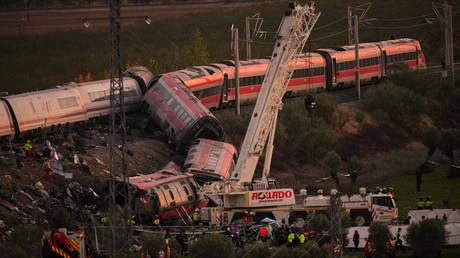
A fatal rail crash in Spain is never merely a localized transportation failure; it acts as a high-velocity stress test that exposes structural fractures across public procurement, regulatory oversight, and coalition governance. When physical infrastructure collapses with loss of life, the resulting political crisis follows a predictable transmission mechanism. The shock begins at the operational periphery—track maintenance, signaling systems, or rolling stock—and travels rapidly up the institutional chain to destabilize central executive authority. Understanding why a deadly train disaster deepens a political crisis in Spain requires isolating the specific operational vulnerabilities of the Spanish rail network and mapping them onto the fragile incentives of decentralized, minority-coalition politics.
The Structural Anatomy of Rail Risk in Spain
Spain operates one of Europe’s most extensive high-speed rail networks alongside a legacy conventional and commuter rail system (Cercanías and Rodalies) that carries the vast majority of daily passenger volume. This dual-track development model creates an acute resource-allocation asymmetry. Capital expenditure has historically favored high-visibility, intercity high-speed corridors, leaving legacy regional lines to absorb chronic underinvestment in signaling upgrades, track-bed renewal, and automated braking infrastructure.
To evaluate how an operational failure materializes, practitioners separate rail risk into three distinct mechanical layers:
- Physical Asset Degradation: Rails, sleepers, switches, and overhead catenary lines suffer cumulative fatigue proportional to axle load and frequency. When maintenance budgets are deferred to fund expansion projects, the probability of a single-point mechanical failure—such as a broken rail or switch malfunction—rises non-linearly.
- Signaling and Train Control Gaps: The transition between legacy optical signaling systems and modern automated protection systems, such as the European Rail Traffic Management System (ERTMS) or Spain’s national ASFA (Anuncio de Señales y Frenado Automático), creates dangerous boundary conditions. Accidents frequently occur at transition zones where automated speed enforcement drops out and safety relies entirely on human operator compliance under high cognitive load.
- Institutional Fragmentation: Since the liberalization of European rail markets and the structural separation of infrastructure management (Adif) from train operations (Renfe, alongside private entrants like Iryo and Ouigo), accountability is distributed across multiple corporate entities, subcontractors, and ministry directorates.
When a fatal collision or derailment occurs, investigators look immediately at these three layers. However, the political system does not wait for forensic metallurgy or black-box telemetry. Political actors immediately weaponize the structural ambiguity created by institutional fragmentation.
The Principal-Agent Breakdown in Public Infrastructure
In economic theory, public infrastructure management suffers from a classic principal-agent problem. Voters (the principals) demand safe, reliable transit, while elected ministers and state-owned enterprise executives (the agents) operate under compressed electoral timelines and competing fiscal constraints.
Maintenance is politically invisible. A transport minister gains zero electoral credit for preventing a derailment through routine ballast tamping or replacing aging relay interlockings. Conversely, ribbon-cutting ceremonies for new high-speed lines generate immediate media visibility and regional political capital. This incentive structure systematically biases capital allocation toward greenfield expansion at the expense of brownfield maintenance.
The second limitation in this governance model is the diffusion of operational liability. When Adif manages the track, Renfe or a private operator runs the train, and third-party engineering firms execute maintenance contracts, an accident triggers immediate blame-shifting across organizational boundaries:
- The Infrastructure Manager points to rolling stock anomalies, operator speeding, or anomalous weather events.
- The Train Operator highlights track defects, unannounced speed restrictions, or erratic signaling behavior.
- Labor Unions cite chronic staffing shortages, excessive overtime, and ignored safety warnings filed by train drivers and traffic controllers.
- The Ministry of Transport retreats behind procedural language, announcing independent technical commissions while distancing the political leadership from operational execution.
This defensive posture confirms public suspicion that no single authority owns system safety. In a high-trust institutional environment, technical investigations insulate politicians during the initial aftermath. In a polarized environment, procedural caution reads as evasion.
How Operational Shock Becomes a Political Crisis
A deadly train disaster deepens an existing political crisis through four sequential phases of institutional contagion. Each phase compounds the pressure on the governing coalition, shifting the narrative from technical failure to systemic state incompetence.
Phase 1: The Immediate Information Vacuum
In the first 24 to 48 hours following a fatal crash, confirmed technical facts are scarce. Emergency response teams prioritize casualty extraction and site stabilization over root-cause analysis. Yet modern media cycles demand instant attribution. Opposition parties exploit this vacuum by framing the disaster not as an isolated engineering failure, but as the inevitable consequence of the government's broader ideological agenda—whether that agenda is characterized as reckless austerity, chaotic liberalization, or cronyism in state-owned enterprises.
Phase 2: The Audit of Prior Warnings
Within days, journalists and parliamentary researchers audit public records, union complaints, and parliamentary questions submitted months or years earlier. In Spain, regional commuter networks and specific secondary lines routinely generate documented complaints regarding signaling glitches, speed restriction bottlenecks, and unexecuted budget allocations. When investigators uncover an unaddressed warning related to the exact corridor where fatalities occurred, the crisis transitions from tragic accident to culpable negligence. The defense of "unforeseeable failure" collapses entirely.
Phase 3: Center-Periphery Friction
Spain’s quasi-federal state structure (Estado de las Autonomías) introduces a potent regional dimension to every infrastructure failure. Rail governance is divided between central state control over the general interest network and regional demands for devolved management, particularly in Catalonia (Rodalies), the Basque Country, and Madrid.
If the disaster strikes a regional commuter line, regional administrations immediately frame the crash as proof of central government neglect and fiscal extraction. Conversely, if the regional government already holds partial operational responsibility, Madrid shifts blame toward local administrative incompetence. In either configuration, the disaster inflames territorial tensions that sit at the core of Spanish political instability.
Phase 4: Coalition Leverage Extraction
When Spain is governed by a minority executive reliant on fragile parliamentary alliances with regionalist and nationalist parties, every national crisis becomes a transactional lever. Coalition partners who depend on regional voters cannot afford to shield a central transport minister from accountability if local commuters were killed.
These allies face a binary choice: distance themselves from the central government to protect their regional flank, or extract massive fiscal concessions, accelerated infrastructure transfers, or high-level resignations as the price for maintaining parliamentary confidence. The transport ministry becomes a sacrificial asset, yet firing a minister rarely resolves the underlying parliamentary arithmetic.
The Illusion of the Parliamentary Inquiry
Faced with escalating street protests, transport strikes, and plummeting approval ratings, Spanish governments reflexively deploy two institutional shock absorbers: the technical investigation commission (such as the CIAF, Comisión de Investigación de Accidentes Ferroviarios) and the parliamentary inquiry committee.
Both mechanisms suffer from severe structural constraints that often deepen public cynicism rather than restoring trust.
Technical commissions operate on engineering timelines, requiring six to eighteen months to conduct metallurgical testing, reconstruct signaling logs, and issue formal safety recommendations. Furthermore, European Union rail safety directives mandate that technical investigations focus strictly on preventing future accidents rather than assigning legal or political blame. Politicians frequently misrepresent this legal mandate, claiming they cannot answer parliamentary questions while technical inquiries are ongoing.
Parliamentary inquiry committees operate on the opposite logic. They are theatrical arenas designed to extract soundbites rather than establish engineering truth. Because committee majorities reflect the exact coalition dynamics of the broader legislature, governing parties use procedural rules to block unfavorable witness summonses, while opposition parties use questioning time to deliver campaign speeches. The resulting final report splits along partisan lines, leaving the public without an authoritative, consensus narrative of what failed and why.
Quantitative Mechanics of Budget Execution vs. Budget Allocation
To understand why Spanish rail infrastructure remains vulnerable despite massive headline spending figures, analysts must distinguish between budgeted capital and executed capital.
In Spanish public finance, central budgets routinely announce multi-billion-euro modernization plans for commuter and regional rail networks. However, actual capital execution frequently lags far behind nominal allocations. Complex environmental impact assessments, protracted public tender processes, supply chain delays for specialized signaling electronics, and rigid public procurement laws create massive bottlenecks between parliamentary approval and physical track renewal.
When a fatal accident occurs, opposition analysts inevitably publish execution ratios showing that only a fraction of promised safety funds actually reached the tracks in the preceding fiscal years. The government responds by citing total multi-year commitments. This clash between nominal commitment and physical execution exposes a core competency gap in public administration: the state can allocate money on paper, but its bureaucratic machinery struggles to convert capital into completed engineering works on schedule.
The Strategic Reality for Crisis Governance
No communication strategy can insulate a government from the political fallout of preventable fatalities on state-managed infrastructure. Spin accelerates collapse when grieving families and daily commuters encounter visibly degraded transit systems. Furthermore, scapegoating mid-level technical directors or train operators triggers immediate retaliation from organized labor, paralyzing the remaining network through work-to-rule actions and strikes that keep the crisis on the front page for weeks.
Resolving the political crisis requires attacking the operational root causes with verifiable, structural interventions rather than rhetorical containment.
First, the executive must decouple safety auditing from political and corporate management by granting the national safety regulator absolute budgetary autonomy and mandatory enforcement power over both Adif and all rail operators. Second, the Ministry of Transport must publish a transparent, corridor-by-corridor engineering audit detailing every active temporary speed restriction, unexecuted maintenance contract, and signaling transition zone across the national network, paired with binding completion dates. Third, capital allocation rules must be restructured to ring-fence brownfield maintenance budgets, legally prohibiting the diversion of maintenance funds toward new high-speed construction until baseline safety metrics across legacy commuter networks reach full compliance. Without hard institutional constraints that force capital toward invisible maintenance, every future infrastructure failure will trigger the exact same cycle of systemic political paralysis.


