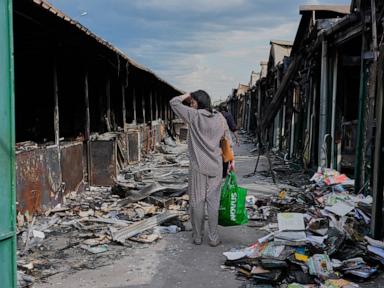
Paper does not scream when it tears. It does not bleed when shrapnel carves through a binding. It simply accepts the weight of the world, folding inward, curling at the edges, turning black and brittle before vanishing into ash.
Consider the silence of a library floor after the windows have blown inward. Glass crunches beneath heavy boots. Dust hangs suspended in shafts of cold grey light, smelling of pulverized concrete and ancient rag-rag paper. Shelves that once held centuries of thought, poetry, mathematics, and memory now stand like broken teeth against scorched walls.
Millions.
The number is too vast to hold in your head. Millions of books erased. Entire printing houses reduced to charred heaps of pulp in Kharkiv and Kyiv. Warehouses where fresh editions of Ukrainian poetry, history, and children's literature waited in neat cardboard boxes, breathing their ink into the cardboard air, suddenly caught in the blinding flash of an incoming blast.
Maria stands in what remains of a municipal archive in the east. She wears a heavy wool coat indoors because the heating went out three winters ago. Her fingers, calloused and stained with printer's ink from decades of work, brush against the charred spine of a rescued dictionary.
"They think they are destroying paper," she says, her voice flat, steady, stripped of panic. "They do not understand. A book is just a vessel. The water is already inside us."
To grasp the true weight of what is happening in Ukraine's publishing ecosystem, you have to look past the military briefings and the satellite maps. You have to look at the quiet, stubborn persistence of people who refuse to let their language be unwritten.
The Architecture of Memory
Language is a homeland. When an invader crosses a border, they do not just seize territory; they attempt to rewrite the coordinates of reality. Throughout history, the destruction of libraries has never been an accidental byproduct of war. It is a deliberate strategy. Burn the dictionaries, and you stutter the tongue. Burn the poetry, and you deaden the imagination. Burn the historical archives, and you sever the roots that anchor a people to the earth.
Before the escalation, Ukraine's publishing scene was experiencing a golden renaissance. Independent presses were blooming in basements and loft spaces across Lviv, Chernihiv, and Odesa. Young translators were rendering contemporary philosophy into Ukrainian for the first time. Children's book illustrators were winning international awards in Bologna, bringing a distinct, vibrant visual storytelling style to the global stage.
Then came the sirens.
In the spring of 2022, a missile tore through the Vivat printing house in Kharkiv—one of the largest printing hubs in Eastern Europe. Tons of paper went up in flames. Millions of copies of forthcoming textbooks, novels, and children's books turned into a towering pillar of black smoke visible for miles.
Imagine waking up to find that the books your children were supposed to read in school tomorrow no longer exist anywhere in physical form. Not because they are out of print, but because the warehouse storing them was vaporized while you slept.
Volodymyr, a publisher whose downtown office took a direct hit, describes the surreal geometry of loss.
"You spend eighteen months editing a manuscript," he recalls, sitting at a wobbly wooden table lit by a battery-powered lamp. "You argue over commas. You select the cover stock. You send it to press. And in forty seconds, an explosion turns it into charcoal. It makes you question the permanence of everything. Except the idea. The idea survived in a PDF on my phone."
Printing Under Fire
Survival requires adaptation. When your presses are bombed, you move underground.
Today, much of Ukraine's literary production operates in a state of clandestine resilience. Presses have been relocated to windowless basements, reinforced bunkers, and rural barns far from front-line artillery ranges. Printers wear heavy thermals, their breath pluming in the damp air as they feed paper into vintage Heidelberg presses that hum with a rhythmic, stubborn heartbeat.
Power cuts are constant. Air raid alerts interrupt press runs mid-sentence. Workers sleep on cots beside stacks of freshly printed pages, waking when the generators stutter back to life to resume the work.
Why do they risk their lives for paper?
Because books are the ultimate proof of continued existence. When a soldier in a muddy trench pulls a pocket-sized collection of Taras Shevchenko's poetry from his vest, he is holding a shield against despair. The ink on those pages connects him to generations of writers who also fought to keep the Ukrainian voice alive against imperial erasure.
Economics in a war zone are brutal. Production costs have skyrocketed. Paper must be imported from the European Union at great expense because domestic paper mills have been damaged or cut off. Shipping logistics are a nightmare of blocked roads, bridge collapses, and fuel shortages. Yet, despite all of this, book sales in Ukraine have actually surged.
People are reading more, not less. In bomb shelters during nightly missile barrages, parents read aloud to children by the weak amber glow of phone screens. Bookstores in western cities like Ivano-Frankivsk host packed poetry readings where standing room only spills out onto the damp pavement. Literature has transformed from a quiet leisure activity into an act of communal defiance.
The International Echo
The shockwaves of this cultural devastation reach far beyond Eastern Europe's borders. Writers' associations, international publishers, and cultural funds have mobilized campaigns to support Ukrainian presses. Book fairs in Frankfurt, London, and Bologna have featured dedicated pavilions celebrating Ukrainian literature, ensuring that stories silenced by bombs find amplification abroad.
Yet foreign solidarity, while vital, cannot replace the physical infrastructure pulverized on the ground. Every printing press destroyed is a blow to the fragile ecosystem of independent thought. Every burned warehouse means thousands of authors whose voices are temporarily muted while publishers scramble to secure alternative funding and machinery.
Consider what happens when a generation of children grows up without native-language books. The gap is not merely educational; it is psychological. It creates a vacuum where cultural memory should be.
This is why Ukrainian publishers refuse to scale back their ambitions. They are printing larger editions of historical texts, translating global classics into Ukrainian at a record pace, and launching digital preservation initiatives to scan rare manuscripts before they can be consumed by fire.
The Last Line
Night falls over Kyiv. The curfew settles in, wrapping the darkened streets in a heavy, watchful quiet.
In a small apartment on the fourth floor, a desk lamp cuts a sharp circle of warm light through the gloom. A writer leans over a spiral-bound notebook, her pen scratching rhythmically across the page. Outside, far off in the distance, a dull rumble echoes across the skyline. She does not look up. She does not stop writing.
The missiles can shatter concrete. They can reduce warehouses to ash and silence printing presses with fire. But they cannot dissolve the architecture of a sentence written with conviction.
The story continues because someone refuses to put down the pen.