Autonomous drones burn through battery power faster than you can blink. Traditional flight computers require massive amounts of energy to process raw video feeds and environmental sensor data, forcing engineers to rely on power-hungry cloud servers or bulky onboard graphics cards. But what if the secret to smarter, hyper-efficient aerial robots is already buzzing around your kitchen porch light?
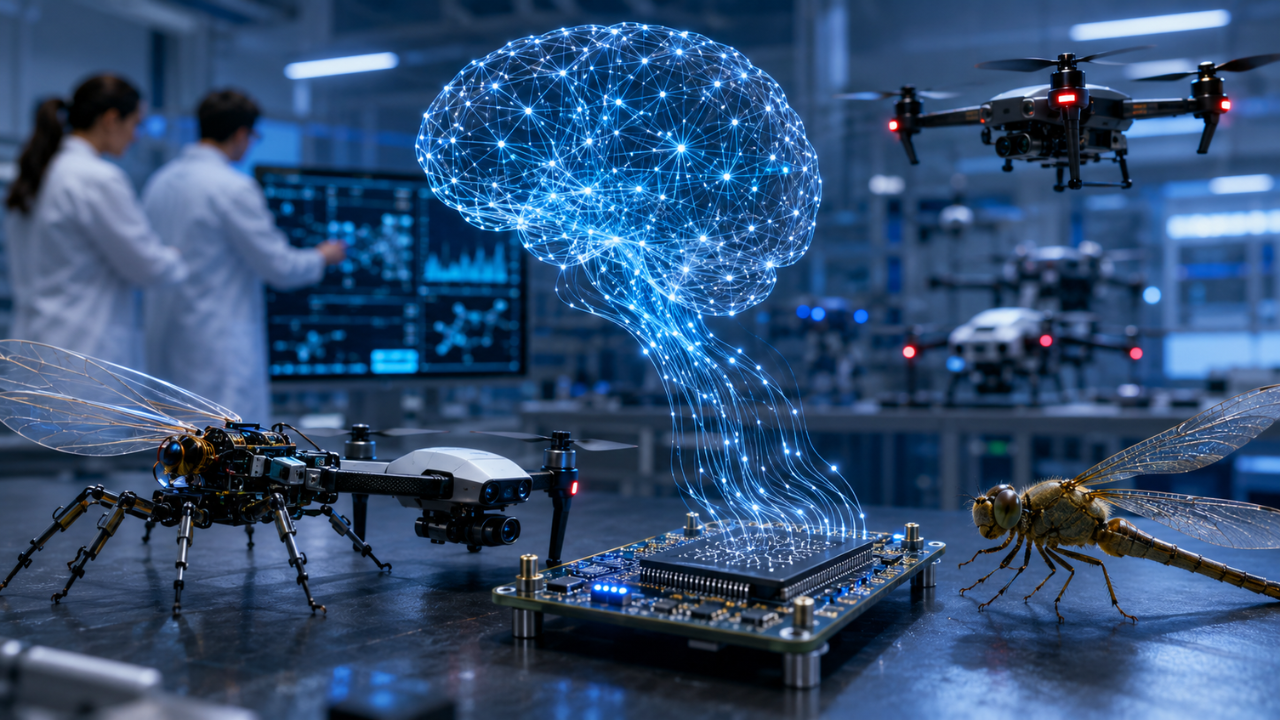
A team of researchers at Penn State just secured a $12 million grant from the U.S. Army Research Laboratory to build a biological-inspired digital brain for drones. Led by engineering science professor Saptarshi Das, the project looks past traditional silicon chips and mimics how tiny creatures like locusts and owls make split-second survival choices using minimal energy. In other updates, we also covered: The Real Reason Navy Catapults Are Failing And How Bureaucrats Kept It Quiet.
The Core Flaw in Modern Drone Computing
Right now, autonomous machines suffer from a massive efficiency bottleneck. Every time a drone camera picks up a visual cue or a microphone catches an acoustic signal, standard computers immediately convert that rich physical data into digital code. Then, heavy algorithms chew through the numbers to separate background noise from actual targets.
This constant digital conversion drains batteries in minutes. It also creates a severe tactical vulnerability. If a drone has to beam data back to a remote cloud server for processing, it gives away its exact location through radio frequency emissions. If it stays completely offline, its internal computer quickly overheats or dies from power exhaustion. The Verge has also covered this important issue in great detail.
Small animals don't work this way. A locust navigating a swarm doesn't run a deep neural network on a server farm. Its tiny cluster of neurons filters out useless background clutter instantly, reacting only to relevant visual changes or approaching threats.
Building a Hardware Mind From Graphene
To replicate this biological efficiency, the Penn State team is ditching pure digital processing in favor of hybrid analog circuitry. They are combining traditional silicon semiconductors with two-dimensional materials like graphene—a one-atom-thick honeycomb carbon sheet—alongside memristors that can amplify electrical currents directly.
By processing signals in the analog domain before they ever touch conventional digital processors, the hardware slashes unnecessary data translation steps.
The system relies on two main biological inspirations:
- Cochlea-Inspired Filtering: Just like the human inner ear separates frequencies before sending signals to the brain, this hardware filters raw sensory inputs at the point of collection.
- Coincidence-Detecting Neurons: Using graphene field-effect transistors, the circuits mimic specialized neurons that only fire an output when two or more distinct signals arrive in rapid succession.
This setup allows a drone's sensor node to ignore constant background clutter and concentrate computational power only on meaningful pattern combinations.
What This Means for Autonomous Swarms
The ultimate goal of this $12 million initiative stretches far beyond single reconnaissance quadcopters. Researchers are developing secure, noise-like communication methods that let drone swarms talk to one another by embedding signals directly into background electromagnetic static.
Because each machine handles its own heavy sensory filtering locally on the edge, a swarm can coordinate complex tactical maneuvers or search-and-rescue grids completely cut off from GPS or cloud infrastructure.
The team plans annual hardware demonstrations to scale up from individual microscopic prototypes toward field-ready autonomous platforms. Bringing compact size, ultra-low power consumption, and biological-grade decision-making into a single package is the holy grail of robotics engineering. Once these insect-inspired brains make it out of the lab, expect autonomous machines to get a lot quieter, smarter, and harder to spot.