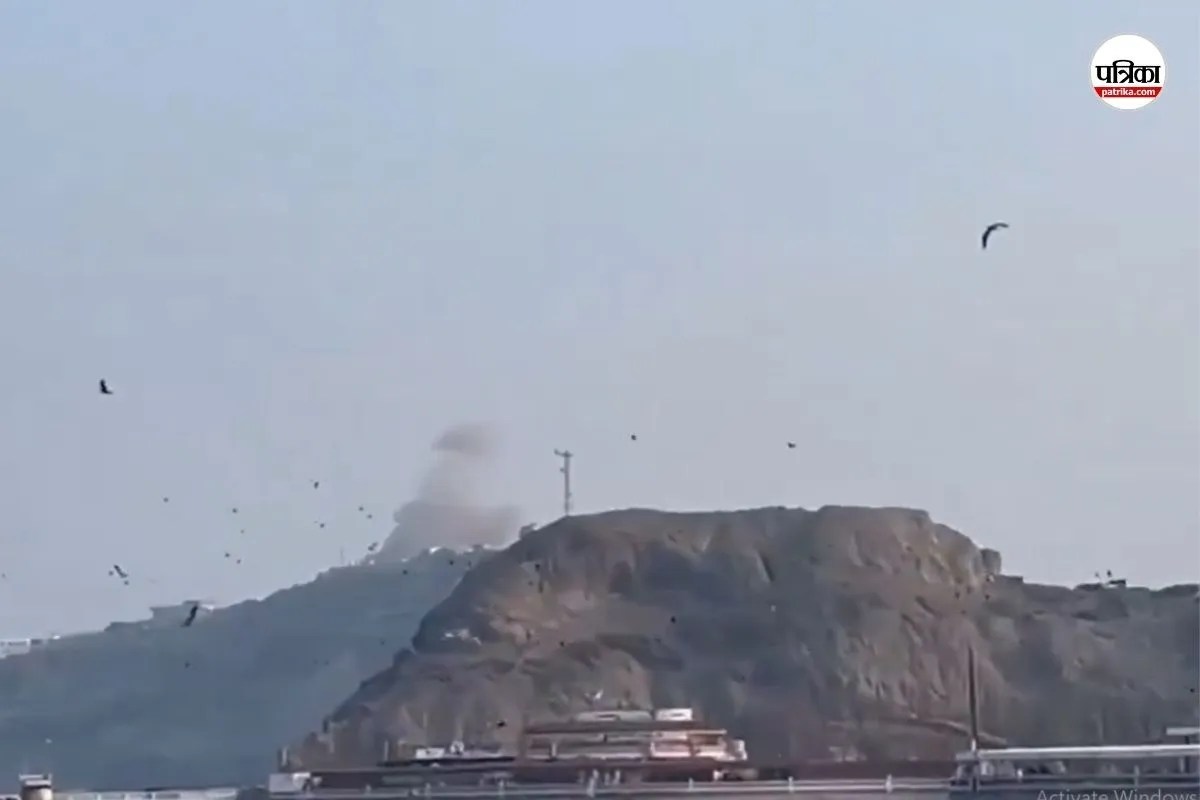
Houthi forces struck the Al-Maashiq presidential palace compound in Aden with missiles, triggering at least six explosions while Yemen's cabinet and Prime Minister Shaya al-Zindani were inside, yet senior government officials survived unharmed. At least five people—including security guards and civilian employees—were killed and 16 wounded in the October 15 assault, which marked a brazen escalation in Yemen's shattered truce.
Read the typical wire dispatch on that strike and you walk away with a neat, comforting illusion. Officials are safe. Smoke rises over a rocky peninsula. The story moves on to the next ticker.
After covering Middle East conflicts for more than two decades, I have learned that the most dangerous moments in a war are rarely the ones where a capital falls overnight. They are the moments where an armed movement proves it can reach the nerve center of its rival's statehood at will, extract a human toll on guards and staff, and leave the political leadership standing inside a wounded compound as a walking target.
Why Aden Still Matters Despite Years of Fragmentation
Aden sits on a basalt promontory jutting into the Gulf of Aden, a geography that has made it a prize for empires, smugglers, and naval planners for centuries. To outsiders, the city often looks like a makeshift administrative capital—a coastal holdout where Yemen's internationally recognized government operates under heavy guard and shifting political alliances.
That view misses the mechanics of power on the ground. Controlling or intimidating Aden is not merely about symbolic territory; it is about denying Yemen's recognized authorities a stable seat of command near one of the busiest maritime corridors on earth, close to the Bab al-Mandab strait.
When missiles and drones target Al-Maashiq Palace while ministers are present, the message is aimed straight at legitimacy. Even if Prime Minister Shaya al-Zindani and his senior colleagues escape physical harm, every blast inside the perimeter degrades the fiction of normal governance. Ministers spend less time administering ports, payrolls, and aid distribution, and more time calculating bunker routes and helicopter exits.
There is an overlooked irony in how analysts treat anti-Houthi forces in southern and central Yemen. On paper, Riyadh-backed government institutions, local security formations, and regional allies command superior hardware and formal diplomatic backing. In practice, fractured chains of command and competing local agendas have repeatedly blunted that advantage.
A palace that survives a missile strike is not automatically a secure seat of government. Survival only buys time—and time in a fractured coalition war is often spent arguing over who holds the keys to the next door.
You see that fragility every time fighting flares along multiple fronts—near Taiz, in Marib, around Sanaa, and along coastal approaches. When pressure mounts simultaneously in besieged cities and at the interim seat of government, logistics stretch thin and intelligence gaps widen.
The Anatomy of a Six-Explosion Strike
Witnesses reported at least six explosions near the government-used palace complex in Aden during the October 15 attack, followed by plumes of smoke and emergency sirens. Accounts from officials and observers varied on exact counts and impact points—a common feature of urban missile and drone strikes where interceptor bursts, secondary blasts, and shockwaves overlap within seconds.
Consider a hypothetical example to see how confusion spreads in the first twenty minutes after an attack like this. Suppose an incoming ballistic missile is engaged by air defense near the coast, a second projectile or one-way attack drone strikes an outer security post or courtyard, and a fuel or ammunition cache cooks off nearby. A resident two kilometers away in Crater counts six distinct booms, a security officer reports two or three hits on compound facilities, and medical teams rush toward smoke before any official can verify whether a warhead hit a command room or an open yard.
In real reporting from Aden, those discrepancies showed up immediately. Health authorities confirmed five dead and 16 injured among guards and civilian staff, while government sources noted that the prime minister and cabinet ministers were unharmed. Houthi media claimed the strike hit military operations headquarters linked to Saudi officers at the complex.
What matters operationally is not arguing over every decimal point of a fast-moving battle damage report. What matters is the pattern that followed. Less than two weeks later, on October 30, explosions rocked Aden again as missiles struck near Al-Maashiq Palace and targeted Aden International Airport, forcing air defenses into action over key institutions.
- Repeated targeting signals persistence, not a one-off probe: Returning to the same compound and airport weeks apart shows the Houthis treat Aden's core infrastructure as an active theater rather than a taboo zone.
- Airport pressure hits civilian lifelines: Aden International Airport is not just a military or VIP node; it is a vital gateway for travel and humanitarian movement into southern Yemen.
- Guards and staff absorb the immediate cost: When senior leaders survive inside fortified spaces, the fatalities frequently fall on perimeter guards, drivers, and support personnel doing routine work.
Beyond Proxy Labels: Why This Escalation Took Hold
Too much commentary reduces Yemen's war to a simple button-pushing exercise by Tehran. Iran has supplied weapons, technical know-how, and regional alignment that bolster Houthi missile and drone capabilities. The Saudi-led coalition has repeatedly accused the group of acquiring advanced military components and systems from regional partners.
Still, treating the Houthis merely as puppets of an external capital is lazy analysis. Their movement has deep domestic roots in northern Yemen, a fierce ideological and political grievance against Saudi intervention, and its own strategic calendar.
When the broader regional crisis involving Iran, Israel, and the United States intensified in 2026, the Houthis sought to tie their own campaign to wider regional pressure while pressing their domestic and cross-border leverage against Saudi Arabia. The years of relative calm following the 2022 truce gave way to renewed ground offensives, airstrikes, maritime threats, and long-range missile and drone exchanges.
| Dimension | Surface Headline Narrative | Ground Reality in Yemen |
|---|---|---|
| Leadership Safety | Officials survived, so the attack failed | Survival preserves continuity, but repeated strikes erode administrative calm |
| Strategic Motivation | Purely external orders from regional patrons | Mix of regional alignment, domestic power grabs, and anti-Saudi leverage |
| Military Balance | Coalition airpower and formal backing dominate | Fragmented anti-Houthi factions face terrain, intelligence, and command hurdles |
| Human Impact | Measured in daily strike tallies | Compounds a worsening humanitarian crisis and strains hospitals and aid |
A fair counter-argument deserves space here. Defenders of hardened security and robust air defense argue that keeping senior officials alive and preventing the capture of Aden is itself a meaningful achievement. In a civil war where state institutions can collapse in days, preserving a functioning cabinet—even under siege conditions—denies the insurgency a clean political knockout.
That argument holds water up to a point. Survival is better than decapitation. Yet survival without cohesion is a holding action, not a strategy. If anti-Houthi factions quarrel over turf or command while missiles fly toward the palace and airport, defensive survival simply postpones harder reckonings.
What Ordinary Yemenis Pay While Capitals Trade Blows
In diplomatic cables and cable-news panels, strikes on a presidential palace or an airport get weighed as escalatory signals between capitals. Inside Yemen, those same escalations land on people already exhausted by more than a decade of war.
Renewed fighting around Taiz and other fronts has squeezed food and fuel supplies, strained overtaxed hospitals, and threatened aid access for hundreds of thousands of vulnerable people. When airstrikes hit northern or central areas and missiles slam into southern hubs like Aden, the civilian toll accumulates quietly between the big headlines.
There is no clean, cost-free off-ramp available to the warring parties right now. Military escalation carries high risks of civilian harm, economic ruin, and wider regional spillover. Rushed or purely cosmetic truces, on the other hand, leave underlying grievances and armed arsenals intact until the next flare-up.
Anyone watching Aden after those six explosions should look past the reassurance that officials escaped unharmed. Watch instead whether Yemen's recognized government and its regional backers can turn a narrow escape into real command unity and protected humanitarian lifelines before the next missile leaves its launcher.


