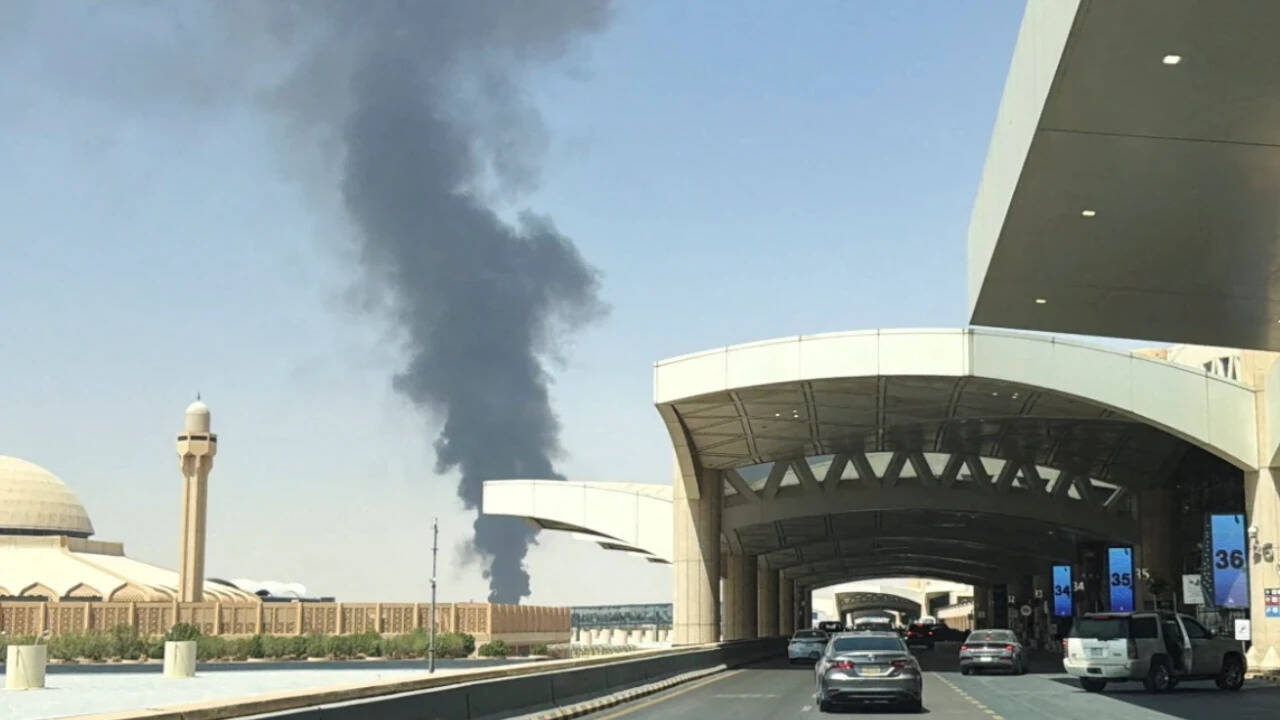
Commercial jets are once again lifting off from King Khalid International Airport in Riyadh, even as Houthi spokesmen declare the Saudi capital's skies permanently unsafe. That contradiction lies at the heart of modern aviation risk management. Airlines are resuming operations not because the regional security threat has vanished, but because military intercept capabilities, diplomatic backchannels, and economic imperatives have converged to make calculated risk acceptable to carriers and regulators. For travelers and aviation insiders, the reopening signals a tense equilibrium where multi-layered air defense shields commercial transit routes against persistent asymmetric warfare.
The Anatomy of an Asymmetric Threat
Civil aviation operates on predictable schedules and fixed corridors. Modern ballistic missiles and one-way attack drones do not. When Yemen's Houthi movement issues warnings that Riyadh airport will "never be safe," they are targeting the psychological and financial foundations of the Saudi economy rather than merely the tarmac. Expanding on this topic, you can also read: When the Signal Drops at Zero Dark Thirty.
Over the past decade, the group's arsenal has evolved from rudimentary, short-range rockets into long-range systems capable of crossing hundreds of miles of desert. These platforms rely on low-altitude flight profiles and composite airframes designed to evade traditional radar sweeps. A single piece of falling debris from an intercepted projectile is enough to force a ground stop, divert dozens of wide-body aircraft, and cost international carriers millions of dollars in fuel, crew overtime, and passenger compensation.
Understanding why flights resume under this shadow requires looking at how air defense actually works around major Gulf hubs. Defense planners do not rely on a single wall of protection. Instead, they use tiered interception networks. High-altitude systems like THAAD handle ballistic trajectories outside the atmosphere, while Patriot batteries and short-range point-defense units engage lower-flying drones and cruise missiles closer to urban centers. Experts at The Guardian have shared their thoughts on this matter.
The reality of this setup is sobering for anyone who has spent years covering defense aviation. No shield is 100 percent impermeable. Defense analysts often refer to the cost-exchange ratio—the vast financial gap between a relatively cheap drone and the multi-million-dollar interceptor fired to destroy it. Yet for commercial aviation regulators, absolute invulnerability is never the threshold for opening airspace. The standard is manageable, mitigated risk.
Why Airlines Fly Into Contested Regions
If a militant group explicitly threatens an airport, why do international carriers return? The answer comes down to insurance underwriting, sovereign guarantees, and the mechanics of conflict zone risk assessment.
Airlines do not make these decisions in a vacuum. Before a single ticket is sold, flight operations teams consult intelligence briefings from state aviation authorities, independent security contractors, and internal threat-monitoring desks. When Riyadh resumes flights following security alerts or regional escalations, it indicates that the General Authority of Civil Aviation (GACA) and international counterparts like the FAA or EASA have determined that active countermeasures are sufficient to protect civilian flight paths.
Consider how war risk insurance dictates global flight maps. Aviation underwriters constantly adjust premiums based on real-time intelligence. If an airport is deemed genuinely indefensible, insurers will either pull coverage entirely or raise premiums so high that operating a Boeing 777 into the hub becomes financially impossible. When commercial traffic flows normally through Riyadh, it means the world's most risk-averse financial institutions—the London and Zurich reinsurance markets—have looked at the radar data, reviewed the military posture, and decided the odds favor safe arrival.
There is also the undeniable gravity of Riyadh's geographic and economic position. Saudi Arabia has poured tens of billions of dollars into transforming its capital into a premier global transit hub, competing directly with Dubai and Doha. Allowing sporadic threats to indefinitely shutter King Khalid International Airport would hand a massive strategic victory to adversaries without them having to fire a single shot. Keeping the runways active is a deliberate projection of state resilience.
Rerouting the Sky and Burning Cash
Resuming flights does not mean returning to business as usual. Behind the scenes, dispatchers and air traffic controllers execute complex, invisible maneuvers to keep civilian aircraft out of harm's way.
In a standard operational environment, aircraft fly the most direct great-circle routes to conserve fuel and minimize flight times. When regional threats escalate, those efficient corridors close. Controllers establish segregated airspace corridors, pushing commercial traffic further north or east, away from southern approach vectors facing Yemen.
- Extended Flight Times: Detouring around restricted military zones adds 20 to 45 minutes to regional legs, cascading into missed connections across Europe and Asia.
- Fuel Penalties: Carrying extra contingency fuel to account for sudden holding patterns or last-minute diversions increases aircraft weight, which in turn burns more fuel per mile.
- Dynamic Airspace Closures: Air traffic management teams maintain direct hotlines with military command centers, allowing controllers to clear civilian lanes within seconds if radar detects an inbound launch.
A hypothetical scenario illustrates the operational strain. Imagine a fully loaded Airbus A350 approaching Riyadh from London just as early-warning satellites detect a launch from northern Yemen. Within minutes, military liaisons alert civilian air traffic control. The A350 is immediately vectored into a holding pattern over the Persian Gulf or diverted to Dammam, hundreds of miles to the east. The flight never enters danger, and passengers remain largely unaware of the specific radar tracks triggering the delay, yet the airline absorbs tens of thousands of dollars in unbudgeted operational costs. This silent choreography happens far more frequently than public flight trackers suggest.
The Information War Over Airspace
When Houthi officials declare an airport unsafe, they are engaging in asymmetric information warfare. The objective is to trigger self-deterrence among travelers and corporate travel departments. If multinational executives cancel trips to Riyadh out of fear, the blockade succeeds functionally even if the runways remain spotless.
This dynamic creates a severe credibility challenge for regional authorities and airlines. In the immediate aftermath of any security incident, information is often scarce, conflicting, or heavily filtered through state media. Travelers frequently turn to social media, where unverified videos of air defense interceptions—often filmed miles away from airport perimeters—circulate rapidly and create the false impression that terminals are under direct siege.
Seasoned aviation observers recognize the difference between proximity and targeting. Most major international airports sit on the outskirts of sprawling metropolitan areas, often sharing airspace or perimeter zones with military airbases. An interception over a city's northern district might rattle windows at the civilian terminal without the airport itself ever being the intended target. However, to a passenger sitting at a departure gate, that distinction matters very little.
What Aviation Insiders Watch Next
The sustainability of Riyadh's flight operations depends on a fragile balance between military deterrence and diplomatic de-escalation. Aviation analysts do not measure safety by the rhetoric coming out of Sanaa or Riyadh; they measure it through concrete operational indicators.
The first indicator is NOTAM frequency. Notices to Airmen (NOTAMs) are the official bulletins issued to pilots detailing hazards along a route. A sudden spike in temporary flight restrictions, GPS jamming warnings, or sudden altitude floor changes around central Saudi Arabia signals heightened defensive posturing, even if commercial schedules appear intact on public booking sites.
The second indicator is fleet allocation. When security risks rise, airlines quietly swap out flagship long-haul aircraft for smaller, regional narrow-bodies on routes into contested zones, minimizing the capital asset value exposed on the tarmac at any given moment. Seeing carriers deploy their newest, highest-capacity jets into Riyadh indicates high institutional confidence in local air defenses.
The third factor is diplomatic backchannel stability. Ceasefires and informal truces in the Arabian Peninsula rarely follow neat legal frameworks. They are maintained through constant, quiet negotiation mediated by regional neighbors. Airspace remains open as long as the political cost of striking a civilian hub outweighs the tactical benefit for the attacker.
The skies over Riyadh are open, busy, and heavily guarded. Commercial aviation has always existed at the intersection of engineering precision and geopolitical reality, relying on invisible shields and calculated probabilities to move millions of people across volatile borders. Until the underlying regional conflicts find a permanent political settlement, every takeoff from King Khalid International Airport remains an exercise in managed defiance.


